


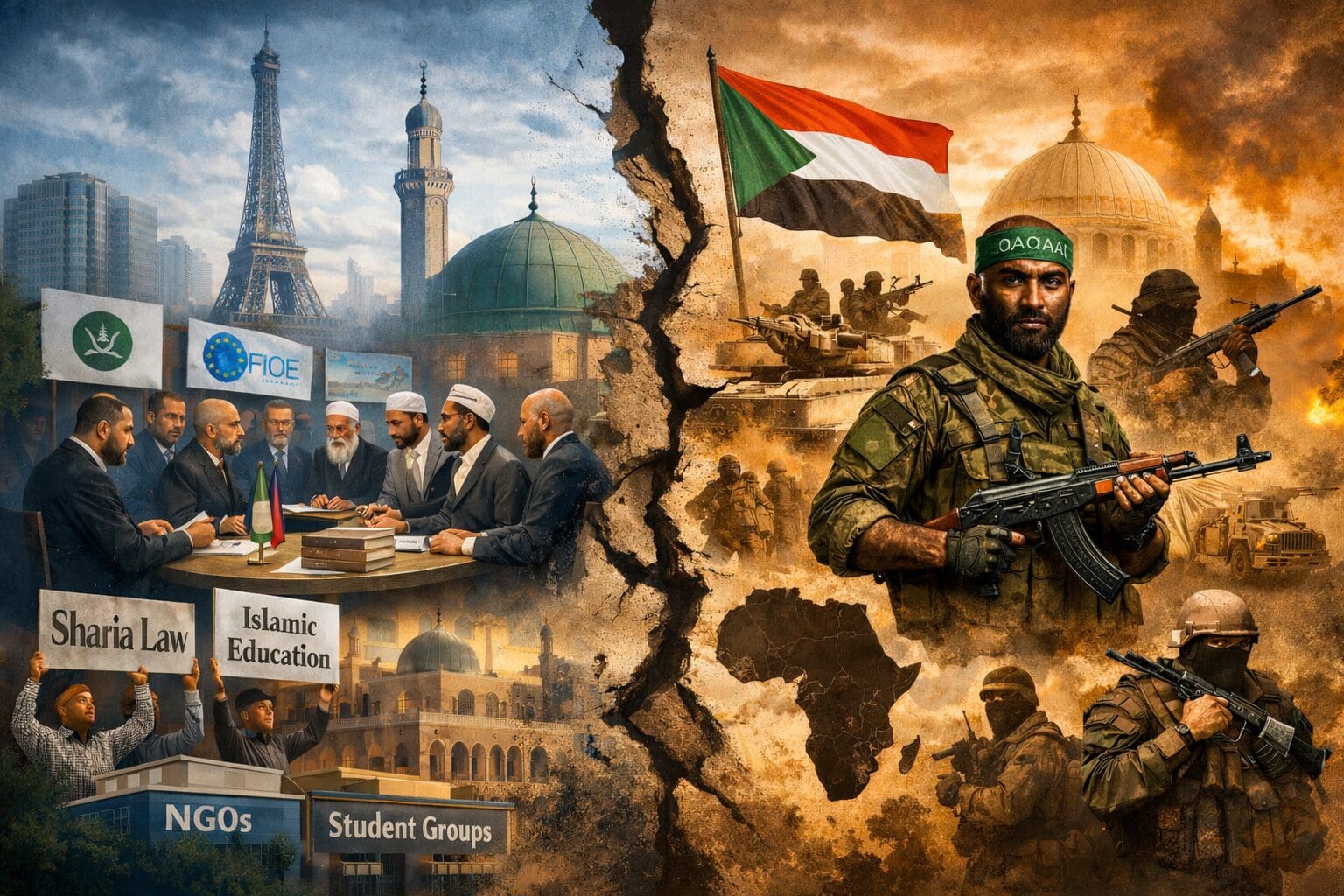
The Muslim Brotherhood, whether being labeled as a terrorist organization by the United States or facing scrutiny and restrictions in France and Austria, is attracting attention; concern is growing over its increasing influence and ambitions. Whether establishing a base in the Horn of Africa or embedding itself in local French life, governments and security services are raising alarms. To effectively address the Brotherhood, it’s crucial to acknowledge their different operations across continents.
The core goal of the Muslim Brotherhood is to transform individuals, society, and the state to be governed under Islamic Sharia law, ultimately aiming for a unified Islamic order or caliphate. However, their methods to achieve this vary by region. In Europe, where Islam is a minority religion, they primarily function as a broad socio-religious and lobbying network through NGOs, mosque federations, youth and student groups, as well as charity and real-estate structures. In Sudan, where Islam is integral to national life and culture, it has historically operated as a mass Islamist movement embedded in the ruling party, security services, and currently in the Sudanese Armed Forces.
In Europe, the Brotherhood is not a formal political party; instead, it operates through a decentralized network of associations coordinated by umbrella groups like the Federation of Islamic Organisations in Europe and the European Council of Muslims in Brussels, along with associated entities like the European Council for Fatwa and Research, youth and student federations (e.g., FEMYSO), and charity and finance entities such as Europe Trust. Its Sudanese branch and allies have formed classic party structures, notably through the Islamic movement that developed in Hassan al-Turabi’s networks and later the National Congress Party (NCP), which under Omar al-Bashir effectively merged party, state, and movement.
Regarding the Brotherhood’s relationship with the state, in Europe, it generally acts as a civil-society intermediary with the state, seeking recognition as a representative of Muslim communities, access to consultation forums, and influence over policy on religious rights, education, and foreign policy, while formally remaining within democratic and legal frameworks. In Sudan, it has historically operated as an embedded Islamist presence in government, influencing constitutions, legislation, and security policy, especially during Bashir’s regime (1989–2019), when Brotherhood-aligned Islamists infiltrated the civil service, intelligence services, and judiciary, and drove the Islamization of law and public space.
How does the Brotherhood’s use of coercive power vary across regions? In Europe, the security services report an “extensive and sophisticated” but mostly covert network focused on ideological, financial, and institutional influence; it does not openly control armed factions and operates legally, though intelligence reports express state concerns about entryism, foreign funding, and long-term societal engineering rather than immediate violence. In Sudan, Brotherhood-aligned Islamists have directly influenced and sometimes integrated








Leave a Reply