Europe Is Failing a Key Test in Press Freedom

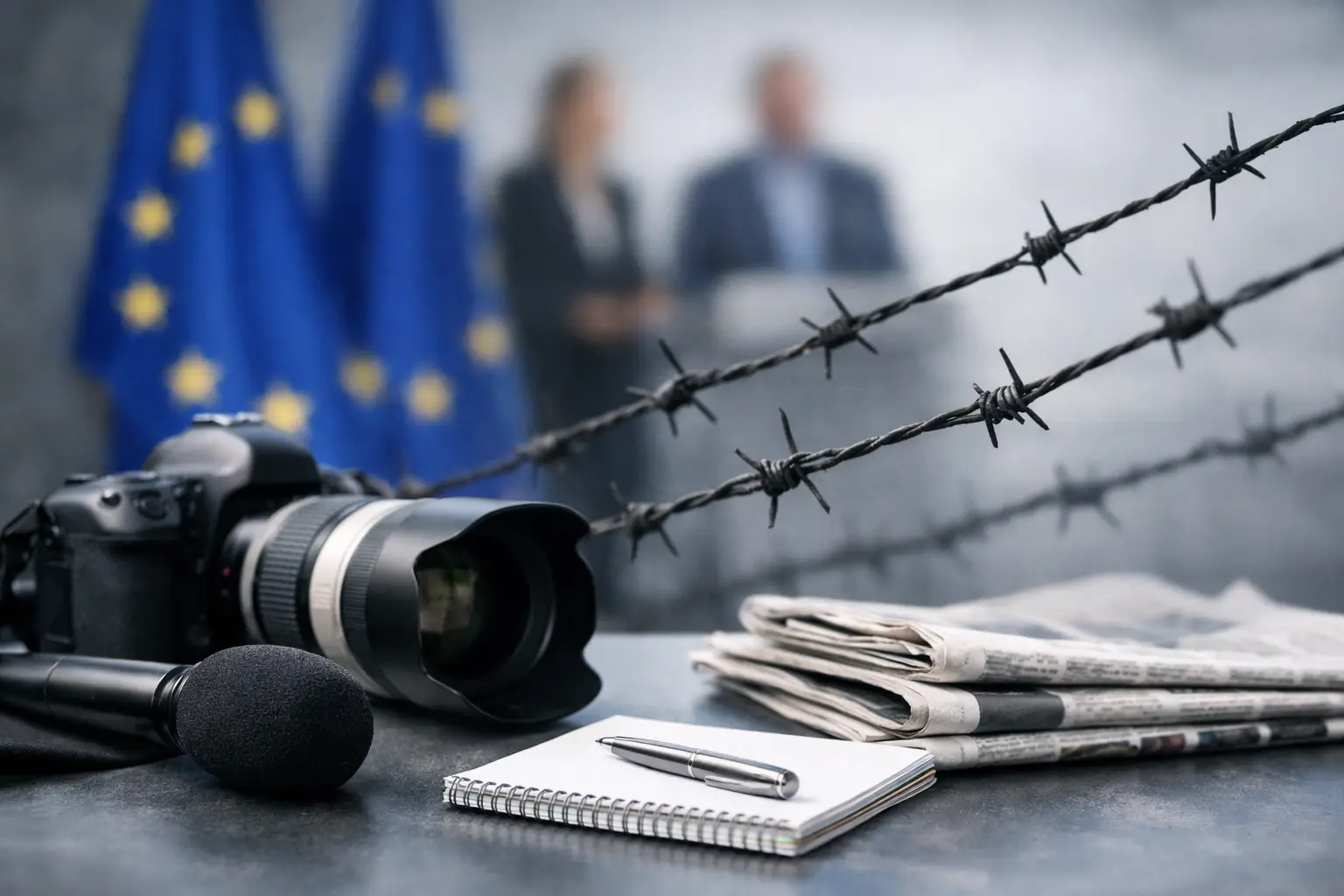
A journalist does not need to be imprisoned for press freedom to be endangered. A tax audit coinciding with an important investigation, spyware on a reporter’s phone, influence from a politically connected owner, or numerous lawsuits can be equally effective. This is the current state of press freedom in Europe, not just in obvious crisis areas, but also in democracies that claim to respect rights while undermining them.

The main issue is not whether Europe supports media freedom in theory, but whether European entities are willing to address the systems that make journalism costly and risky. The results are inconsistent.

Press freedom is not just a professional issue for journalists and publishers. It is a public safeguard that impacts corruption detection, electoral fairness, judicial scrutiny, minority rights, and the exposure of abuses. When independent reporting weakens, citizens lose not just stories but critical information on power dynamics.

This is crucial in Europe, where democratic legitimacy is linked to rule-of-law standards, human rights, and institutional credibility. Governments restricting critical reporting while maintaining democratic claims are testing how much accountability can be reduced without consequences.

For readers, NGOs, religious communities, whistleblowers, and civil society, this has practical implications. If media cannot investigate fraud, illegal surveillance, discrimination, transnational repression, or misuse of powers, public interest claims become harder to prove. A weak press environment limits the evidence base for rights protection.

Threats to press freedom in Europe are more complex than straightforward censorship. Journalists can still publish critical material, but issues arise before and after publication.

Legal harassment, particularly through SLAPPs, is a powerful tool. These lawsuits aim not to win but to impose costs, delay, and intimidation. Wealthy individuals and entities use them to drain resources and deter others. The process can be punitive even if cases fail.

Surveillance is another concern. Spyware use against journalists and activists has changed the debate. Compromised confidential communications weaken source protection. Investigative journalism is compromised if reporters operate under interception fears. This affects the core of journalism under democratic conditions.

Ownership concentration also requires attention. While not every proprietor interferes editorially, opaque ownership, political alignment, or state advertising reliance poses risks. Governments can shape media markets to favor compliant voices over independent ones.

Public broadcasters need proper funding and independence from political control. When controlled by governing parties, they become narrative tools. Europe has examples of both models, highlighting the importance of actual independence.

Europe has principles, but enforcement is lacking. States can endorse media freedom at European levels while local journalists face police obstruction, selective leaks, weak threat investigations, or politically motivated regulatory decisions at home. This inconsistency reflects broader issues where values are not enforced.

The EU’s efforts to enhance media pluralism and independence are important, but legislation alone won’t solve problems if regulators lack resolve and governments view criticism as disloyalty. Press freedom depends on institutions imposing costs on those who undermine it.

State advertising, public subsidies, and licensing decisions can distort the market. If funds are distributed on partisan lines, media capture occurs without overt censorship. Transparency and oversight are democratic safeguards.

A simplistic east-west divide in the press freedom debate is misleading. Issues appear across Europe in various forms. Some countries face political capture and hostility toward independent media, others face ownership concentration, shrinking local journalism, weak labor conditions, digital harassment, or secrecy around security and migration. Established democracies are not immune to media pluralism erosion or surveillance normalization.

Selective outrage weakens Europe’s stance. Press freedom defense must be consistent across all regions. Different institutional forms may exist, but the democratic consequence is shared.

Digital platforms have transformed journalism’s market, affecting local reporting and making investigative work costly. While market changes matter, governments still hold responsibility. They decide on defamation law use, journalist protection, source confidentiality, public broadcaster independence, and media merger scrutiny. Press freedom decline is political, not just structural.

Journalism must not be conflated with disinformation and security debates. Some regulation is necessary, but frameworks must not chill legitimate reporting. The line between countering falsehoods and suppressing scrutiny is fine.

A serious response to press freedom requires enforcement. Anti-SLAPP measures should be swift and cross-border. Surveillance authorizations need judicial control with special safeguards for journalists. Media ownership transparency is crucial.

Independent regulators matter, as do independent prosecutors and courts. Impunity for threats or attacks on journalists is corrosive. Funding requires honest discussion. Europe needs to support public-interest journalism and address local news deserts and fragile investigative units.

Political leaders should stop treating adversarial journalism as disruptive. Language against the press is significant. When criticism is depicted as sabotage or conspiracy, it legitimizes harassment and undermines factual scrutiny.

For Brussels, this is a credibility issue. The EU cannot claim to defend democratic values while tolerating media intimidation within its own space. For member states, the message is clear: formal rights are insufficient if journalism can be silenced, economically strained, or politically captured.

The measure of a


Comments

One response to “Europe Is Failing a Key Test in Press Freedom”

  1. Slinger Avatar
    Slinger

    In a dazzling twist of irony, Europe flaunts its commitment to press freedom while simultaneously perfecting the art of legal gymnastics to keep journalists on their toes—who needs a free press when you have SLAPP suits and spyware to do the dirty work? 😂

  2. Sherm Avatar

    Looks like Europe’s idea of press freedom is akin to a fancy café serving watered-down espresso—looks good on the outside but leaves you with that bitter aftertaste of censorship and legal shenanigans. ☕️✨

Leave a Reply

Your email address will not be published. Required fields are marked *

Last News

Kallas, von der Leyen, and the EU Intelligence Rivalry

Kallas, von der Leyen, and the EU Intelligence Rivalry

Kallas and von der Leyen are engaged in a rivalry over EU intelligence. Brussels is enhancing its intelligence capabilities, with Zoya Sheftalovich and Kathryn Carlson discussing the increased role of INTCEN, the EU’s lesser-known intelligence-analysis center within the European system.

Read More

Europe Is Failing a Key Test in Press Freedom

Europe Is Failing a Key Test in Press Freedom

A journalist does not need to be imprisoned for press freedom to be endangered. A tax audit coinciding with an important investigation, spyware on a reporter’s phone, influence from a politically connected owner, or numerous lawsuits can be equally effective. This is the current state of press freedom in Europe, not just in obvious crisis areas, but also in democracies that claim to respect

Read More

Fears Over UK Trade Policy Resurface Amid Brexit Divisions in London, 2026

Fears Over UK Trade Policy Resurface Amid Brexit Divisions in London, 2026

LONDON, United Kingdom – May 18, 2026 – Eurotoday Newspaper — UK trade policy has once again become one of the most discussed political and economic topics in Britain after renewed Brexit tensions pushed the issue back into national headlines. The latest political disagreements surrounding Britain’s future relationship with the European Union have triggered fresh concerns from businesses, investor

Read More

Ex-PM Tsipras Aims to Unite Greece’s Divided Opposition with New Party

Ex-PM Tsipras Aims to Unite Greece’s Divided Opposition with New Party

The 53-year-old pediatrician became a prominent leader in a series of protests against the nation’s political leadership after a crash and alleged governmental cover-up. However, she distanced herself from many supporters with statements close to right-wing populism concerning abortion rights and relations with Turkey.
“Her stances are reminiscent of [Italy’s] 5Star Movement, but with a more

Read More

What Jesus Likely Ate Based on Historical Records

What Jesus Likely Ate Based on Historical Records

One of history’s most renowned figures, Jesus of Nazareth, believed by scholars to have been born between 6 and 4 BC, is recognized by Christians as the Messiah. His life and teachings are detailed in the New Testament of the Bible.
These scriptures also reference some of the foods he ate. For instance, the Gospel of Matthew recounts the miracle where Jesus fed five thousand, as well as wom

Read More

Lithuania Faces Heightened Baltic Security Crisis Amid Russian GPS Threat Warning in 2026

Lithuania Faces Heightened Baltic Security Crisis Amid Russian GPS Threat Warning in 2026

VILNIUS, Lithuania – May 26 – Eurotoday Newspaper — Baltic security crisis concerns escalated after Lithuanian officials warned that Russia possesses the capability to falsify GPS signals deep into Europe. The warning has intensified regional anxiety surrounding aviation safety, NATO defense coordination, cybersecurity risks, and the growing use of electronic warfare technologies near Europe’s eas

Read More

Electric Ferrari Sparks Outrage from Transport Minister and Across Italy

Electric Ferrari Sparks Outrage from Transport Minister and Across Italy

Salvini’s remarks are expected to escalate tensions between the Italian government and the Agnelli-Elkann family, the principal shareholder in Ferrari and the global car manufacturer Stellantis.
The contentious Luce — the first Ferrari model to be entirely electric and to feature five seats — has immediately caused a stir among traditionalists in Italy.
It also failed to immediately reassure

Read More

Galileo’s Relics: The Museum Display of His Sacrificed Fingers and Teeth

Galileo’s Relics: The Museum Display of His Sacrificed Fingers and Teeth

In 1642, upon Galileo’s death, the Catholic Church denied him burial in consecrated ground due to his controversial theories. Over 380 years later, parts of Galileo Galilei’s body are displayed as valuable exhibits in Italy. Almost a century after his burial, admirers dismembered him, leading to his current veneration in a Florence museum, reminiscent of a saint’s cult.
His righ

Read More

Senegal-IMF Discussions Jolt African Bond Markets Following PM’s Exit in Dakar 2026

Senegal-IMF Discussions Jolt African Bond Markets Following PM’s Exit in Dakar 2026

DAKAR, Senegal – May 26 – Eurotoday — Senegal IMF talks have become increasingly complicated following the departure of the country’s outspoken prime minister, a political development that has intensified concerns among international investors, financial institutions, and sovereign bondholders.
Analysts warn that the leadership transition could delay ongoing negotiations with the International Mon

Read More

Metropolitan Hilarion (Alfeev) Arrested in Karlovy Vary, Czech Republic

Metropolitan Hilarion (Alfeev) Arrested in Karlovy Vary, Czech Republic

An announcement was posted on Metropolitan Hilarion (Alfeev)’s official Telegram channel regarding his detention by Czech police in Karlovy Vary, where he resides as appointed by the Russian Orthodox Church. The statement reads:
“Currently, Metropolitan Hilarion cannot personally address the channel’s subscribers. Due to the events in Karlovy Vary, we provide information from the defe

Read More