Denmark’s 2026 Election and the Normalization of Exclusion: A Turning Point for Democracy

How Anti-Islam Politics Moved from the Fringe to the Center of Political Campaign

Bashy Quraishy
Secretary General – European Muslim Initiative for Social Cohesion – Strasbourg

Thierry Valle
Coordination des Associations et des Particuliers pour la Liberté de Conscience

The recent parliamentary elections in Denmark on March 24, 2026, signaled a significant shift in the political landscape. Held by Prime Minister Mette Frederiksen amid geopolitical tensions, especially regarding Greenland and the US, the election was expected to solidify her leadership. Instead, it revealed setbacks for the governing coalition and disturbing political undercurrents.

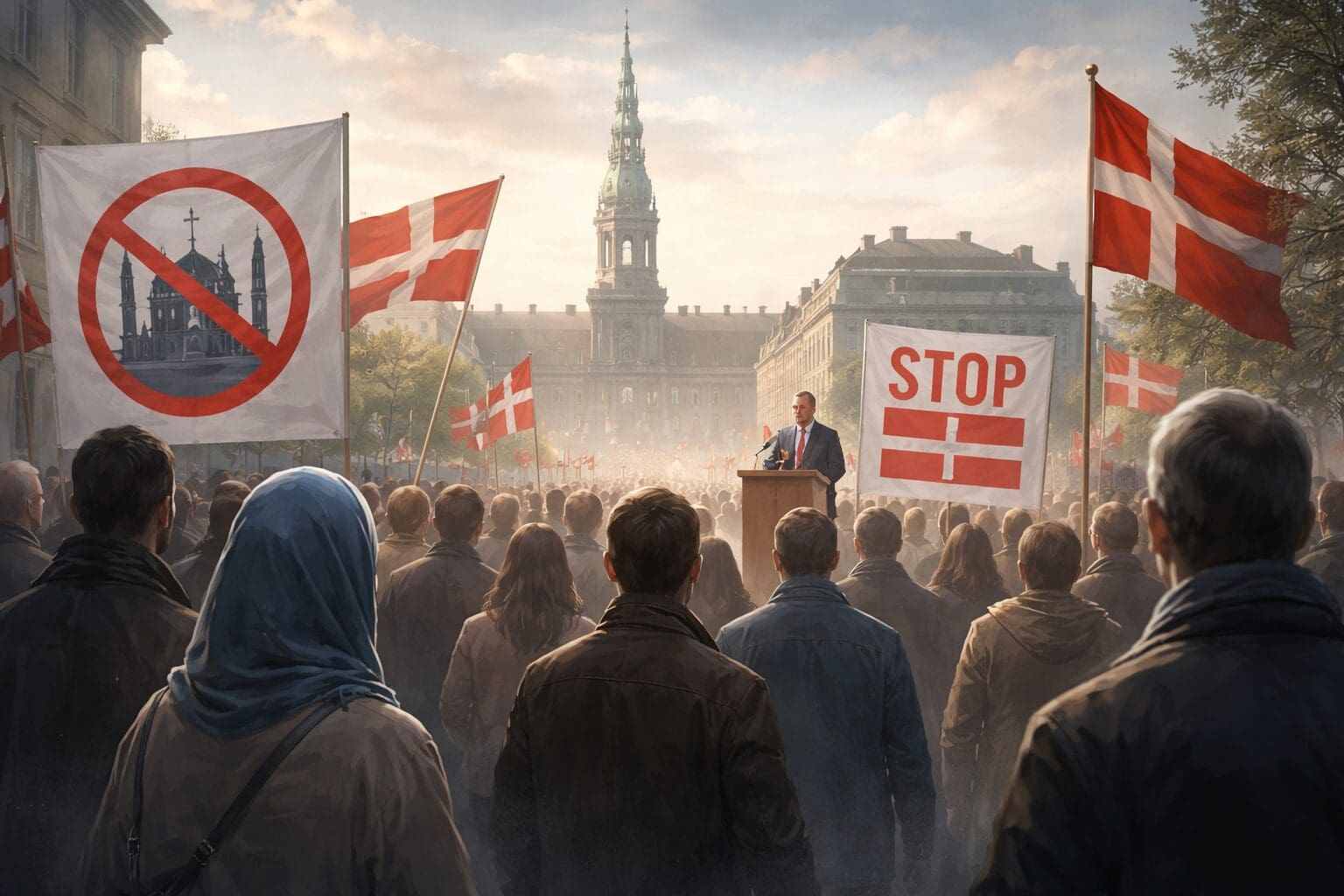
The Social Democrats and their coalition suffered major losses. More notably, parties with anti-Islam and anti-immigration agendas performed strongly. The Danish People’s Party and right-wing groups portrayed Islam as a threat to national identity, rather than a cultural difference.

This election marked the culmination of a political shift. It normalized the idea of Islam as incompatible with Danish society. Campaign rhetoric framed Islam as a civilizational challenge, linking Muslim communities to crime and social issues. Immigration and integration were top concerns for voters, highlighting the resonance of these narratives.

Central to this shift was identity politics targeting minorities. Danish People’s Party leader, Morten Messerschmidt, called for “net emigration of Muslim residents,” placing religion at the core of political identity. Such proposals entered mainstream debate as negotiable positions.

Framing of Islam as a Societal Threat

In the lead-up to the election, anti-Islam discourse dominated. Integration, security, and cultural values were framed to disproportionately target Muslim communities. Mainstream actors cautiously navigated these debates, rarely challenging the divisive framing, creating a vacuum filled by parties pushing political boundaries.

This development built on years of framing Islam as a societal problem. PM Frederiksen described Islam as “a barrier to integration,” while extreme politicians like Rasmus Paludan called for Muslims to leave Denmark. Although condemned, such statements expanded acceptable discourse, making moderate exclusionary positions appear reasonable. Normalization operates through electoral success, repetition, and insufficient resistance.

The normalization of exclusionary rhetoric shifted the political center. Once-fringe positions gained legitimacy, embedding narratives that undermine equality and mutual respect.

Silence as Strategy by Mainstream Parties

A notable feature was not just anti-Islam rhetoric, but the lack of opposition to it. Mainstream parties avoided direct confrontation, adopting softer variations like “integration challenges” and “cultural cohesion.”

This convergence is strategic: challenging narratives risks alienating voters. By not contesting the premise, mainstream actors legitimize it, shifting the debate to how exclusionary ideas should be implemented.

Exclusionary rhetoric no longer needs to win arguments, just be repeated.

A Representation Gap is Widening

Denmark’s population includes many citizens with immigrant roots, yet political representation is marginal. Of 179 parliament members, only four have ethnic minority backgrounds, despite significant immigrant roots.

This disparity is influenced by party structures. Minority candidates are underrepresented and often placed in unwinnable positions. Political recruitment relies on networks that minorities struggle to access, with “electability” concerns persisting.

A political system focused on minority communities yet resistant to participation results in a parliament debating integration and identity with minimal representation from affected communities.

Rhetoric and representation reinforce each other. Absence of minorities in parliament makes debates abstract and detached, sustaining simplified narratives and discouraging political participation, deepening underrepresentation. This benefits those relying on polarization.

Breaking the Pattern and Changing the Picture, from Margins to Representation

Reversing this trajectory requires structural change. Political parties must confront their role in shaping discourse and challenge assumptions framing Islam as a threat.

Candidate selection must change, actively recruiting minority candidates and ensuring measurable inclusion.

Recognizing risks of inaction is key. An unbalanced parliament is vulnerable. Democratic legitimacy depends on meaningful representation.

Minority participation should be seen as political agency, not assimilation. Engagement is essential for reshaping the system. Responsibility lies with those controlling access.

Representation must be viewed as democratic legitimacy. A parliament not reflecting its population risks losing trust, failing to address societal complexities. Civic participation in minority communities is crucial. Higher voter turnout and engagement can influence strategies, especially in urban areas where minority voters are significant.

Minorities Should Utilize Their Rights and Responsibilities in the Political Spectrum

Low ethnic voter turnout highlights the need for renewed engagement from Denmark’s ethnic and religious minorities. Political participation is essential for representation and influence. Voting, civic engagement, and involvement in political parties ensure minority voices in decision-making.

Younger generations’ awareness of political representation’s importance is encouraging. Supporting their public life entry, locally or nationally, helps rebalance discourse and bring lived experiences into policymaking.

Denmark’s democracy depends on defining itself amid rising polarization. Will it reaffirm inclusivity and democratic integrity, or allow exclusionary narratives to deepen?

The answer depends


Comments

6 responses to “Denmark’s 2026 Election and the Normalization of Exclusion: A Turning Point for Democracy”

  1. BlackExcalibur Avatar
    BlackExcalibur

    Seems like Denmark’s democracy is taking a lovely stroll down the path of exclusion, eh? Quite the political vacation spot, where anti-Islam politics have gone from the shadows to the spotlight, all while the mainstream parties enjoy a quiet game of pass-the-buck. 🥳

  2. tootsie killer Avatar
    tootsie killer

    Looks like Denmark’s decided that democracy is just a fancy word for “let’s exclude everyone who doesn’t fit our IKEA model.” 🙃 Who knew politics could be this much fun?

  3. mr. peppermint Avatar
    mr. peppermint

    Oh, brilliant! Who needs democracy when you can just turn the political landscape into a game of “who can shout the loudest about exclusion”? Classic Danish charm, I must say! 🇩🇰🙄

  4. Rando Tank Avatar
    Rando Tank

    What a brilliant way to redefine democracy—by excluding half the population! 🥳 I suppose next we’ll be normalizing the idea that only Danes with a specific haircut can vote.

  5. Light Despair Avatar
    Light Despair

    Just what Denmark needed—more exclusion in the name of democracy! It’s like serving herring at a vegan feast; confusing and utterly delightful for the bystanders. 🐟🤷‍♂️

  6. chlorine Avatar

    Ah, the Danish elections—a masterclass in how to turn democracy into a game of musical chairs, where only the most exclusionary players get to sit down. 🎩🇩🇰 Who knew that embracing anti-Islam sentiments would become the new chic? Just what we needed, right? 🙄

  7. New Cycle Avatar
    New Cycle

    Oh, fantastic! Who knew that “exclusion” could be the new trend in democracy? Must be the latest fashion from Copenhagen—very chic, I must say! 😏

Leave a Reply

Your email address will not be published. Required fields are marked *

Last News

Countries Bypass WTO Stalemate to Implement E-Commerce Deal

Countries Bypass WTO Stalemate to Implement E-Commerce Deal

South Korean Trade Minister Yeo Han-koo told POLITICO that ministers have decided to move on without waiting for unanimous agreement, emphasizing the urgency of the matter. He described it as a “practical approach” where more members will join over time and consensus will integrate this into the WTO. The implementation of the deal should happen quickly to allow members to benefit.
WTO Director-Gen

Read More

Denmark’s 2026 Election and the Normalization of Exclusion: A Turning Point for Democracy

Denmark’s 2026 Election and the Normalization of Exclusion: A Turning Point for Democracy

How Anti-Islam Politics Moved from the Fringe to the Center of Political Campaign
Bashy Quraishy
Secretary General – European Muslim Initiative for Social Cohesion – Strasbourg
Thierry Valle
Coordination des Associations et des Particuliers pour la Liberté de Conscience
The recent parliamentary elections in Denmark on March 24, 2026, signaled a significant shift in the political landscape. Held b

Read More

Ukraine Strengthens Gulf Security Relations by Exporting Air Defense Expertise

Ukraine Strengthens Gulf Security Relations by Exporting Air Defense Expertise

Following Ukraine’s signing of a defense cooperation pact with Saudi Arabia during Zelenskyy’s visit to Riyadh, Zelenskyy highlighted that this agreement “lays the foundation for future contracts, technological cooperation, and investment,” and strengthens Ukraine’s international role as a security donor.
Kyiv aims to leverage its battlefield experience from Russia’s

Read More

Religious Leadership Criminalized in France

Religious Leadership Criminalized in France

PARIS, France—A French abbot, Father Bernard Domini, leader of the Missionary Family of Notre-Dame (FMND), was convicted under France’s new law against “psychological subjection,” raising concerns about religious freedom. The abbot received a two-year suspended sentence and a five-year priesthood ban, with the community facing a one-year closure. The case focused on the demanding monastic l

Read More

EU lawmakers advised to leave phones at home for China trip

EU lawmakers advised to leave phones at home for China trip

A Parliament spokesperson stated that “all necessary preventive and reactive measures are in place to ensure the security and safety of MEPs and [European Parliament] staff during official missions,” with “briefings, training and assistance regarding security” provided to both lawmakers and officials.
Previously, the European Parliament has utilized burner phones and security pouches to safe

Read More

France to spend €70M on fuel subsidies for farmers, trucks and fishermen in April

France to spend €70M on fuel subsidies for farmers, trucks and fishermen in April

PARIS — Starting April 1, the French government will allocate €70 million to subsidize fuel prices for farmers, logistics companies, and fishermen until the month’s end.
“This response is national, gradual, targeted, and specific to sectors, limited to April,” Economy and Finance Minister Roland Lescure announced Friday evening, addressing rising energy costs due to the conflict

Read More

COMECE Congratulates Mairead McGuinness on Appointment as EU Special Envoy for Freedom of Religion or Belief

COMECE Congratulates Mairead McGuinness on Appointment as EU Special Envoy for Freedom of Religion or Belief

Mairead McGuinness during Rethinking Europe in 2017. (Photo: COMECE)
PRESS RELEASE // COMECE // The Commission of the Bishops’ Conferences of the European Union (COMECE) congratulates Mairead McGuinness on her appointment as EU Special Envoy for the Promotion of Freedom of Religion or Belief outside the European Union, announced today, Thursday 26 March 2026.
“COMECE knows Ms McGuinness well and

Read More

Orbán’s spies were hunting me, says Hungarian journalist accused of espionage

Orbán’s spies were hunting me, says Hungarian journalist accused of espionage

“That’s when they took all the material they had on me, edited it, spun it around, and released it as a type of kompromat,” Panyi remarked, referencing the Russian term for compromising material.
Szijjártó has admitted to speaking with Russian counterparts before and after EU meetings, as reported by The Washington Post, revealing that he shared reports with Russian Foreign Minister Sergey Lavrov

Read More

Secularism on Trial: France’s Struggle with Faith and Identity

Secularism on Trial: France’s Struggle with Faith and Identity

PARIS — In the core of the French Republic, the longstanding principle of laïcité, ensuring the separation of church and state, is under significant strain. A comprehensive report by the Personal Representatives of the OSCE Chair-in-Office, following a visit in June 2025, depicts a nation where this foundational principle is increasingly perceived as a mechanism of exclusion, surveillance, and &#

Read More

Vadym Novynskyi: “Peace Is as Essential to Ukraine as Air”

Vadym Novynskyi: “Peace Is as Essential to Ukraine as Air”

Former Ukrainian parliamentarian Vadym Novynskyi, who is currently living in one of the European countries after being forced to leave Ukraine, gave an interview to the conservative Spanish channel HerqlesTV. In the interview, he addressed key issues related to the current situation in Ukraine and placed particular emphasis on the condition of the Ukrainian Orthodox Church, which, according t

Read More