


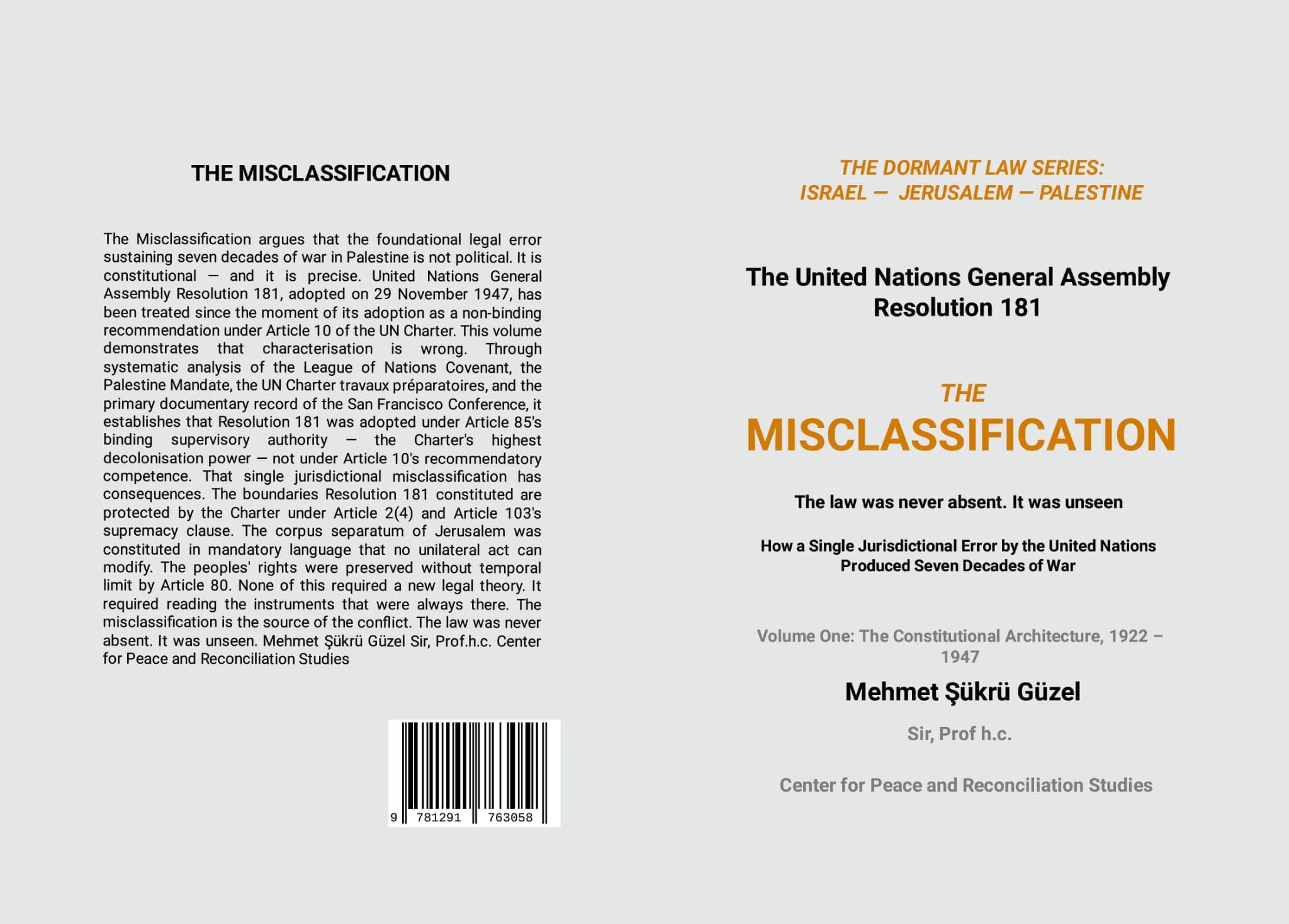
In the quiet realm of international law, where treaties and resolutions lie undisturbed, there’s been a longstanding silence regarding the origins of one of today’s most persistent conflicts. Typically, the Middle East’s strife is perceived through political failures, diplomatic impasses, or age-old hatreds. However, Mehmet Şükrü Güzel’s new book, “The Misclassification,” proposes that the conflict’s root might be more technical and bureaucratic than previously thought.
Güzel’s book isn’t a political manifesto but a forensic look at the legal frameworks that ended the British Mandate for Palestine. His central thesis is straightforward: for almost eight decades, the international community has misunderstood the legal nature of United Nations General Assembly Resolution 181. According to him, a single jurisdictional error—treating a binding constitutional order as a non-binding recommendation—created an authority vacuum that decades of conflict haven’t resolved.
The book encourages readers to examine the UN Charter’s text beyond the conflict’s reality. Güzel argues that Resolution 181, adopted on November 29, 1947, wasn’t an exercise of the General Assembly’s typical recommendatory powers (Article 10). Instead, he claims it was enacted under the Assembly’s “terminal disposition” authority (Article 85), acting as the Successor Trustee for the “Sacred Trust of Civilization” from the League of Nations.
This isn’t a mere semantic issue. If Resolution 181 was a recommendation, parties could accept, reject, or negotiate its terms, implying that the territory became terra nullius—a land without sovereign, open to force acquisition. If Güzel’s legal analysis is correct, the Resolution was a binding fiduciary determination. The boundaries and Jerusalem’s international regime were protected obligations under the Charter’s supremacy clause (Article 103).
This argument has an “Arendtian” quality. Hannah Arendt noted that great evils often arise from functionaries following flawed logic within bureaucracies. Güzel views international law similarly, not accusing the 1947 actors of malice, but of a collective cognitive slip categorizing a complex constitutional act as a mere diplomatic suggestion.
Güzel outlines the consequences of this misclassification with precision. He tracks how not recognizing the binding nature of the UN’s fiduciary duty allowed the mandatory power to withdraw without ensuring lawful transition. This abandonment, he argues, left a legal void, replacing legal authority with military capacity. “Peace processes” like Oslo are presented as efforts to negotiate already legally determined rights or trade territories under a specific international regime.
The book’s treatment of Jerusalem is particularly interesting. Güzel asserts the international status (corpus separatum) wasn’t a proposal but a legal reality upon adoption. Decades of recognizing exclusive sovereignty over the city by any party are seen as a continuous breach of an obligation owed to the international community.
“The Misclassification” is dense, rooted in the Covenant of the League of Nations, the UN Charter, and the Vienna Convention on the Law of Treaties. Yet, it’s accessible in its logic. It removes political rhetoric to reveal a structural failure in applying international law.
For those looking to understand why the conflict endures, Güzel offers a provocative answer: we’ve tried solving a political problem instead of enforcing a legal trust. The book reminds us that, in nations’ realm, the absence of law isn’t freedom; it precedes chaos. Whether one agrees or not, Güzel insists we view the 1947 documents not as historical artifacts but as the active, unseen constitution of a region that has forgotten its rules.











Leave a Reply