


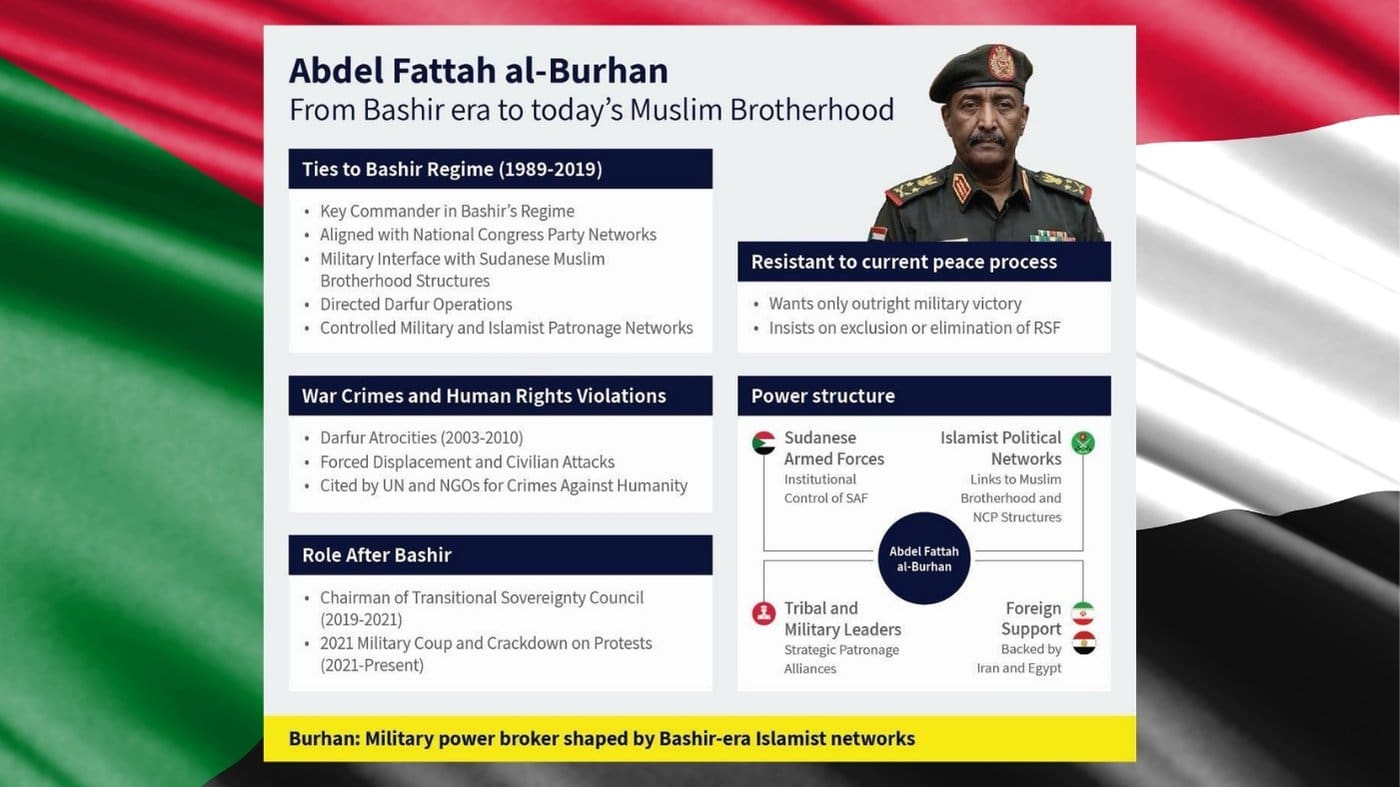
In understanding Sudan and the civil war that has claimed up to 150,000 lives in the last three years—twice as deadly as Gaza—it’s crucial to remember that Abdel Fattah al-Burhan wasn’t elected leader of Sudan. He overthrew a popular revolt to restore the regime of his predecessor, Omar al-Bashir, and the ‘Islamist current’ that has controlled the state for almost 60 years. This war continues to further that aim.
The accompanying graphic, inspired by Sahel conflict analyst Rachel Allen, highlights this point—urging attention from international diplomats in the Middle East, Africa, Europe, and the United States. These diplomats, since the war began, have been attempting unsuccessfully to bring the Sudanese Armed Forces to negotiate a ceasefire and long-term peace with the Rapid Support Forces and various political and civic groups. However, Burhan, the SAF, and their Islamist cadres—including regional warlords, militias, and state functionaries from the Bashir regime (linked with the Sudanese Muslim Brotherhood, recently designated by the US State Department as a Global Terrorist and Foreign Terrorist Organization)—have consistently rejected peace overtures.
Instead, they have cloaked themselves in nationalism; framed the conflict as a ‘war of dignity’; falsely claimed their council should be recognized as Bashir’s successor; alleged support from ‘the Sudanese people’; asserted their ‘sovereign’ right over the country’s political future; and made it clear the Army will be central to Sudan’s governance.
Sudan’s instability is a threat both east and west. Attention is focused on its geopolitical significance to the Red Sea and the regional interests of northern and Gulf powers, but less on its ties to Islamist groups in the Sahel.
UN and specialist reports since 2019 identify a dedicated IS network in Sudan that operates businesses and front companies to channel funds to Islamic State branches in West Africa and the Sahel and support fighter movements across Africa. This shared ecosystem provides ISIS and Al‑Qaeda franchises with finance, facilitation, and recruits, helping them solidify territorial control across the Sahel and West Africa. The Islamists of Al Qaeda and Islamic State, differing from Burhan’s cohort, attempt to establish ministates from their West African enclaves. Burhan already controls a state captured by Islamism decades ago and is resolved to retain it at any cost, with the Sudanese people suffering the consequences.








Leave a Reply