


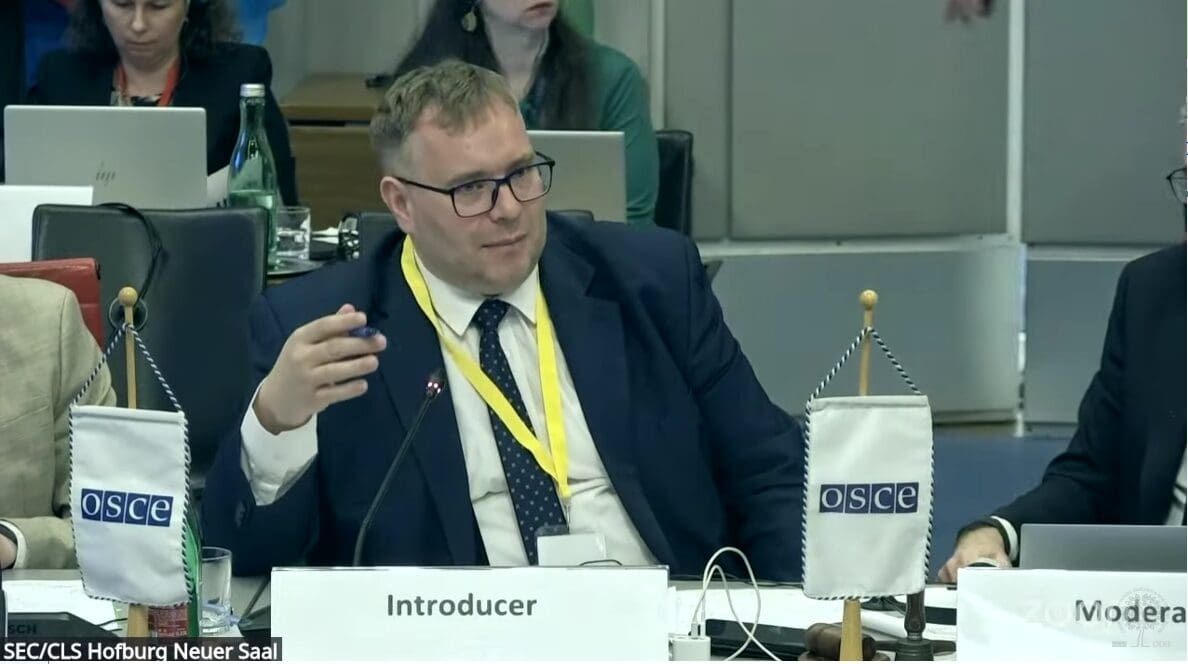
A remark in Vienna could reignite Slovakia’s long-standing religious-freedom dispute.
Slovakia’s ongoing issue regarding state recognition of religion was brought back into focus at the OSCE ODIHR meeting in Vienna. Public Defender of Rights, Róbert Dobrovodský, announced plans to challenge the law requiring religious communities to have 50,000 adult adherents for official registration. This threshold has been deemed excessive and discriminatory by the ombudsman’s office, which argues it is inconsistent with democratic principles.
This development occurred during the OSCE ODIHR Supplementary Human Dimension Meeting on “Lawmaking for Democratic Resilience,” which examined how undemocratic laws can undermine democratic systems. The final session of Tuesday’s meeting focused on the role of courts and constitutional review bodies as the ultimate defense in such scenarios.
Slovakia’s legal framework requires a religious group to have declarations from 50,000 adult citizens for recognition, a requirement that is more than a formality. Groups unable to meet this threshold cannot gain the rights and public functions of a recognized religious community, leading to a two-tier system where historic churches receive protection and newer ones are disadvantaged.
Many already registered churches wouldn’t meet this requirement if applying today but remain protected due to prior registration before stricter rules. This system creates barriers to entry beyond just abuse prevention.
The ombudsman’s office argues the law is unconstitutional, claiming it is disproportionate and unnecessary in a democratic society. A 2022 statement and the 2024 annual report criticize the registration rules for violating constitutional protections and hindering smaller churches. The office disputes claims that the threshold prevents speculative registrations, suggesting administrative scrutiny as a less restrictive solution.
Political solutions have stalled. The Ministry of Culture did not reform the law, and a bill for a lower-status registration failed in Parliament. President Zuzana Čaputová acknowledged the high registration requirements but did not press the Constitutional Court for review.
Dobrovodský’s remarks in Vienna signal a potential move from political debate to constitutional litigation. This raises the question of whether Slovakia can claim to protect religious freedom while maintaining such a restrictive rule.
European examples illustrate why Slovakia’s system is criticized. Unlike Slovakia’s numerical requirement, countries like Spain, Portugal, and Sweden use registration models based on governance, continuity, or social presence without requiring tens of thousands of signatures.
These examples suggest various ways to regulate legal status without excluding smaller communities. Slovakia’s 50,000-signature rule tests whether formal religious freedom aligns with practical legal access.
The issue extends beyond Slovakia, highlighting how legal recognition rules impact religious communities’ public existence and test neutrality under the law. Vienna, with its focus on democratic resilience and judicial accountability, was a fitting backdrop for this discussion.
Slovakia may soon face a crucial test of its constitutional review process.






Leave a Reply