Julian the Apostate: The Final Emperor of the Old Gods

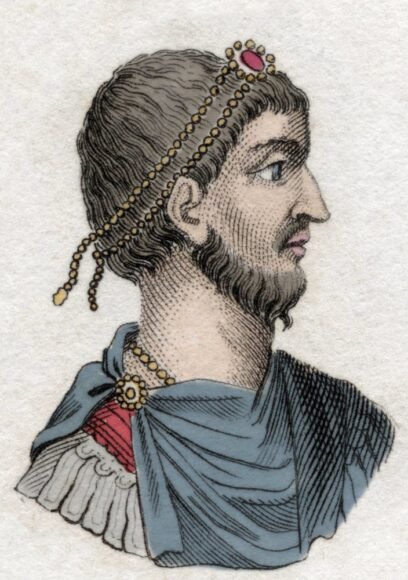
In the 4th century, Roman emperors included Flavius Claudius Julianus, famously known as Julian the Apostate, a figure of great controversy and complexity. For Christians, he is the ruler who turned away from his upbringing’s faith and made a last significant effort to revive old pagan traditions. Others see him as a well-educated philosopher, a competent military strategist, and a humble emperor opposing the decadence prevalent in late Roman society. His brief rule epitomizes the conflict between the waning ancient religion and ascendant Christianity, now a dominant force in the empire.

Julian, born in 331 or 332 in Constantinople, was part of Constantine the Great’s dynasty. His father, Julius Constantius, was Constantine’s half-brother, placing Julian close to power, but also in constant danger. After Constantine’s death in 337, many imperial family men were eliminated to secure his sons’ rule, including Julian’s father. Only Julian and his brother Constantius Gallus survived this bloodbath.

This family tragedy deeply affected Julian, raised as a Christian yet possibly never forgetting that those who destroyed his family also claimed to defend Christianity. His early years were spent under watchful eyes, kept from political life due to Emperor Constantius II’s fear of rivals.

Julian turned to education, studying in Nicomedia, Pergamum, Ephesus, and Athens, becoming one of late antiquity’s most learned rulers. He delved into Homer, Plato, Aristotle, and Neoplatonic philosophy, particularly influenced by those who viewed paganism as a comprehensive belief system.

In Athens, he encountered the environment of future Christian theologians Basil the Great and Gregory the Theologian. Julian and Basil, though not necessarily friends, were part of the same learned circle familiar with classical traditions. Gregory later criticized Julian, having observed him as a student. Athens thus became the meeting ground for Julian, the eventual pagan defender, and the future Christian leaders.

Gradually renouncing Christianity, Julian covertly embraced the pagan mysteries, believing ancient gods could restore Rome’s spiritual might, with Hellenistic culture and divine worship intertwined. His title “Apostate” symbolized a rejection of the post-Constantine empire’s direction, beyond a mere personal faith change.

Julian’s rise was unexpected. After Gallus’ execution, Constantius II lacked trustworthy relatives to oversee the expansive empire and named Julian Caesar in 355 at Mediolanum (modern Milan), as a junior ruler under him. Julian married Helena, the emperor’s sister, tying him closer to the dynasty. Dispatched to Gaul amid turmoil, Julian, known as a philosopher, proved an adept military leader. Restoring discipline and provisions, he actively led campaigns, notably defeating the Alemanni at Argentoratum (now Strasbourg) in 357, followed by operations across the Rhine, reestablishing forts and freeing captives.

Julian’s military victories endeared him to soldiers. When Constantius II redirected Gallic units eastward to confront Persia, they rebelled, declaring Julian Augustus in Lutetia (present-day Paris) in 360. This began preparations for civil war, though Constantius’s 361 death left Julian sole emperor, free to reinstate pagan practices, opening temples, reestablishing priestly privileges, and reviving sacrifices. Although he didn’t initiate widespread Christian persecutions, he anticipated internal church rifts by allowing exiled bishops’ return, reflecting his anti-Christian stance.

A notable edict barred Christian teachers from classical literature instruction, asserting that non-believers in ancient gods lacked credibility to interpret Homer and other pagan writers. Julian also encouraged rebuilding the Jerusalem Temple, likely to contest Christian claims about its prophesied destruction, but this project was never completed.

Understanding that rejuvenating paganism required more than rituals, Julian aimed to remodel it akin to Christianity, demanding priestly morality, poor relief, and public duty—paradoxically mirroring the church’s organizational and charitable frameworks.

Julian’s ascetic lifestyle sharply contrasted with typical imperial luxury. Preferring modest meals, minimal sleep, and focusing on intellectual and administrative pursuits, he scorned opulent attire and ceremonies. After his wife Helena’s death, he remained single, avoiding courtly excess or romantic scandals. Though mocked by some, even adversaries acknowledged his discipline and simplicity.

Julian’s grand military campaign was his 363 expedition against Sassanid Persia, where he led substantial forces deep into enemy lands, reaching Ctesiphon and achieving a nearby victory but failing to seize the city. Opting to advance, Julian burned a portion of his fleet, a dire miscalculation as Persians evaded pitched battles, devastated resources, and disrupted Roman supplies. During the withdrawal, Julian suffered a fatal spear wound in combat on June 26, 363, at thirty-one. While a Persian is commonly credited, rumors suggested a Christian

Comments

2 responses to “Julian the Apostate: The Final Emperor of the Old Gods”

  1. rightn0w2 Avatar
    rightn0w2

    What a delightful tale of a guy who thought he could just resurrect paganism like it was an old vinyl record! 😏 One can only admire the audacity of trying to out-church the church while being the emperor—classic European overreach, innit? 🍷

  2. Brick Mooch Avatar
    Brick Mooch

    Couldn’t have picked a better title—“The Final Emperor of the Old Gods,” eh? Sounds like the ancient Roman version of a last-ditch effort to get the nostalgia crowd back onside. 😂

  3. granola Avatar

    Seems like Julian was really trying to bring back the ‘good old days’ of paganism while everyone else was busy with their newfangled Christianity—classic case of being a trendsetter in the wrong century, eh? 😏 Can’t blame a chap for trying to bring a bit of flair back to the Roman Empire! 🍷

Leave a Reply

Your email address will not be published. Required fields are marked *

Last News

Julian the Apostate: The Final Emperor of the Old Gods

Julian the Apostate: The Final Emperor of the Old Gods

In the 4th century, Roman emperors included Flavius Claudius Julianus, famously known as Julian the Apostate, a figure of great controversy and complexity. For Christians, he is the ruler who turned away from his upbringing’s faith and made a last significant effort to revive old pagan traditions. Others see him as a well-educated philosopher, a competent military strategist, and a humble e

Read More

Musk Advocates for Silencing French Greens’ Presidential Candidate

Musk Advocates for Silencing French Greens’ Presidential Candidate

“I’d rather be accused of defending democracy than of trying to buy it.”
Musk, a former adviser to U.S. President Donald Trump, frequently comments on European politics and supports far-right candidates and parties, including in France.
In July, Musk called far-right presidential candidate Marine Le Pen “France’s last hope,” but her National Rally party quickly downplayed his endorseme

Read More

China Plants 78 Billion Trees: A Warning of Danger

China Plants 78 Billion Trees: A Warning of Danger

China has executed one of the largest ecological projects ever, planting trees across an area equivalent to the size of Algeria, according to Wirtualna Polska.
Since the 1980s, an estimated 78 billion trees have been planted in China. However, an analysis by scientists from Tianjin, Utrecht, and China Agricultural University indicates that the “Great Green Wall” project has had signif

Read More

Germany’s gas gamble puts Europe’s winter at risk

Germany’s gas gamble puts Europe’s winter at risk

The low reserves have further increased pressure on gas prices connected to rising tensions around the Strait of Hormuz, with the European natural gas benchmark consistently higher now than during the first four months of the Iran conflict.
The European Commission, the EU’s executive body, stated there are no winter supply risks for the bloc. However, a report from energy analytics firm Rapi

Read More

The Ayoub Aïssiou Case: Caught Between Extradition and Allegations of Political Persecution

The Ayoub Aïssiou Case: Caught Between Extradition and Allegations of Political Persecution

PRESS RELEASE
Spain Will Not Sacrifice Its Dignity for a Few Barrels of Oil
Since July 25, 2026, Ayoub Aïssiou has been held in a detention center in Barcelona, awaiting extradition to Algeria. He has committed no crime; rather, he is a political target of the Algerian regime due to his media activism and support for the democratic opposition.
A Peaceful Dissident, Victim of a Political Vendetta

Read More

EU Expands Russia Sanctions List by Adding 5 Individuals Following Ukraine Attacks

EU Expands Russia Sanctions List by Adding 5 Individuals Following Ukraine Attacks

The European Union has expanded its Russia sanctions by including five more individuals. This action is in response to Moscow’s “intensified strikes deliberately targeting civilians and civilian infrastructure” in Ukraine, as mentioned in a press release.
Although the press release does not specify any particular attack, Russia launched one of its deadliest assaults on the Ukrainian capital earl

Read More

Iceland Centers Fisheries in EU Referendum

Iceland Centers Fisheries in EU Referendum

With an August vote approaching, Reykjavík emphasizes that any renewed accession talks must maintain national control over its marine resources.
Iceland’s debate over closer EU ties is focused on who controls the fish. Ahead of a referendum on August 29, the government insists that any future membership agreement must protect the country’s fisheries authority. The vote will decide whether n

Read More

Italy Declares Independence from Spain’s Border Check Directives

Italy Declares Independence from Spain’s Border Check Directives

Earlier in the day, the Spanish government warned of taking “proportional measures” if Rome did not cease its reintroduced border checks and temporarily suspended the Schengen Agreement by August 9.
In its announcement, Rome stated it would maintain these controls “at least until August 15 and, in any case, until security and terrorism risks to Italy can be completely ruled out,&

Read More

After years of sanctions: Russia launched the MS-21 – the plane intended to replace Boeing and Airbus

After years of sanctions: Russia launched the MS-21 – the plane intended to replace Boeing and Airbus

/CROSS/ The MS-21, Russia’s latest passenger plane, has completed its maiden flight. This marks the first flight of a fully import-substituted serial aircraft, in the configuration that airlines will eventually receive. The delivery deadline is now set for 2027. Despite hurdles, Russia has developed an aircraft that is expected to serve for the next 30-40 years.
The MS-21’s first ful

Read More

Madrid Warns of Retaliation if Italy Maintains Border Controls on Spanish Travelers

Madrid Warns of Retaliation if Italy Maintains Border Controls on Spanish Travelers

Madrid criticized Rome for introducing border controls that disrupted thousands of passengers during the summer holiday season, accusing it of creating legal uncertainty. Spain also condemned Italy for criticizing its migrant policy while neglecting its own border security.
Despite Italy being the EU country with the highest number of irregular crossings in recent years—sometimes double Spain&#821

Read More