



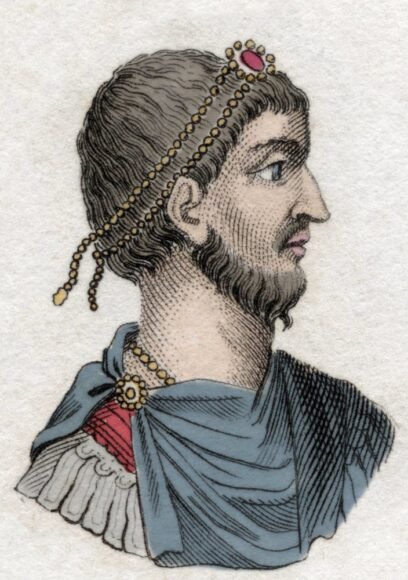
In the 4th century, Roman emperors included Flavius Claudius Julianus, famously known as Julian the Apostate, a figure of great controversy and complexity. For Christians, he is the ruler who turned away from his upbringing’s faith and made a last significant effort to revive old pagan traditions. Others see him as a well-educated philosopher, a competent military strategist, and a humble emperor opposing the decadence prevalent in late Roman society. His brief rule epitomizes the conflict between the waning ancient religion and ascendant Christianity, now a dominant force in the empire.
Julian, born in 331 or 332 in Constantinople, was part of Constantine the Great’s dynasty. His father, Julius Constantius, was Constantine’s half-brother, placing Julian close to power, but also in constant danger. After Constantine’s death in 337, many imperial family men were eliminated to secure his sons’ rule, including Julian’s father. Only Julian and his brother Constantius Gallus survived this bloodbath.
This family tragedy deeply affected Julian, raised as a Christian yet possibly never forgetting that those who destroyed his family also claimed to defend Christianity. His early years were spent under watchful eyes, kept from political life due to Emperor Constantius II’s fear of rivals.
Julian turned to education, studying in Nicomedia, Pergamum, Ephesus, and Athens, becoming one of late antiquity’s most learned rulers. He delved into Homer, Plato, Aristotle, and Neoplatonic philosophy, particularly influenced by those who viewed paganism as a comprehensive belief system.
In Athens, he encountered the environment of future Christian theologians Basil the Great and Gregory the Theologian. Julian and Basil, though not necessarily friends, were part of the same learned circle familiar with classical traditions. Gregory later criticized Julian, having observed him as a student. Athens thus became the meeting ground for Julian, the eventual pagan defender, and the future Christian leaders.
Gradually renouncing Christianity, Julian covertly embraced the pagan mysteries, believing ancient gods could restore Rome’s spiritual might, with Hellenistic culture and divine worship intertwined. His title “Apostate” symbolized a rejection of the post-Constantine empire’s direction, beyond a mere personal faith change.
Julian’s rise was unexpected. After Gallus’ execution, Constantius II lacked trustworthy relatives to oversee the expansive empire and named Julian Caesar in 355 at Mediolanum (modern Milan), as a junior ruler under him. Julian married Helena, the emperor’s sister, tying him closer to the dynasty. Dispatched to Gaul amid turmoil, Julian, known as a philosopher, proved an adept military leader. Restoring discipline and provisions, he actively led campaigns, notably defeating the Alemanni at Argentoratum (now Strasbourg) in 357, followed by operations across the Rhine, reestablishing forts and freeing captives.
Julian’s military victories endeared him to soldiers. When Constantius II redirected Gallic units eastward to confront Persia, they rebelled, declaring Julian Augustus in Lutetia (present-day Paris) in 360. This began preparations for civil war, though Constantius’s 361 death left Julian sole emperor, free to reinstate pagan practices, opening temples, reestablishing priestly privileges, and reviving sacrifices. Although he didn’t initiate widespread Christian persecutions, he anticipated internal church rifts by allowing exiled bishops’ return, reflecting his anti-Christian stance.
A notable edict barred Christian teachers from classical literature instruction, asserting that non-believers in ancient gods lacked credibility to interpret Homer and other pagan writers. Julian also encouraged rebuilding the Jerusalem Temple, likely to contest Christian claims about its prophesied destruction, but this project was never completed.
Understanding that rejuvenating paganism required more than rituals, Julian aimed to remodel it akin to Christianity, demanding priestly morality, poor relief, and public duty—paradoxically mirroring the church’s organizational and charitable frameworks.
Julian’s ascetic lifestyle sharply contrasted with typical imperial luxury. Preferring modest meals, minimal sleep, and focusing on intellectual and administrative pursuits, he scorned opulent attire and ceremonies. After his wife Helena’s death, he remained single, avoiding courtly excess or romantic scandals. Though mocked by some, even adversaries acknowledged his discipline and simplicity.
Julian’s grand military campaign was his 363 expedition against Sassanid Persia, where he led substantial forces deep into enemy lands, reaching Ctesiphon and achieving a nearby victory but failing to seize the city. Opting to advance, Julian burned a portion of his fleet, a dire miscalculation as Persians evaded pitched battles, devastated resources, and disrupted Roman supplies. During the withdrawal, Julian suffered a fatal spear wound in combat on June 26, 363, at thirty-one. While a Persian is commonly credited, rumors suggested a Christian










Leave a Reply