


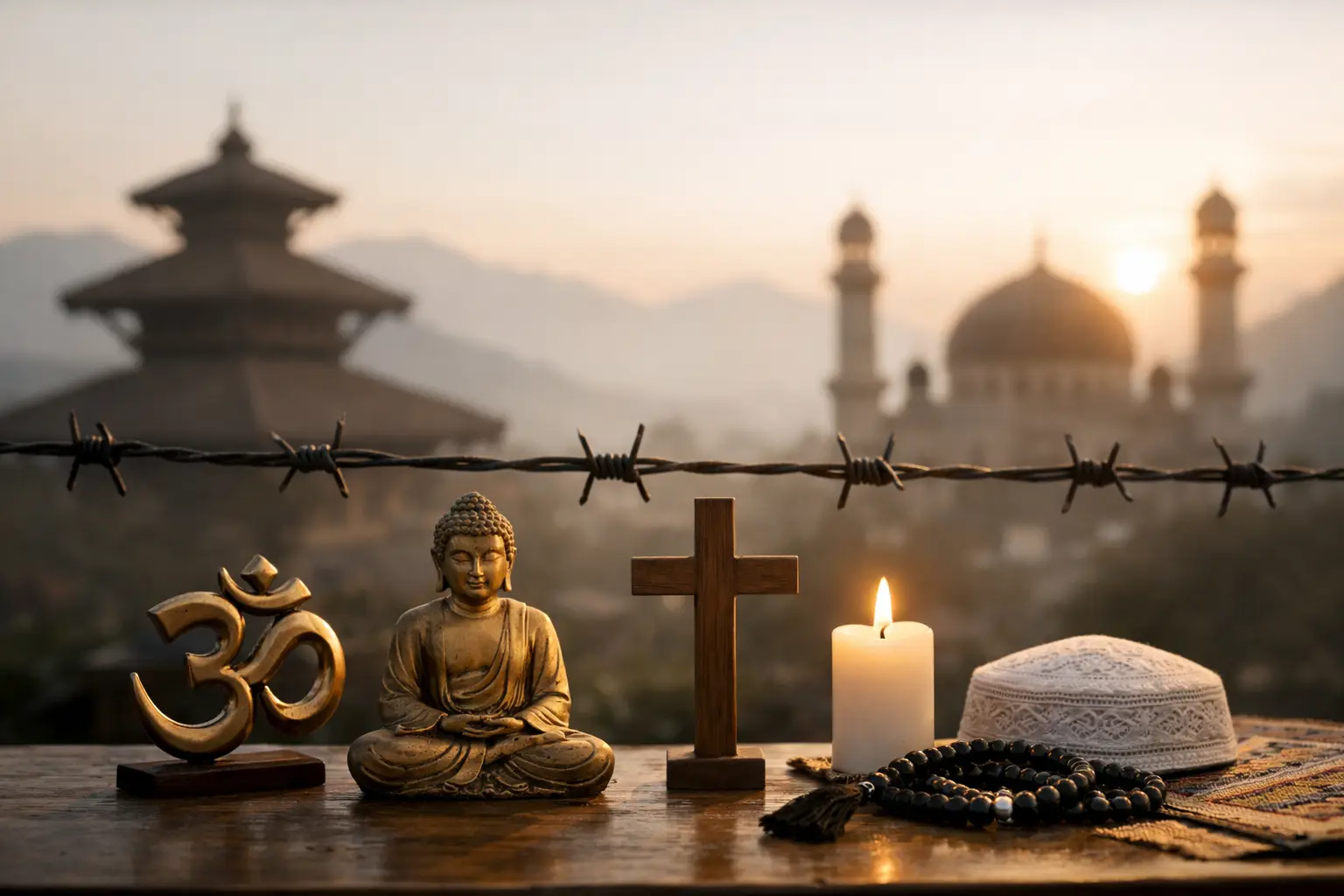
A constitution may guarantee liberty on paper while leaving believers, dissidents, and minorities vulnerable in practice. This is the core issue of religious freedom in South Asia, where democratic desires, majoritarian politics, state insecurity, and identity-driven mobilization often intersect.
For Europeans, this isn’t a far-off issue. South Asia is crucial to international human-rights diplomacy, asylum policy, development partnerships, trade relations, and the defense of religious freedom as a universal right. The region also sees formal guarantees alongside blasphemy laws, anti-conversion rules, surveillance, communal violence, and unequal citizenship.
Importance of Religious Freedom in South Asia
South Asia hosts vast religious diversity. Islam, Hinduism, Buddhism, Christianity, Sikhism, Jainism, and various local traditions shape public life in India, Pakistan, Bangladesh, Sri Lanka, Nepal, Bhutan, the Maldives, and Afghanistan. This pluralism should showcase equal rights but often reveals their fragility when intertwined with nation-building.
The challenge is not just about worship. Religious freedom includes changing religion, having no religion, public expression of beliefs, educating children according to convictions, peaceful gatherings, and protection from coercion. In South Asia, all these freedoms face challenges.
Narrow views miss the point. The key question is whether states treat religion as a liberty to protect or a loyalty to enforce. Once the latter takes hold, not only minorities but also journalists, academics, human-rights defenders, and dissenting majority members are at risk.
Regional Pattern: Guaranteed vs. Restricted Rights
There is no single South Asian model. Legal systems, political traditions, and religious demographics vary. Yet, a regional pattern is recognizable.
Constitutions and official statements often affirm tolerance, equality, or religious freedom. However, these are undermined by legislation, selective enforcement, and impunity for private actors. Some states impose penalties linked to belief or religious expression, while others allow social intimidation, mob pressure, or discriminatory administration to prevail.
This results in a layered repression. Individuals may not be banned from practicing religion but can face obstacles like being prevented from building places of worship, denied registration, threatened for converting, accused of insulting religion, or attacked with authorities turning a blind eye. On a constitutional level, the situation may seem better than reality.
India: Scale, Polarization, and Legal Ambiguity
India’s constitutional framework promises pluralism, yet the practical environment is more contested. Anti-conversion laws in several states, often about forced or fraudulent conversions, are criticized for enabling harassment of Christians, Muslims, and interfaith couples. Such laws, intended to protect consent, can presume coercion where unproven.
The issue is not only legislation. Vigilante violence, inflammatory political speech, and communal narratives online heighten minority pressure. Demolitions, arrests, and local restrictions suggest that citizenship is graded by identity. The legal process becomes part of the punishment before any conviction.
This doesn’t render India’s institutions irrelevant. Courts, civil society, independent journalists, and rights advocates remain significant. But their presence doesn’t diminish the seriousness of the trend. A democracy can maintain elections and constitutional language while equal freedom erodes in everyday life.
Pakistan: Blasphemy Accusations and Structural Fear
Pakistan poses a significant challenge. Blasphemy laws are visible threats to religious freedom, especially for Ahmadis, Christians, Hindus, Shia Muslims, and those accused of disrespecting Islam. Fear stems from accusations themselves, triggering mob violence, displacement, killings, and social exclusion, even with weak or absent evidence.
Ahmadis face state-backed exclusion as laws restrict their religious self-identification and practice. This isn’t mere social prejudice; it’s a legal framework narrowing equal belonging.
Pakistan’s authorities sometimes denounce mob violence, but without consistent accountability, this has limited effect. When police fail to protect the accused and courts operate under pressure, the rule of law is visibly compromised.
Bangladesh and Sri Lanka: Vulnerability Beyond Headlines
Bangladesh is often seen through secular nationalism, yet religious minorities and secular voices face serious threats. Hindus, Buddhists, Christians, and indigenous communities report intimidation or violence. State responses vary, and commitments to pluralism haven’t always resulted in lasting protection.
Sri Lanka struggles with civil war legacy, ethno-religious nationalism, and uneven accountability. Muslims and Christians have faced hostility, and Buddhist majoritarian rhetoric has influenced the political climate. The issue isn’t reducible to a single law or incident; it’s about consistent state action against incitement and equal community protection.
Afghanistan: Coercion’s Hardest Edge
Under Taliban rule, Afghanistan represents the region’s starkest spectrum end. Religious freedom is severely repressed, particularly for non-Muslims, converts, dissenters, and women, whose rights are restricted by a broader theocratic order. Public religious freedom is inseparable from other civic liberties’ collapse.
This matters in discussions of South Asia as a whole.









Leave a Reply