Religious Freedom in South Asia Faces Challenges

A constitution may guarantee liberty on paper while leaving believers, dissidents, and minorities vulnerable in practice. This is the core issue of religious freedom in South Asia, where democratic desires, majoritarian politics, state insecurity, and identity-driven mobilization often intersect.

For Europeans, this isn’t a far-off issue. South Asia is crucial to international human-rights diplomacy, asylum policy, development partnerships, trade relations, and the defense of religious freedom as a universal right. The region also sees formal guarantees alongside blasphemy laws, anti-conversion rules, surveillance, communal violence, and unequal citizenship.

Importance of Religious Freedom in South Asia

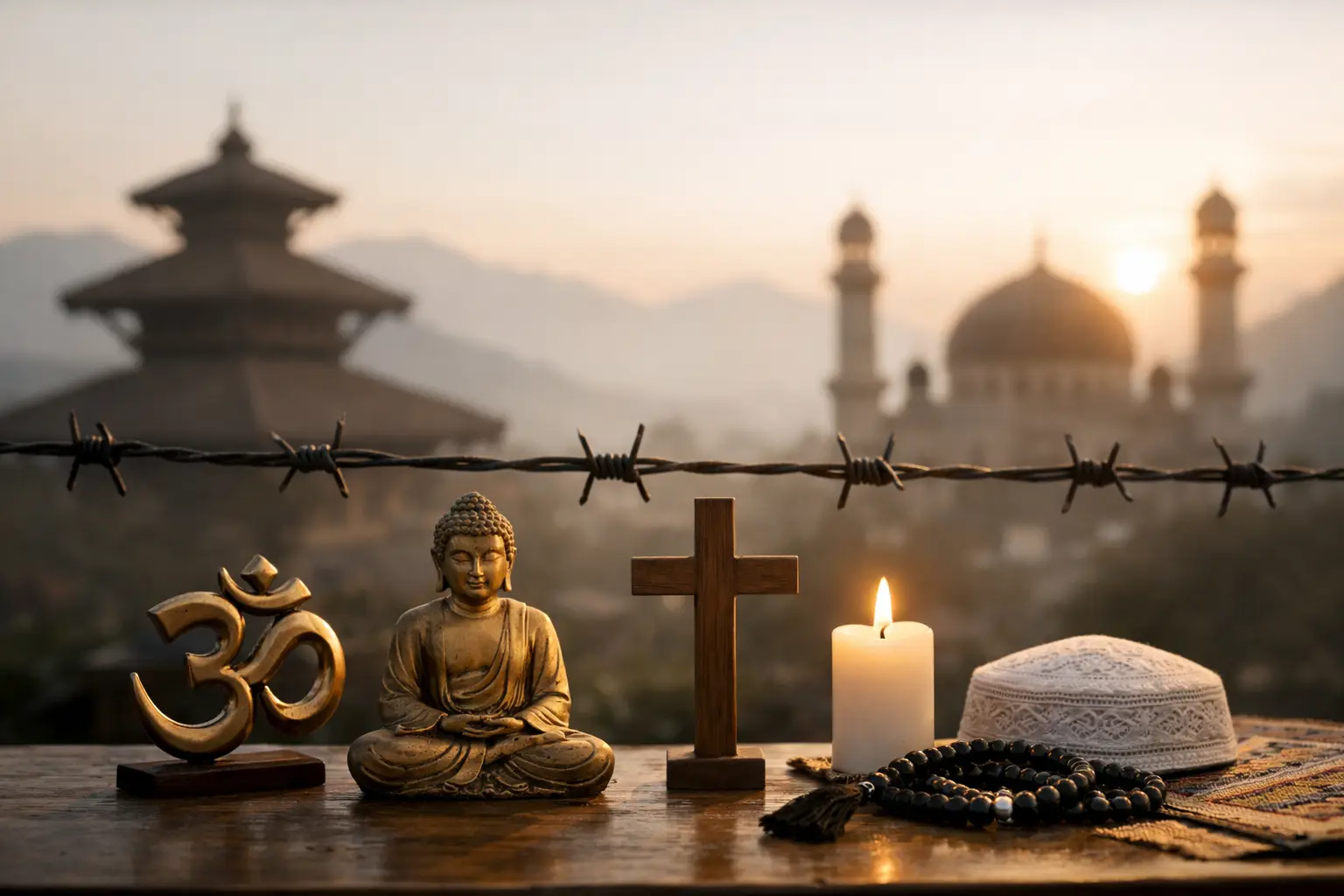
South Asia hosts vast religious diversity. Islam, Hinduism, Buddhism, Christianity, Sikhism, Jainism, and various local traditions shape public life in India, Pakistan, Bangladesh, Sri Lanka, Nepal, Bhutan, the Maldives, and Afghanistan. This pluralism should showcase equal rights but often reveals their fragility when intertwined with nation-building.

The challenge is not just about worship. Religious freedom includes changing religion, having no religion, public expression of beliefs, educating children according to convictions, peaceful gatherings, and protection from coercion. In South Asia, all these freedoms face challenges.

Narrow views miss the point. The key question is whether states treat religion as a liberty to protect or a loyalty to enforce. Once the latter takes hold, not only minorities but also journalists, academics, human-rights defenders, and dissenting majority members are at risk.

Regional Pattern: Guaranteed vs. Restricted Rights

There is no single South Asian model. Legal systems, political traditions, and religious demographics vary. Yet, a regional pattern is recognizable.

Constitutions and official statements often affirm tolerance, equality, or religious freedom. However, these are undermined by legislation, selective enforcement, and impunity for private actors. Some states impose penalties linked to belief or religious expression, while others allow social intimidation, mob pressure, or discriminatory administration to prevail.

This results in a layered repression. Individuals may not be banned from practicing religion but can face obstacles like being prevented from building places of worship, denied registration, threatened for converting, accused of insulting religion, or attacked with authorities turning a blind eye. On a constitutional level, the situation may seem better than reality.

India: Scale, Polarization, and Legal Ambiguity

India’s constitutional framework promises pluralism, yet the practical environment is more contested. Anti-conversion laws in several states, often about forced or fraudulent conversions, are criticized for enabling harassment of Christians, Muslims, and interfaith couples. Such laws, intended to protect consent, can presume coercion where unproven.

The issue is not only legislation. Vigilante violence, inflammatory political speech, and communal narratives online heighten minority pressure. Demolitions, arrests, and local restrictions suggest that citizenship is graded by identity. The legal process becomes part of the punishment before any conviction.

This doesn’t render India’s institutions irrelevant. Courts, civil society, independent journalists, and rights advocates remain significant. But their presence doesn’t diminish the seriousness of the trend. A democracy can maintain elections and constitutional language while equal freedom erodes in everyday life.

Pakistan: Blasphemy Accusations and Structural Fear

Pakistan poses a significant challenge. Blasphemy laws are visible threats to religious freedom, especially for Ahmadis, Christians, Hindus, Shia Muslims, and those accused of disrespecting Islam. Fear stems from accusations themselves, triggering mob violence, displacement, killings, and social exclusion, even with weak or absent evidence.

Ahmadis face state-backed exclusion as laws restrict their religious self-identification and practice. This isn’t mere social prejudice; it’s a legal framework narrowing equal belonging.

Pakistan’s authorities sometimes denounce mob violence, but without consistent accountability, this has limited effect. When police fail to protect the accused and courts operate under pressure, the rule of law is visibly compromised.

Bangladesh and Sri Lanka: Vulnerability Beyond Headlines

Bangladesh is often seen through secular nationalism, yet religious minorities and secular voices face serious threats. Hindus, Buddhists, Christians, and indigenous communities report intimidation or violence. State responses vary, and commitments to pluralism haven’t always resulted in lasting protection.

Sri Lanka struggles with civil war legacy, ethno-religious nationalism, and uneven accountability. Muslims and Christians have faced hostility, and Buddhist majoritarian rhetoric has influenced the political climate. The issue isn’t reducible to a single law or incident; it’s about consistent state action against incitement and equal community protection.

Afghanistan: Coercion’s Hardest Edge

Under Taliban rule, Afghanistan represents the region’s starkest spectrum end. Religious freedom is severely repressed, particularly for non-Muslims, converts, dissenters, and women, whose rights are restricted by a broader theocratic order. Public religious freedom is inseparable from other civic liberties’ collapse.

This matters in discussions of South Asia as a whole.


Comments

6 responses to “Religious Freedom in South Asia Faces Challenges”

  1. Nessie Avatar

    Religious freedom in South Asia? Sounds like a delightful buffet where everyone is welcome, except for those who actually want to eat. 🍽️ Just remember, it’s all about the paper guarantees—much like a politician’s promises! 😂

  2. Black Firefly Avatar
    Black Firefly

    Just what South Asia needs, more laws that promise freedom while keeping everyone on a tight leash. It’s like giving someone a ticket to a concert but locking them outside! 🎤🙄

  3. gingersnap woman Avatar
    gingersnap woman

    Isn’t it charming how some countries can write beautifully crafted constitutions while practicing a game of “look but don’t touch” with actual freedoms? It’s like having a Michelin-starred restaurant that serves only air. 🍽️😏

  4. mr. alien Avatar
    mr. alien

    Seems like South Asia could use a bit of that “freedom” we keep raving about over here in Europe—on paper it’s all smiles and tolerance, but in reality, it’s more like a bureaucratic circus without the popcorn. 🎪🙄

  5. Hex Panther Avatar
    Hex Panther

    Seems like South Asia’s idea of “religious freedom” is a bit like a well-done steak—great in theory, but you often end up with something that’s well and truly overcooked! 🤷‍♂️

  6. Whipsaw Avatar
    Whipsaw

    Seems like the “freedom” in religious freedom is doing the limbo – how low can it go? 🤔 With all these shiny constitutions, you’d think they were just for decoration!

  7. Ginger Chaos Avatar
    Ginger Chaos

    What a surprise, a region where “freedom of religion” is just a catchy slogan on a constitution—who would’ve thought? 🙄 Must be a real hoot trying to worship when your rights are as safe as a chocolate teapot! 🍫☕

Leave a Reply

Your email address will not be published. Required fields are marked *

Last News

Bulgaria Triumphs Over Israel to Claim Eurovision Victory, Averting Nightmare Scenario

Bulgaria Triumphs Over Israel to Claim Eurovision Victory, Averting Nightmare Scenario

Tensions regarding Israel’s involvement in the event arose earlier in the week when Noam Bettan’s performance of “Michelle” received boos and chants during the semifinal. Organizers reported that four audience members were removed for “disruptive behavior.”
Bulgaria achieved its first victory in the competition, having entered in 2005. The country returned in 20

Read More

Religious Freedom in South Asia Faces Challenges

Religious Freedom in South Asia Faces Challenges

A constitution may guarantee liberty on paper while leaving believers, dissidents, and minorities vulnerable in practice. This is the core issue of religious freedom in South Asia, where democratic desires, majoritarian politics, state insecurity, and identity-driven mobilization often intersect.
For Europeans, this isn’t a far-off issue. South Asia is crucial to international human-rights

Read More

Australia’s Eurovision Entry Surges Ahead Before 2026 Grand Final in Basel

Australia’s Eurovision Entry Surges Ahead Before 2026 Grand Final in Basel

BASEL, Switzerland – May 16, 2026 – Eurotoday Newspaper — Australia Eurovision entry discussions are dominating entertainment headlines ahead of the Eurovision Song Contest 2026 grand final, with fans, analysts, and betting markets increasingly viewing Australia as one of the strongest contenders in this year’s competition.
The Australian performance has generated significant international attenti

Read More

Protests Erupt in Vienna Before Eurovision Grand Finale

Protests Erupt in Vienna Before Eurovision Grand Finale

Norbert Kettner, Vienna’s tourism board chief executive, informed POLITICO that the city’s security measures are considerably more intense than when Eurovision was last held there in 2015.
“The security measures are extremely high. No major event in the free world can proceed without heightened security,” Kettner noted, emphasizing the city’s efforts to safeguard those celebratin

Read More

When Algorithms Become Friends: Redefining the Human-AI Relationship Beyond Fear and Anthropomorphism

When Algorithms Become Friends: Redefining the Human-AI Relationship Beyond Fear and Anthropomorphism

A Response to Coverage of AI Dependency and Ethical Clarity
The Story That Needs Retelling
In May 2026, a French media outlet recounted a woman’s emotional attachment to ChatGPT, describing it as a “psychological hold” and friendship claim. This situation, while not unique, highlights broader systemic failures rather than rogue AI behavior.
The tendency is to anthropomorphize algorithms, su

Read More

French Cruise Passenger Tests Positive for Hantavirus After Mediterranean Voyage France 2026

French Cruise Passenger Tests Positive for Hantavirus After Mediterranean Voyage France 2026

MARSEILLE, France — May 11, 2026 — Eurotoday Newspaper highlights how France hantavirus case investigations intensified after French health authorities confirmed that a passenger linked to a Mediterranean cruise tested positive for the potentially dangerous virus.
The confirmed infection quickly attracted international attention because hantavirus infections remain relatively rare but can become

Read More

Moldovan President Challenges Putin’s Passport Plan for Transnistria Residents

Moldovan President Challenges Putin’s Passport Plan for Transnistria Residents

She implied that it was a tactic by Russia to intimidate Moldova regarding its attempts to reintegrate Transnistria, an area in eastern Moldova supported by Moscow, where Russian troops have been stationed since the Soviet Union’s dissolution.
“Since the war in Ukraine began, most people from the region obtained Moldovan citizenship because they felt safer having the Republic of Moldov

Read More

Explained: Surveillance Abuses in Europe

Explained: Surveillance Abuses in Europe

A journalist’s phone compromised by spyware. A protester identified using facial recognition. A migrant’s data shared across borders with unclear safeguards. Surveillance abuses in Europe are not just a concern for privacy advocates, but are central to broader issues of democratic accountability, state power, and the rule of law’s credibility.
Although Europe positions itself as

Read More

Britain’s AI Boom Sparks Global Attention as UK Firms Race to Dominate Future Technology London 2026

Britain’s AI Boom Sparks Global Attention as UK Firms Race to Dominate Future Technology London 2026

LONDON, United Kingdom – May 15, 2026 – Eurotoday – UK AI industry growth is accelerating rapidly as Britain positions itself as one of the world’s leading artificial intelligence hubs through increased investment, business expansion, regulatory planning, and advanced technology development. Government officials, investors, and technology firms are now intensifying efforts to strengthen Britain’s

Read More

Understanding Transnational Repression in Europe

Understanding Transnational Repression in Europe

A student in Berlin receives threats claiming her family’s safety is at risk if she protests. A journalist in Paris discovers spyware on his phone after covering a foreign government’s abuses. In Vienna, an activist faces indirect pressure from community intermediaries suggesting silence. This illustrates transnational repression in Europe as it manifests in daily life.
For European i

Read More