


Remembering the 2004 Indian Ocean Tsunami: Lessons Learned and a Call for Action
On December 26, 2004, the world faced one of its most devastating natural disasters. A 9.1-magnitude earthquake struck off the coast of Indonesia, triggering a colossal tsunami that swept across the Indian Ocean.
Catastrophic Impact Across the Region
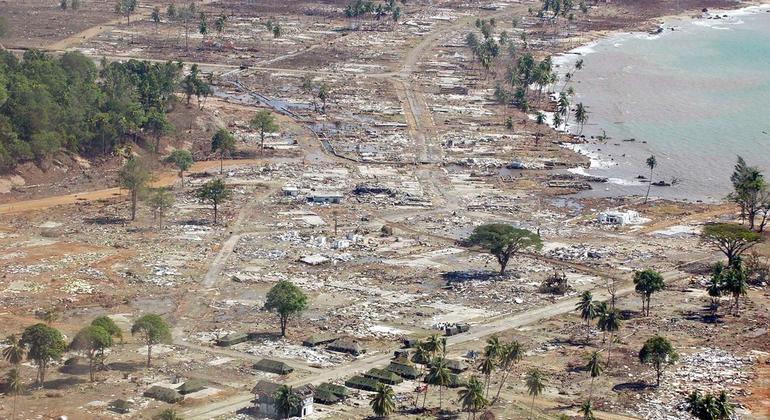
In Indonesia’s Aceh province, towering waves up to 51 meters (167 feet) high inundated communities, with flooding extending as far as five kilometers (three miles) inland. The tsunami’s destructive force reached far beyond Indonesia, affecting Thailand, Sri Lanka, Maldives, and India. Traveling at speeds of 800 kilometers per hour (500 miles per hour), tsunami waves also struck Somalia and Tanzania, and were detected as far as Mexico, Chile, and even the Arctic.
The human and economic toll was staggering. Over 230,000 lives were lost, more than 1.7 million people were displaced, and the economic damage was estimated at $10 billion. Children were among the most affected, with thousands left dead or orphaned.
A Wake-Up Call for Humanity
Philémon Yang, President of the United Nations General Assembly at the time, called the tsunami “the first global disaster of the 21st century and one of the most devastating in recent history.” He urged governments worldwide to prioritize disaster preparedness and resilience as part of sustainable development strategies to safeguard future generations.
Kamal Kishore, the United Nations Special Representative for Disaster Risk Reduction, echoed this sentiment. “This disaster was a wake-up call for humanity,” he said. “It showed us how low-frequency, high-impact hazards can generate ripple effects across the global system and multiple geographies.”
Progress Through Global Cooperation
The 2004 disaster inspired an unprecedented wave of global collaboration in disaster management. Armida Salsiah Alisjahbana, Executive Secretary of the UN Economic and Social Commission for Asia and the Pacific (ESCAP), emphasized the critical importance of transboundary solutions for transboundary problems.
In 2005, the global community came together under UNESCO’s Intergovernmental Oceanographic Commission (IOC-UNESCO) to establish the Indian Ocean Tsunami Warning and Mitigation System (IOTWMS). Today, 27 national tsunami warning centers can issue alerts within minutes of seismic activity, a significant improvement from 2004. Over 75% of coastal communities in high-risk areas now have access to tsunami early warning information, compared to just 25% two decades ago.
The UN’s “Tsunami Ready Programme” and “Tsunami Project” have empowered local communities with critical knowledge and resources, while ESCAP’s Multi-Donor Trust Fund continues to enhance early warning systems across vulnerable regions.
The Growing Challenge of Climate Change
Despite these strides, the challenges of disaster risk management have become more complex. Climate change is amplifying the frequency and intensity of water-related disasters, often in conjunction with geophysical events like earthquakes and volcanic eruptions.
ESCAP’s estimates reveal that 68 million people across 43 countries in the Asia-Pacific region remain at risk, along with $2.3 trillion in coastal infrastructure. In the Indian Ocean basin alone, critical facilities, including over 2,600 schools, 1,200 ports, and 140 power plants, remain vulnerable to future tsunamis.
A Call to Action: Do More, Stay Prepared
Kamal Kishore highlighted the importance of maintaining awareness and preparation for tsunami risks. “We must not forget the 2004 Indian Ocean tsunami,” he stressed. “It is crucial that we protect ourselves, our children, and future generations from the impacts of future tsunamis.”
As the world commemorates the anniversary of the 2004 catastrophe, it serves as a sobering reminder of nature’s power and the urgent need for international collaboration. Continued investment in disaster preparedness, advanced warning systems, and community resilience remains essential in safeguarding lives and livelihoods.
Survivors Remember the Tragedy
The memories of that fateful day remain vivid for survivors, who recall the unimaginable devastation and loss. Their stories of resilience and recovery serve as powerful reminders of humanity’s strength in the face of adversity, as well as the importance of learning from past disasters to protect future generations.









Leave a Reply