“Commemorating the Indian Ocean Tsunami: A Call to Protect Future Generations”

Remembering the 2004 Indian Ocean Tsunami: Lessons Learned and a Call for Action

On December 26, 2004, the world faced one of its most devastating natural disasters. A 9.1-magnitude earthquake struck off the coast of Indonesia, triggering a colossal tsunami that swept across the Indian Ocean.

Catastrophic Impact Across the Region

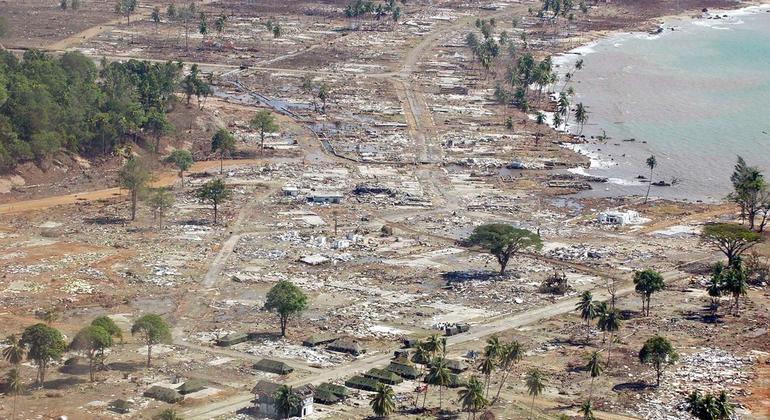
In Indonesia’s Aceh province, towering waves up to 51 meters (167 feet) high inundated communities, with flooding extending as far as five kilometers (three miles) inland. The tsunami’s destructive force reached far beyond Indonesia, affecting Thailand, Sri Lanka, Maldives, and India. Traveling at speeds of 800 kilometers per hour (500 miles per hour), tsunami waves also struck Somalia and Tanzania, and were detected as far as Mexico, Chile, and even the Arctic.

The human and economic toll was staggering. Over 230,000 lives were lost, more than 1.7 million people were displaced, and the economic damage was estimated at $10 billion. Children were among the most affected, with thousands left dead or orphaned.

A Wake-Up Call for Humanity

Philémon Yang, President of the United Nations General Assembly at the time, called the tsunami “the first global disaster of the 21st century and one of the most devastating in recent history.” He urged governments worldwide to prioritize disaster preparedness and resilience as part of sustainable development strategies to safeguard future generations.

Kamal Kishore, the United Nations Special Representative for Disaster Risk Reduction, echoed this sentiment. “This disaster was a wake-up call for humanity,” he said. “It showed us how low-frequency, high-impact hazards can generate ripple effects across the global system and multiple geographies.”

Progress Through Global Cooperation

The 2004 disaster inspired an unprecedented wave of global collaboration in disaster management. Armida Salsiah Alisjahbana, Executive Secretary of the UN Economic and Social Commission for Asia and the Pacific (ESCAP), emphasized the critical importance of transboundary solutions for transboundary problems.

In 2005, the global community came together under UNESCO’s Intergovernmental Oceanographic Commission (IOC-UNESCO) to establish the Indian Ocean Tsunami Warning and Mitigation System (IOTWMS). Today, 27 national tsunami warning centers can issue alerts within minutes of seismic activity, a significant improvement from 2004. Over 75% of coastal communities in high-risk areas now have access to tsunami early warning information, compared to just 25% two decades ago.

The UN’s “Tsunami Ready Programme” and “Tsunami Project” have empowered local communities with critical knowledge and resources, while ESCAP’s Multi-Donor Trust Fund continues to enhance early warning systems across vulnerable regions.

The Growing Challenge of Climate Change

Despite these strides, the challenges of disaster risk management have become more complex. Climate change is amplifying the frequency and intensity of water-related disasters, often in conjunction with geophysical events like earthquakes and volcanic eruptions.

ESCAP’s estimates reveal that 68 million people across 43 countries in the Asia-Pacific region remain at risk, along with $2.3 trillion in coastal infrastructure. In the Indian Ocean basin alone, critical facilities, including over 2,600 schools, 1,200 ports, and 140 power plants, remain vulnerable to future tsunamis.

A Call to Action: Do More, Stay Prepared

Kamal Kishore highlighted the importance of maintaining awareness and preparation for tsunami risks. “We must not forget the 2004 Indian Ocean tsunami,” he stressed. “It is crucial that we protect ourselves, our children, and future generations from the impacts of future tsunamis.”

As the world commemorates the anniversary of the 2004 catastrophe, it serves as a sobering reminder of nature’s power and the urgent need for international collaboration. Continued investment in disaster preparedness, advanced warning systems, and community resilience remains essential in safeguarding lives and livelihoods.

Survivors Remember the Tragedy

The memories of that fateful day remain vivid for survivors, who recall the unimaginable devastation and loss. Their stories of resilience and recovery serve as powerful reminders of humanity’s strength in the face of adversity, as well as the importance of learning from past disasters to protect future generations.



Comments

Leave a Reply

Your email address will not be published. Required fields are marked *

Last News

Burnham Launches Battle Against ‘Cover-Up Culture’

Burnham Launches Battle Against ‘Cover-Up Culture’

With parliament breaking for the summer recess on Thursday, this will probably be Burnham’s sole intervention from the backbenches of the House of Commons.
The Public Office (Accountability) Bill, also known as the Hillsborough law, is named after the 1989 tragedy at the Sheffield stadium where 97 Liverpool fans lost their lives in a crush.
The proposed legislation requires public bodies to be tru

Read More

The Day the European Parliament Yielded to Far-Right Pressure, Setting a Concerning Precedent

The Day the European Parliament Yielded to Far-Right Pressure, Setting a Concerning Precedent

Eurotoday is a daily online newspaper based in Belgium. BM publishes unique and independent coverage on international and European affairs. With a Europe-wide perspective, BM covers policies and politics of the EU, significant Member State developments, and looks at the international agenda with a European perspective.

Read More

Noskova Brings Wimbledon Victory to Czech Republic

Noskova Brings Wimbledon Victory to Czech Republic

Linda Noskova’s victory at Wimbledon marks a significant achievement for Czech women’s tennis as she secured her first Grand Slam title by defeating Karolina Muchova 6-2, 5-7, 6-3 in an all-Czech singles final.
Written by Daniel Mercer, Sports Correspondent, The European Times
Although Wimbledon often highlights champions as solitary figures, Noskova’s win represents a triumph f

Read More

Peers told to attend House of Lords more often — or get fired

Peers told to attend House of Lords more often — or get fired

Hereditary peers, who have membership in the UK’s House of Lords by birthright, were removed from parliament earlier this year through legislation introduced by Keir Starmer.
The implementation of this limited change took over 18 months, and Starmer did not secure agreement on additional reforms to reduce the House’s size, which were part of his Labour Party’s election-winning 2024 man

Read More

Business Press Releases Foster Trust and Enhance Google Visibility

Business Press Releases Foster Trust and Enhance Google Visibility

London, July 13 Eurotoday Newspaper –  Business press releases are becoming a key part of corporate communication strategies as companies seek stronger online visibility and greater public trust. Public relations professionals report that businesses publishing timely, factual announcements are more likely to attract media attention while supporting their long-term presence in Google Search and G

Read More

Brussels Considers Online Child Safety

Brussels Considers Online Child Safety

Expert recommendations prioritize privacy, platform design, and young people’s wellbeing in Europe’s upcoming digital discussion
Today, the European Commission’s child-safety-online panel presents its recommendations to Ursula von der Leyen, steering the European debate from general concerns about young people’s screen time to specific policy decisions regarding social media, age assurance, and

Read More

Blair Advises Burnham: Popularity May Not Follow

Blair Advises Burnham: Popularity May Not Follow

Sir Keir Starmer’s farewell tour is in full swing, but will most of it take place outside the UK?
With additional time in Paris for Bastille Day celebrations and a potential trip to the World Cup final in the US, Starmer is concluding his tenure on the global stage – perhaps his comfort zone.
In Westminster, prime minister-in-waiting Andy Burnham intensifies government preparation, promisin

Read More

Mylan Intends to Divest Up to $363 Million Stake in India’s Biocon

Mylan Intends to Divest Up to $363 Million Stake in India’s Biocon

Bengaluru, July 13 Brussels Morning Newspaper –  Mylan Biocon stake sale has moved into focus after a term sheet showed Mylan plans to sell shares worth up to $363 million in Indian biopharmaceutical company Biocon. The proposed transaction is expected to take place through a block deal, allowing institutional investors to purchase a significant portion of the company’s publicly traded shares.
M

Read More

A ‘Super Tuesday’ for an Expanded EU

A ‘Super Tuesday’ for an Expanded EU

Ireland is prioritizing enlargement during its presidency of the EU Council, actively advancing accession discussions. Today, alongside the EU’s General Affairs Council, four separate accession conferences will be held for Ukraine, Moldova, Albania, and Montenegro, marking significant progress in their membership pursuits. Ireland’s Europe Minister Thomas Byrne noted this is the highest number of

Read More

Brazil’s Economy Forecast Predicts Moderate Growth After October Presidential Election

Brazil’s Economy Forecast Predicts Moderate Growth After October Presidential Election

São Paulo, July 13 Eurotoday Newspaper –  Brazil economy forecast remains positive as economists expect the country’s economy to grow at a moderate pace following the October presidential election. Analysts believe stable domestic demand, improving investment conditions and easing inflation could support continued economic expansion, although fiscal policy and global market uncertainty remain ke

Read More