


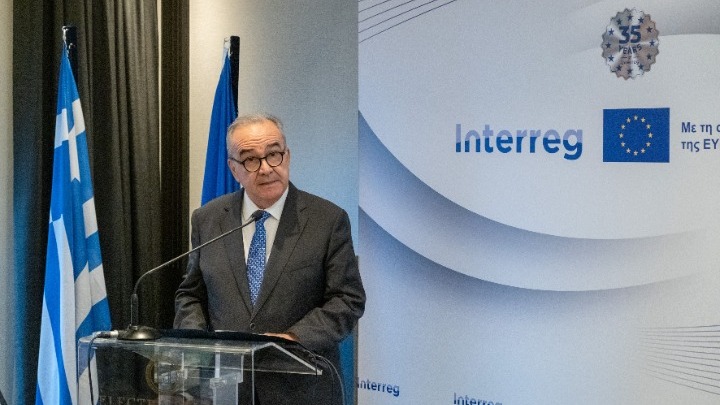
The planning for the Interreg program’s new programming period from 2028 to 2034 has commenced, with the European Commission proposing a resource allocation of 10 billion euros for Interreg initiatives. This was highlighted by the Deputy Minister of National Economy and Finance, Nikos Papathanasis, during an event celebrating the program’s 35th anniversary and its 20 years in Thessaloniki, focusing on the importance of cooperation for European and Regional Cohesion. He asserted, “Greece can and must take a more leading role and serve as a gateway for collaboration between the EU, the Balkans, and the Mediterranean.”
He remarked that “Europe has shown great solidarity in addressing the major issues faced by member states and neighboring countries, and the unity of peoples continues along this path,” emphasizing that “a stable pillar is the European perspective of peace and solidarity among peoples.”
The Deputy Minister characterized Interreg as a vital program for the region and a mechanism for building trust and stability. He noted that Greece is actively involved in all Interreg programs related to Southeast Europe, the Mediterranean, and the Adriatic and Ionian region, managing five programs with Bulgaria, Italy, North Macedonia, Cyprus, and Albania, in addition to participating in eight interregional cooperation programs. “Over 2,500 actions have been implemented in Greece benefitting neighboring countries and making significant contributions to local communities and economies. Presently, within the scope of the five programs, over 70% of resources have been activated, involving 105 projects with a total budget of 240 million euros,” he highlighted. An example provided was the border crossing of Prespa, Laimos, and Markova Noga from the Greece – North Macedonia program.
Interreg received three out of six regional awards
European Commission official Maria Galefska noted the European Commission’s collaboration with Greek national, regional, and local authorities, calling Greece a leader in the European strategy for the Adriatic and Ionian region, and underscoring her presence at the event to affirm the cooperation among Greek entities.
She mentioned the annual RegioStars Awards, likened to the Oscars for this sector, which took place last week in Brussels. Out of 25 finalists chosen by an independent committee, ten projects were from Interreg, and ultimately, Interreg secured three out of six awards. “Interreg accounted for only 3% of the total cohesion policy budget, yet we achieved 50% of the awards,” she remarked.
Furthermore, she discussed two Greek Interreg projects: the rewater project from Interreg Greece – Italy, focused on natural resource protection, which was a finalist, and the BalkanRoad from the Interreg Balkan Med program, whose projects were also finalists. “These Greek projects enhance excellence by promoting European values of democracy, cooperation, and equality, fundamental characteristics of Interreg,” she added.
The General Secretary of the Regional Development Partnership Agreement (ESPA), Vasiliki Pantelopoulou, highlighted that Greece participates in 13 Interreg programs, with five under Greek management. Hundreds of projects have been completed through these programs. From 2014 to 2020, more than 3,000 institutions, municipalities, entities, and businesses collaborated, investing over 600 million euros in joint actions. For the current 2021-2027 period, the budget exceeds 300 million euros, with 80% of available resources activated for projects aligned with major European priorities such as green and digital transitions, resilience to crises, and enhanced social cohesion.
Deputy Minister of Interior (Macedonia – Thrace sector) Kostas Gioulekas expressed that past separations should serve as opportunities to build future bridges, stating that Interreg, as one of its oldest members, provides financial capabilities for uniting states. He assured ongoing government support for these European convergence and cohesion programs successfully implemented for 35 years.
In his remarks, the Mayor of Thessaloniki, Stelios Angeloudis, mentioned that Thessaloniki’s strategic position justifies hosting the program’s management service, which he described as highly productive and efficient. He noted the Municipality’s swift engagement with European funding tools and ongoing European territorial cooperation initiatives facilitating faster progress on various issues.
Discussion on Interreg programs’ impact on Regional Development
During discussions regarding the impact of Interreg programs on Regional Development and









Leave a Reply