



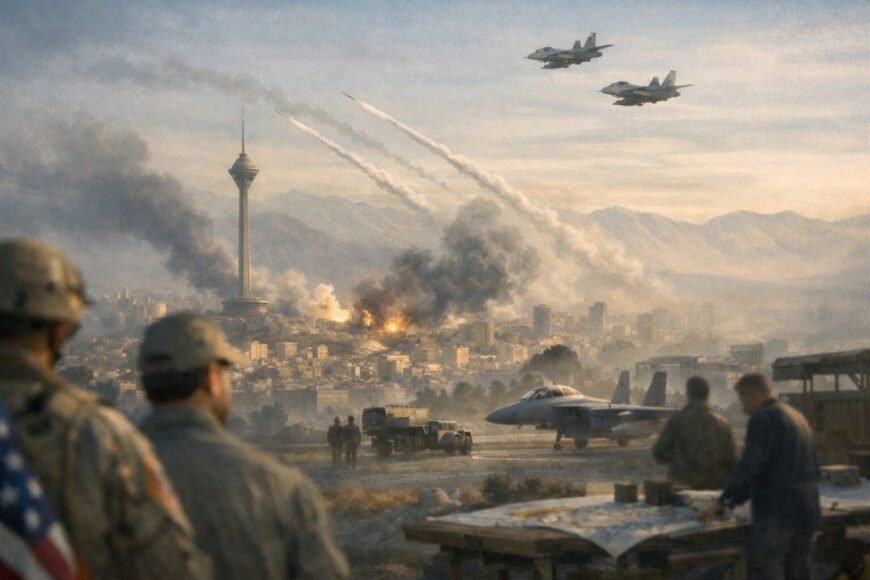
In recent weeks, several Moroccan cities have seen demonstrations where, beyond traditional solidarity with Palestine, slogans and symbols have shown explicit support for the Iranian regime and what Tehran calls the “axis of resistance.” These gatherings have surfaced amidst a tense international climate marked by increasing military tensions in the Middle East following Israeli strikes, with the U.S.’s political and strategic backing, on structures linked to Iran.
In this environment of regional conflict and collective emotion surrounding the Palestinian tragedy, some Moroccan activists have taken a step further by turning solidarity with Gaza into an alignment—sometimes almost blindly—with Iran’s geopolitical narrative.
This phenomenon remains marginal in Moroccan society but warrants serious examination. It exposes a significant contradiction between certain activist discourses and the foundational elements of Morocco’s religious and institutional identity.
Morocco is founded on a unique religious framework within the Muslim world, organized for centuries around a specific doctrinal balance: Sunni Islam according to the Maliki school, Ashʿarism theology, and Sufi spirituality. This structure is not only theological but is institutionally guaranteed by the Moroccan sovereign, who holds the title of Commander of the Faithful. In this role, the king—currently Mohammed VI—represents religious unity and protects the national spiritual sphere from radicalization and foreign influences.
In contrast, the Iranian politico-religious model is based on a completely different logic. The Islamic Republic of Iran operates according to the doctrine of Wilayat al-Faqih, theorized by Ruhollah Khomeini during the 1979 Iranian Revolution. In this system, supreme political authority resides in a Shiite religious jurist governing in the name of divine law. This system implies a structured clerical hierarchy with direct political authority—an idea not found in Sunni Islam and incompatible with the Moroccan model, where religious authority is national, historical, and embodied by the monarchy.
The contradiction is evident: politically supporting a regime founded on Wilayat al-Faqih essentially legitimizes a model that competes with Morocco’s institution of Imarat al-Mouminine. Thus, geopolitical support for Iran may sometimes implicitly challenge the religious architecture that underpins Morocco’s stability.
The recent demonstrations exemplify this shift. In various rallies, slogans extended beyond simple denunciations of war or expressions of solidarity with Palestinians, explicitly glorifying the “axis of resistance” and its actors. The Iranian regime is depicted as the primary defender of the Muslim world against Israel and the United States.
This oversimplified portrayal, fueled by social media and activist rhetoric, results in an emotional adherence where geopolitical complexities dissolve into a binary worldview: oppressors on one side, resisters on the other.
In this narrative, Iran becomes a heroic figure. It is of little importance that its politico-religious project is fundamentally foreign to Moroccan Islam, that its regional alliances are driven by power strategies, or that its relations with Morocco have been marked by significant diplomatic tensions. Emotion triumphs over coherence.
How have some Moroccan activists arrived at such a paradoxical stance?
The first explanation lies in the emotional centrality of the Palestinian cause. Solidarity with the Palestinian people has been deeply embedded in Moroccan political consciousness for decades. The issue arises when this solidarity is used to justify alignment with regional powers whose objectives extend beyond defending Palestinians.
In many activist narratives, the equation has become overly simplistic: Israel is seen as the aggressor, Iran portrays itself as Israel’s enemy, therefore Iran automatically becomes a legitimate ally. This reasoning deliberately overlooks doctrinal, geopolitical, and strategic realities.
The second factor is the ideological convergence between certain Islamist currents and segments of the radical left. The former employ the rhetoric of the “umma” and Islamic resistance, while the latter adopts an anti-imperialist perspective. Despite their doctrinal differences, both milieus converge around the same symbol: Iran as a power challenging the West and Israel. This convergence creates an unusual intellectual alliance where doctrinal coherence becomes secondary to the logic of geopolitical camps.
A third factor involves internal dynamics of political contestation. In some activist circles, adopting positions that contradict the Moroccan state becomes a way of asserting political relevance. Morocco’s diplomatic normalization with Israel under the Abraham Accords has amplified this phenomenon. For some activists, opposition to this policy leads to a rhetorical escalation that ultimately idealizes the Iranian regime.
Yet, Moroccan authorities have clearly voiced their concerns about Iranian influence. Morocco severed diplomatic ties with Iran twice—first in 2009 and again in 2018. In the latter case, Rabat accused Tehran, through Hezbollah, of providing military support to the Polisario Front. Given the importance of the Sahara issue in Morocco’s strategic doctrine, this accusation places the Iranian question firmly within the scope of national security.
In this context, some Moroccan activists’ complacency toward Iran appears not only as a doctrinal inconsistency but also as political irresponsibility. It normalizes the influence of a regime that Moroccan authorities view—rightly or wrongly—as hostile on a matter of vital national interest.
Can this be called tre



Leave a Reply