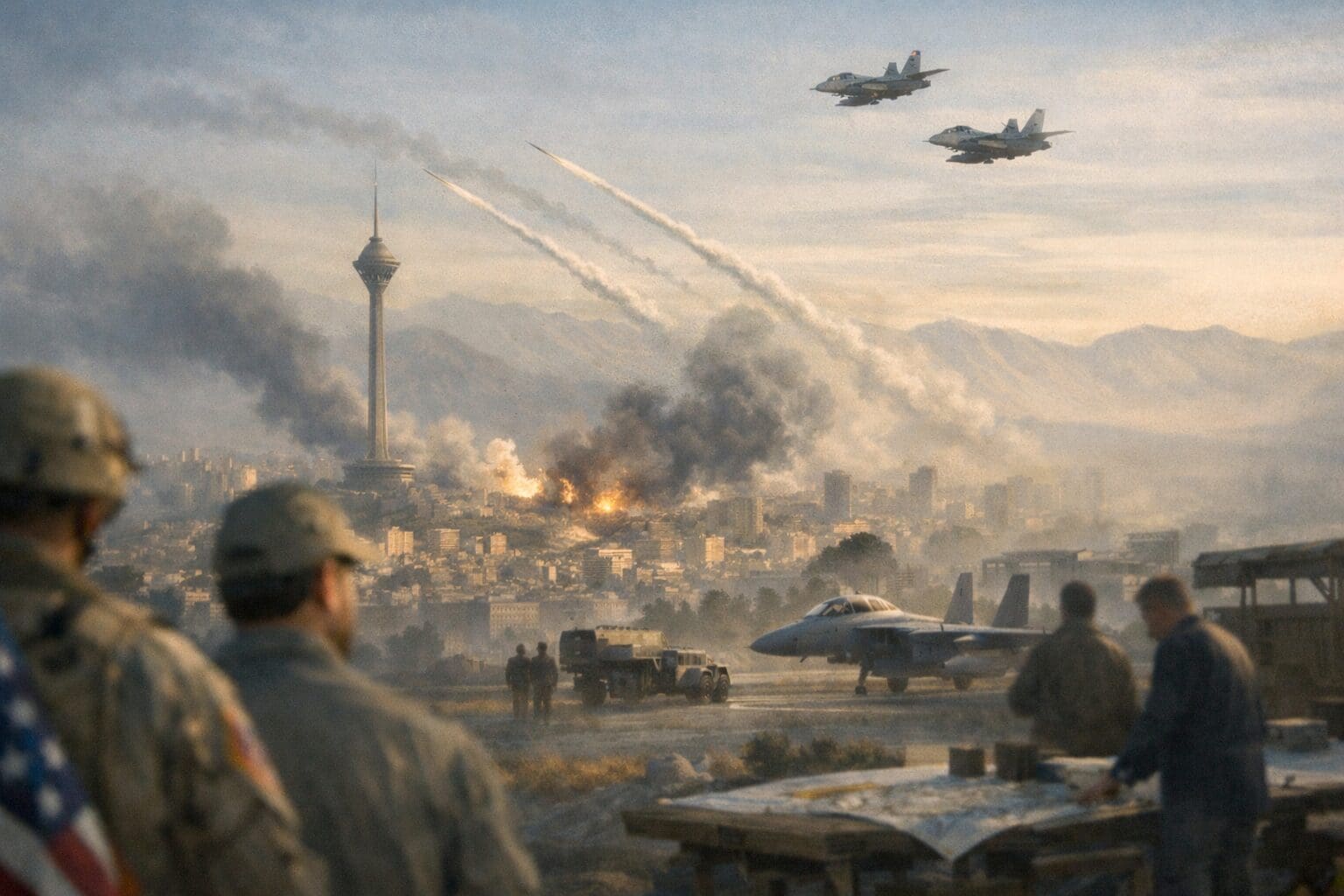
Iran Under Fire: The United States, Israel, and the War

Stephen Eric Bronner*

Amid cynicism, illusions, and imperialist aims, bombs are falling on Iran in a conflict between gangster states. Despite public disputes between President Donald Trump and Prime Minister Benjamin Netanyahu over Israel’s actions in Gaza, their differences were exaggerated by liberal media. This intense bombing of Iran, following the June 2025 attacks, was premeditated. The U.S. and its ally, Israel, share a goal to establish dominance in the Middle East.

Why did the bombing occur now? Trump aimed to divert attention from various scandals and a sinking 43% approval rating, while Netanyahu’s numbers were at 30%. Both leaders needed a win. Attacking Iran could attract independent voters and bolster Trump’s base, while Netanyahu would find support among religious-settlement parties. Iran appeared weakened by the aftermath of the June 2025 bombings, currency collapse, and early 2026 protests. Its true strength remains uncertain.

Geo-politics and realism drive events as Trump and Netanyahu assume the strong act at will while the weak suffer. Only Iran remains among Israel’s regional adversaries: Egypt, Jordan, and Morocco have recognized Israel, Saudi Arabia and the Gulf States engage economically, Syria is war-torn, Iraq is divided, and Lebanon is unstable. Palestine struggles with Israeli settlements, humanitarian crises in Gaza, and sovereignty issues. Attacking Iran seemed timely.

U.S. and Israeli foreign policy is not unique. Historically, “great powers” like England, France, Germany, Japan, and Russia pursued regional hegemony, expanded influence, and used horrific tactics. Justifications include national interest, security requirements, potential benefits for victims, and imperialism fulfilling national “destiny.”

The war was not driven by religious missions or fabricated conspiracies, but by material and psychological gains for the U.S. and Israel regarding oil, real estate, annexation projects, group narcissism, and political celebrations.

Iran, vocal against the U.S., is seen as opposing U.S. regional dominance in Latin America and the Caribbean. The Monroe Doctrine and ideas of “manifest destiny” drive U.S. actions. National security justifies targeting “narco-terrorist” states, acquiring Greenland, and potentially bringing Canada into the U.S. The country aims to be the independent global hegemon, accountable only to itself, withdrawing from international agreements and organizations.

Justifications for bombing Iran shifted from defending protestors to addressing an “imminent threat” and Iran’s nuclear ambitions. However, the CIA denied an imminent attack, and a deal preventing Iran’s nuclear development was made by Obama, which Trump undermined in 2018.

Monitoring Iran became impossible, enabling its nuclear program to resume. Despite claims of peaceful nuclear development, its facilities were reportedly destroyed in June 2025 bombings, falsely claimed by Trump and Netanyahu.

Iran’s theocracy is corrupt and oppressive, cracking down on protests with tragic outcomes, adding complexity to the current situation. Trump’s call for regime overthrow risks further conflict or civil war.

Post-regime collapse scenarios are uncertain, similar to post-Iraq invasion issues. Internal divisions could lead to chaos, echoing past uprisings. Philosopher Thomas Hobbes warned that toppling leadership without a replacement leads to chaos, a lesson unheeded by the U.S.

The stakes rise with the death of Iran’s Supreme Leader Ayatollah Khamenei and key Revolutionary Guard officers. Iran is divided, with potential for internal conflicts or conflicts with a democratic opposition.

The war escalates as Israel targets Hezbollah in Lebanon, and Iran retaliates against Gulf States and the U.S. embassy in Riyad. Regional tensions rise, with Trump suggesting possible troop deployment, implying invasion. Iran, a Shia state, cannot rely on Sunni Muslim neighbors for support, as the Arab League responds cautiously. Consequences for aggressors seem unlikely, securing regional power balance, benefiting Netanyahu’s backers.

Iran suffers nearly 1000 casualties and infrastructure devastation early in the conflict. U.S. and Israeli goals remain unclear, ranging from negotiation pressure to nuclear disarmament to regime change. Mission creep occurs as objectives shift, while the conflict prolongs, testing American patience as casualties rise.

Progressive opportunities exist, but Democrats focus on legalistic criticisms of Trump’s unilateral war action. They must evaluate potential outcomes of a successful attack on Iran and develop alternative Middle East policies. The Democratic Party lacks a clear stance against American imperialism or Israel’s actions. Without a foreign policy alternative

Comments

14 responses to “Iran Under Fire: The United States, Israel, and the War”

  1. Hidden Tree Avatar
    Hidden Tree

    Oh, look! Another thrilling episode of “Two Clowns and a Country,” where geopolitical strategy is just a punchline in a sad joke. Can’t wait to see how this circus unfolds! 🎪💥

  2. Wrangler Jim Avatar
    Wrangler Jim

    Bloody hell, looks like the world’s geopolitics are just a game of poker with nuclear stakes, and everyone’s bluffing but the poor sods on the ground. What’s next? A reality show: “Who Wants to Be a Middle Eastern Dictator?” 🎭

  3. Roadblock Avatar
    Roadblock

    Looks like the lads across the pond are at it again—nothing like a good old-fashioned bombing to distract from plummeting approval ratings! 😂 Who needs to solve problems when you can just drop a few bombs and call it a day, right?

  4. cardinal rebel Avatar
    cardinal rebel

    Seems like the U.S. and Israel are playing a game of geopolitical chess, but with actual bombs instead of pawns. Just another Tuesday in the world of “my missile is bigger than yours!” 🙄💣

  5. Prof. Screw Avatar
    Prof. Screw

    Seems like the U.S. and Israel have decided that diplomacy is overrated—who needs that when you can drop bombs and play geopolitical chess? 🙄 Honestly, it’s like watching two kids throw tantrums in a candy store, but the toys are real, and the stakes are a bit higher than just bedtime!

  6. low voltage Avatar
    low voltage

    Looks like the U.S. and Israel are having a bit of a “who can bomb better” contest, eh? Hope they at least brought snacks for the spectators—might need something to wash down the taste of irony in this geopolitical circus. 🎪💣

  7. Waylay Dave Avatar
    Waylay Dave

    Seems like we’re all just waiting for the next episode of “Who’s the Bigger Bully?” in the Middle East. Can’t wait for the plot twist where everyone suddenly remembers diplomacy exists. 🙄💣

  8. d-hog-day Avatar
    d-hog-day

    Seems like playing whack-a-mole with Iran is the new trend in geopolitics—who knew that dropping bombs could be the latest strategy for boosting poll numbers? 😂 Don’t forget to order your “peace” on the side, though; it pairs well with chaos!

  9. ELLerG!c Avatar
    ELLerG!c

    Fancy a read that’s as enlightening as a rainy day in London? The U.S. and Israel teaming up for a Middle Eastern makeover—now that’s a classic tale of “let’s fix what’s not broken” with a side of “who needs a plan anyway?” 🤦‍♂️💼

  10. Prometheus Avatar
    Prometheus

    Isn’t it just delightful to see two aging politicians playing with fire while the rest of us are left to pick up the pieces? Honestly, who needs a stable Middle East when you can have a flashy war to distract from your crumbling approval ratings? 🤷‍♂️

  11. Riff Raff Avatar
    Riff Raff

    What a delightful read! It’s almost as if we stumbled upon a political soap opera, where the lead characters juggle scandals and war like a bunch of circus clowns. 🎪 Can’t wait for the next episode, starring the same old script! 😂

  12. vilehero Avatar
    vilehero

    Blimey, looks like the U.S. and Israel are having another go at the ‘how to win friends and influence people’ game, but with a bit more bang for their buck this time! 💥 Can’t wait to see how they’ll twist this into a “strategic success” while the rest of us grab the popcorn and watch the chaos unfold. 🍿

  13. Chameleon Avatar
    Chameleon

    A right proper mess, innit? Seems like while we’re all trying to enjoy a quiet pint, the big boys across the pond have decided to play “who can drop the most bombs” – all for a few votes and some fancy oil. 🍺💣

  14. Cabbie Avatar

    Just what we needed—another high-stakes game of “Who’s Got the Bigger Bomb” played by the same old faces. 🤷‍♂️ Apparently, a little bit of regional chaos is the perfect recipe for boosting your approval ratings.

Leave a Reply

Your email address will not be published. Required fields are marked *

Last News

Blair’s Speech Sparks New Debate on Labour’s Identity, With or Without Starmer

Blair’s Speech Sparks New Debate on Labour’s Identity, With or Without Starmer

Blair and Starmer have had distant relations in recent months, as noted by a senior figure at the Tony Blair Institute for Global Change. Blair, having relinquished significant influence over the Starmer operation, now aims to transcend the traditional right or left dichotomy, focusing on broader centrist ideas essential for Britain’s advancement. He envisions politics that are more aspirati

Read More

Norway Aligns with France’s Nuclear Deterrence Policy

Norway Aligns with France’s Nuclear Deterrence Policy

“Russia’s largest nuclear arsenal is located in the High North, near Norway,” he stated, emphasizing Norway’s continued reliance on NATO for security.
On March 2, the French president announced that Germany, Poland, Greece, the Netherlands, Belgium, Denmark, and Sweden agreed to discuss nuclear cooperation with Paris. This may include joint nuclear drills, information shari

Read More

Debate on European Nuclear Deterrence Intensifies Following Norway’s Support for France’s Security Role in Oslo 2026

Debate on European Nuclear Deterrence Intensifies Following Norway’s Support for France’s Security Role in Oslo 2026

OSLO, Norway – May 27 – Eurotoday Newspaper — European nuclear deterrence discussions are gaining momentum after Norwegian Prime Minister Jonas Gahr Støre indicated that Norway would come under France’s nuclear umbrella, marking a potentially significant development in Europe’s evolving security structure.
The statement comes during a period of heightened geopolitical uncertainty, increasing Arcti

Read More

Von der Leyen to Meet Hungarian PM Magyar on Friday

Von der Leyen to Meet Hungarian PM Magyar on Friday

Budapest aims to mend its strained relationship with Brussels following long-standing conflicts under former leader Viktor Orbán.
Magyar, whose centrist party recently won Hungary’s election, is working to access billions in EU funds frozen due to violations of EU laws under Orbán’s 16-year governance.
Securing €10.4 billion in EU post-pandemic recovery funds is the top priority for th

Read More

Kazakhstan’s Energy Crisis Worsens as Rosatom Approaches Balkhash Nuclear Agreement for Astana 2026

Kazakhstan’s Energy Crisis Worsens as Rosatom Approaches Balkhash Nuclear Agreement for Astana 2026

ASTANA, Kazakhstan – May 27 – Eurotoday Newspaper — Kazakhstan energy crisis concerns are intensifying as Russian nuclear giant Rosatom moves closer to participating in the country’s planned Balkhash nuclear power project, a development that could reshape Central Asia’s long-term energy landscape.
Kazakhstan’s government has increasingly warned about electricity shortages, rising industrial deman

Read More

Power Rivalries and Their Impact on the Middle East and Horn of Africa

Power Rivalries and Their Impact on the Middle East and Horn of Africa

In a period marked by intricate challenges, the United Arab Emirates (UAE) has become a true stabilizing force in the region, achieving this not through rhetoric, but with tangible actions and measurable impacts. The UAE’s strategy has consistently aimed to avert state collapse and manage disorder. This dedication has driven the UAE to adapt, forge robust security alliances, and invest in i

Read More

Europe Enhances Ebola Detection Amid Congo Epidemic Surge

Europe Enhances Ebola Detection Amid Congo Epidemic Surge

Earlier this week, Italy reported two suspected cases among passengers from Uganda, but they later tested negative for Ebola, according to the disease prevention agency.
Belgium has direct daily flights to and from Congo. Brussels Airlines announced adjustments to its crew schedules since the United States banned entry from the region, but stated that these changes wouldn’t impact the curren

Read More

Spanish Police Raid Headquarters of PM Sánchez’s Socialist Party

Spanish Police Raid Headquarters of PM Sánchez’s Socialist Party

The El Confidencial news site reported that the UCO’s deployment was authorized by the National Court and is linked to an unrelated investigation overseen by Spain’s Anti-Corruption Prosecutor.
Spanish judicial authorities did not immediately respond to POLITICO’s request for comment.
Sánchez’s fragile minority government has been under heavy pressure since news of Zapatero’s indictment.
The regio

Read More

Kallas, von der Leyen, and the EU Intelligence Rivalry

Kallas, von der Leyen, and the EU Intelligence Rivalry

Kallas and von der Leyen are engaged in a rivalry over EU intelligence. Brussels is enhancing its intelligence capabilities, with Zoya Sheftalovich and Kathryn Carlson discussing the increased role of INTCEN, the EU’s lesser-known intelligence-analysis center within the European system.

Read More

Europe Is Failing a Key Test in Press Freedom

Europe Is Failing a Key Test in Press Freedom

A journalist does not need to be imprisoned for press freedom to be endangered. A tax audit coinciding with an important investigation, spyware on a reporter’s phone, influence from a politically connected owner, or numerous lawsuits can be equally effective. This is the current state of press freedom in Europe, not just in obvious crisis areas, but also in democracies that claim to respect

Read More