


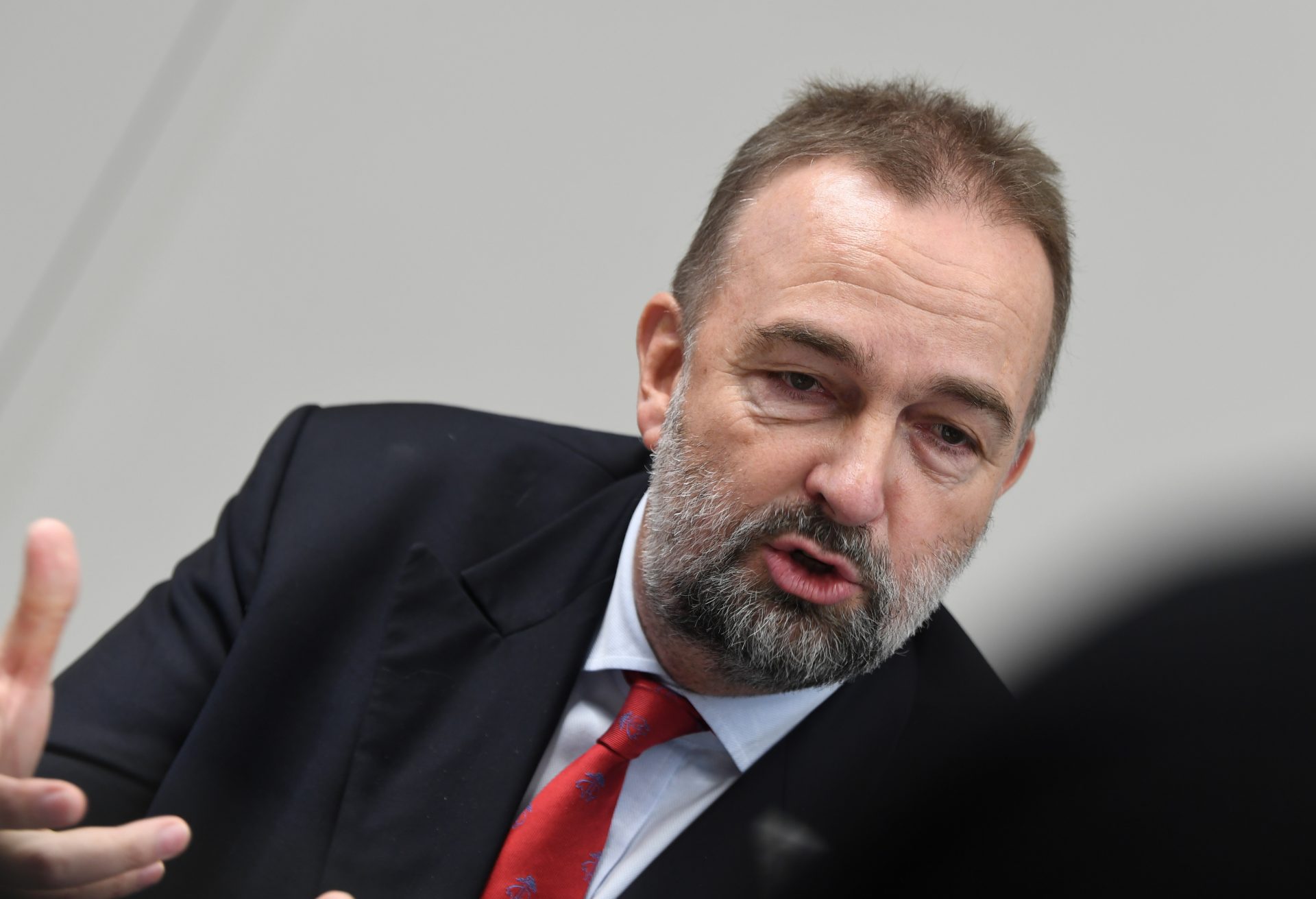
Vienna (APA) – Karl Habsburg, the grandson of the Austrian emperor, former Member of the European Parliament, and honorary president of the Pan-European movement, has urged Europe to embrace greater responsibility. In his “Speech on the Future of Europe” marking his 65th birthday, Habsburg discussed political crises, the U.S. security strategy, and the perceived U.S. support for anti-European groups. He described certain factions within the right-wing EU group “Patriots for Europe” as a “fifth column of Moscow” and called for a regime change in Russia under Vladimir Putin.
During his address at Fuchs Villa in Vienna-Penzing, Habsburg criticized the EU Parliament group as composed of “not patriots, but partly brutal nationalists.” He argued that their agenda aims to revert European unification to mere governmental cooperation, dismantling common institutions. He asserted that many affiliated parties have connections to Putin, labeling them as a new fifth column of Moscow that betrays both their nations and Europe. The right-wing Patriots group includes the Austrian FPÖ, the French Rassemblement National, and the Hungarian Fidesz.
Criticism of EU leadership
Habsburg highlighted Moscow’s war against Ukraine as the greatest threat to Europe in recent years, stating it seeks to destroy a state and its people while fragmenting Europe for easier domination. He called for Ukraine’s territorial integrity and sovereignty to be restored, reparations from Russia, and the prosecution of Putin in an international tribunal for war crimes.
Furthermore, Habsburg criticized EU leadership for bureaucratic missteps that undermine Europe, questioning the accountability of politicians who rush laws through only to later retract them. He asked, “Where is the responsibility of politicians? According to what criteria are laws passed as if there were no alternatives?”
Austria in U.S. security strategy
Addressing recent reports about Austria’s mention in an unpublished U.S. security strategy, Habsburg emphasized that the modern idea of European unification originated in Austria, inspired by Richard Coudenhove-Kalergi’s 1922 proposal. He called for unity in the face of threats to Western values from various global actors, urging Europeans to confront challenges with courage.
Praise for Meinl-Reisinger’s courage
Habsburg commended Foreign Minister Beate Meinl-Reisinger from NEOS for her boldness, acknowledging her symbolic choice to wear the traditional Ukrainian vyshyvanka despite media backlash. He underscored the significance of standing for one’s beliefs.
Meinl-Reisinger affirmed her commitment to Europe, stating that prosperity, freedom, and democracy are not guaranteed and that decisive actions are necessary. She advocated for a diverse Europe rather than a single unitary state.
Dynasty ruled for 640 years
Karl Habsburg, born on January 11, 1961, in Starnberg, Bavaria, is the grandson of the last Austrian emperor, Karl I. He served as a Member of the European Parliament for the ÖVP, starting in the first European elections in 1996. He succeeded his father Otto Habsburg as the head of the Pan-European movement and has been its honorary president since 2024, engaging in media ventures across several countries.
The Habsburgs have profoundly influenced European history, reigning for 640 years following Rudolf von Habsburg’s victory over King Ottokar II of Bohemia in the Battle on the Marchfeld in 1278. The dynasty’s privileges were revoked following the establishment of the republic on November 12, 1918. (11.1.2026)




Leave a Reply