


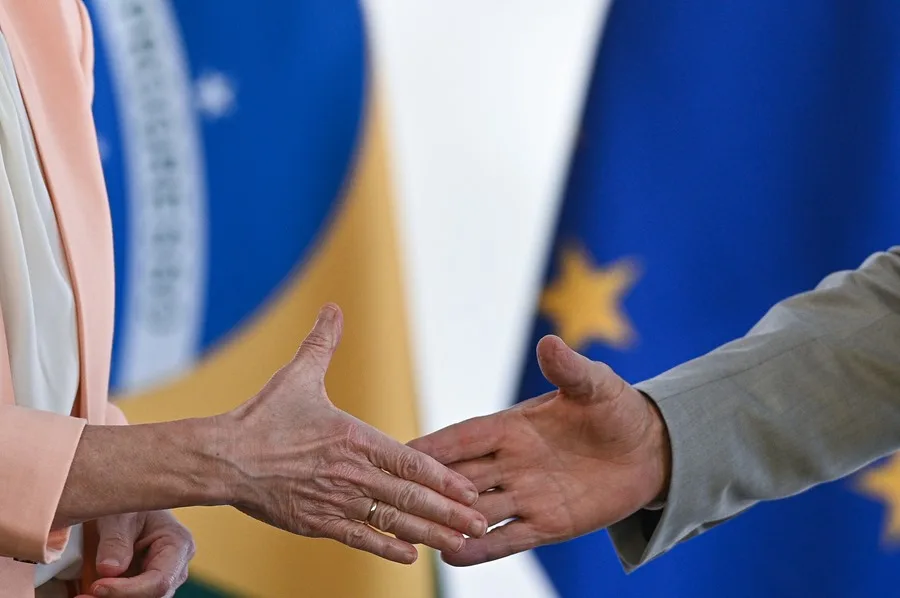
Vienna (APA) – Economists assessing the EU-Mercosur trade agreement suggest its impact on the European economy will be minimal. Nonetheless, they view the agreement positively. The FPÖ criticized the potential effects on farmers during a press conference on Monday, targeting the ÖVP Farmers’ Association.
Multiple studies indicate that the EU’s gross domestic product (GDP) will rise by approximately 0.05 percent over ten years due to the free trade agreement with Mercosur countries—Brazil, Argentina, Paraguay, Uruguay, and Bolivia. Conversely, the Mercosur region anticipates an average GDP growth of 0.25 percent, according to IHS economist Klaus Weyerstrass in an interview with APA.
Following over 25 years of negotiations, the trade agreement made significant progress last week, with EU ambassadors voting in favor of signing it. Austria, however, is bound by a parliamentary resolution to oppose it.
Focus on Rare Earths
Weyerstrass emphasized that the agreement’s merits lie more in geostrategic considerations rather than economic benefits, citing the tariff policies of US President Donald Trump and competition with China. He highlighted the importance of South America’s rare earth deposits for economic transformation, stating, “Diversification in this region will reduce dependency on and vulnerability to Chinese influence.”
Weyerstrass expressed confidence in European agriculture, noting that its interests, despite its small contribution to overall value creation, are well protected in the agreement. He assured that EU’s stringent food standards remain intact for imported products.
“A Mutual Benefit Approach”
Wifo economist Harald Oberhofer remarked that extensive exemptions and quotas for agricultural products were included in the agreement. “Trade agreements are predicated on mutual benefit,” he said. For European industry to gain from exports, Mercosur states must simultaneously benefit. The agreement imposes significant protections in sensitive areas like beef, leading Oberhofer to predict minimal impact on local farmers, although stronger price fluctuations may arise for other agricultural goods.
FPÖ Advocates for Mandatory Origin Labeling
The FPÖ reiterated its strong opposition to the EU-Mercosur agreement, with deputy spokesperson for agriculture and forestry, Albert Royer, labeling the majority approval by EU member states as a “drama” at a press conference on Monday. He called for mandatory origin labeling for food products and criticized the ÖVP and its associated Farmers’ Association for their inconsistent stance between EU policy and domestic farmer interests. (12.1.2026)






Leave a Reply