


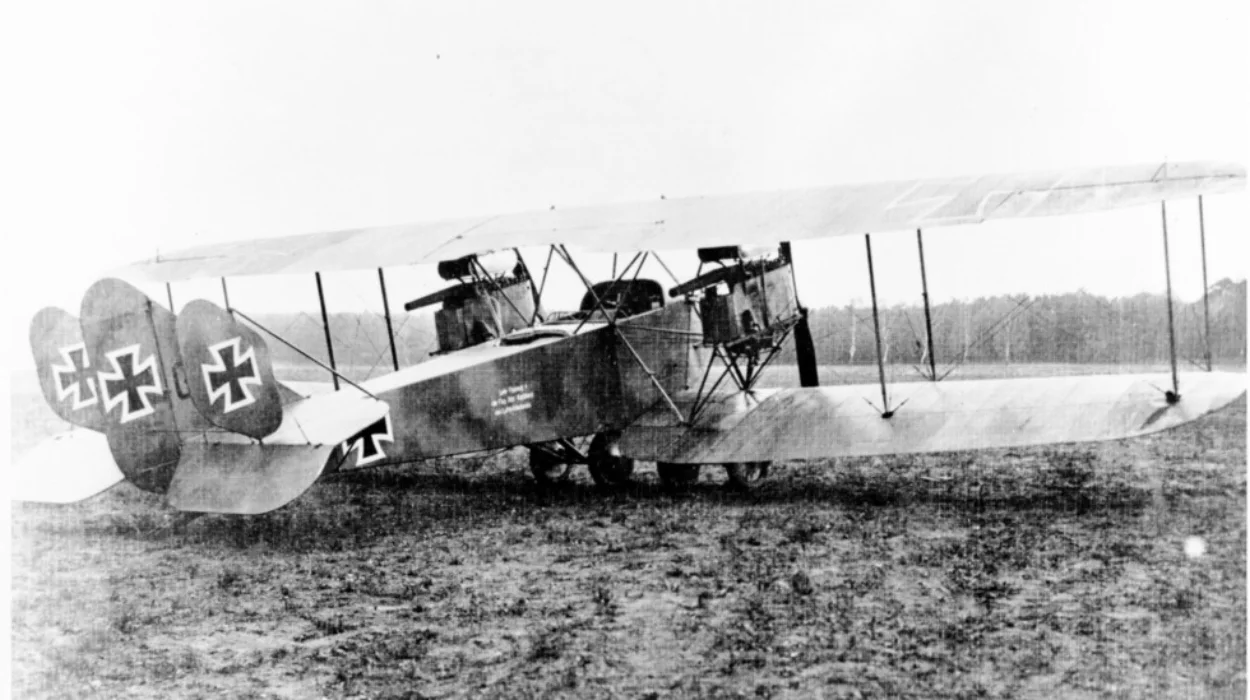
What comes to mind when we talk about World War I? People normally tend to associate this war with trench warfare, tanks, and fighter planes flying in the sky. But one crucial part of the war effort often gets overlooked: the bombers. In particular, the AEG G.II bomber stands out as an important piece of German aviation history.
One might ask the following question: “What was special about the AEG G.II?” or “How was this bomber involved in the specifications of the war?” Well, let’s learn a bit more about this interesting, high-performing craft, its history of service, and how it contributed to shaping the skies over Europe.
The Birth of the AEG G.II: An Innovation in the History of Germany in World War I
The AEG G.II was introduced by Germany in 1915 during the First World War, a time when planes were still a relatively new addition to the battlefield. As a technologically advanced nation, Germany sought to leave a mark in the skies. The AEG G.II was their answer. It was a two-engine bomber of considerable size, designed to carry significant bomb loads.
Before the emergence of bombers like the G.II, the idea of a reliable flying weapon was more conceptual than a reality. Early bombers were often cumbersome, difficult to maneuver, and had limited payload capacity. The AEG G.II changed that. Its design was a major improvement, allowing it to target significant military objectives from the air.
Imagine trying to hit a bull’s-eye in the middle of a battlefield, armed only with a colossal flying machine. The AEG G.I made this possible, paving the way for its successors, including the G.II. Although it wasn’t a particularly fast or maneuverable aircraft by modern standards, it marked a significant leap forward at the time.
AEG G.II 1915: The Year of First Flights
The AEG G.II was officially introduced to the battlefield in the middle of the war. Its maiden flights began amid high expectations, and the bomber was quickly embraced for its relative stability and ability to carry more bombs than other German planes of its time.
The G.II wasn’t just about dropping explosives on enemy front lines. It was part of a broader strategy to disrupt the Allies’ supply lines, bombard strategic locations, and sow chaos in general. German bombers of World War I, including the G.II, were often tasked with attacking industrial areas, railway hubs, and aerodromes, aiming to hinder the enemy’s war efforts.
The G.II wasn’t just a flying weapons platform, though. It could carry up to 300 kg of bombs, a significant payload for the era. Its twin-engine design provided enough power to reach targets and ensured stability during flight, which allowed for more precise bomb delivery.
Over time, the AEG G.II’s operational history became closely tied to Germany’s growing bomber program. However, while the AEG G.II contributed to bombing campaigns, it wasn’t a game-changer that significantly altered the course of the war.
The bomber faced several challenges typical of early aviation, including poor visibility, limited navigation aids, and vulnerability to anti-aircraft fire. While the G.II was a major step forward in aerodynamics and capability, it wasn’t an all-encompassing solution to the challenges of aerial warfare. Nevertheless, it paved the way for the more advanced bombers that followed.
Key Features of the AEG G.II Bomber: What Made It Stand Out?
What made the AEG G.II bomber stand out from other aircraft of its time? Here are a few of its key features:
Twin Engines: Equipped with two engines, the G.II was more powerful and reliable than its single-engine








Leave a Reply