


Poland Set to Take Over EU Council Presidency in 2025
Poland is set to assume the rotating presidency of the Council of the European Union starting on January 1, 2025. This six-month term will run until June, under the theme: “Security, Europe!”
Poland’s agenda prioritizes various aspects of security, encompassing external, internal, informational, economic, energy, food, and health security.
Polish Prime Minister and former President of the European Council, Donald Tusk, noted that Poland will lead the 27 EU member states during a particularly challenging time, highlighting ongoing crises in Ukraine, the Middle East, and developments in Georgia.
In a briefing on the presidency’s priorities, Agnieszka Bartol, head of Poland’s Permanent Representation to the EU, emphasized the goal of enhancing the competitiveness of European companies, particularly regarding energy costs and reducing bureaucratic hurdles.
Earlier this month, Fatih Birol, head of the International Energy Agency (IEA), criticized the EU for becoming overly reliant on Russia, abandoning nuclear energy, and lagging behind China in green technologies. He pointed to the upcoming clean industry strategy from the European Commission, which is anticipated to be introduced within the first 100 days of its new term, coinciding with the Polish presidency.
Regarding EU enlargement, Ambassador Bartol mentioned that Poland aims to adopt a balanced approach, particularly regarding the Western Balkans, which is a geopolitical priority for Warsaw.
Tusk’s Plans for Peace Talks in Ukraine
As Poland prepares for its presidency, discussions concerning Ukraine’s situation are ongoing with various international officials. Tusk revealed that he spoke with French President Emmanuel Macron about the potential deployment of foreign troops in Ukraine if a ceasefire is reached. However, he clarified that Poland is not currently planning such actions.
Tusk indicated that peace talks concerning Ukraine could commence “in the winter of this year,” adding that the EU presidency will play a crucial role in shaping the political landscape for potential negotiations.
As a member of NATO, Poland remains a strong supporter of Ukraine and serves as a vital logistics hub for Western military assistance.
EU foreign policy chief Kaja Kallas recently stated, “We need peace in Ukraine to have peacekeeping missions,” emphasizing the necessity for Russia to halt hostilities before any discussions can take place.
Poland is expected to significantly influence the situation surrounding Ukraine. February marks three years since Russia’s invasion, and a package of sanctions against Moscow is anticipated to be adopted around that time, aiming to exert substantial pressure on Russia.
EU member states are also working to bolster support for Ukraine, though not without political challenges at home. Bulgarian caretaker Prime Minister Dimitar Glavchev sought parliamentary approval to sign a Security Cooperation Agreement with Ukraine, which had been approved by Bulgaria’s Council of Ministers. However, responses in Parliament on December 18 were largely negative, with some parties opposing the mandate and the sharing of military resources with Ukraine. Glavchev stated he would only sign the agreement if he secured the National Assembly’s backing.
Ukraine's EU Membership Prospects
Following Russia’s full-scale invasion of Ukraine in 2022, the EU has intensified its enlargement efforts, with Ukraine making significant progress. Under Belgium’s presidency in the first half of 2024, the EU officially initiated accession talks with Ukraine, which included a screening process to assess national legislation and identify alignment with EU standards.
This screening process, a prerequisite for opening accession clusters, may be completed during Poland’s presidency.

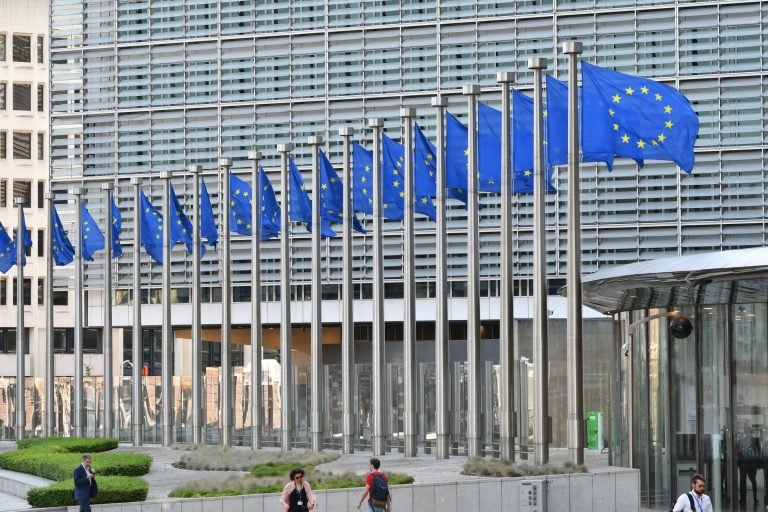
EU flags flutter outside the Council of the EU and European Council buildings in Brussels. Photo: © European Union
Looking Ahead: Poland's Role in the EU Council
The logo for the Polish EU presidency, featuring the Polish flag alongside the letters ‘E’ and ‘U’, symbolizes Poland’s commitment to the European Union, its 20 years of membership, and its ambition to influence EU policies, particularly concerning security.
This logo was crafted by renowned Polish artist Jerzy Janiszewski, who is also known for creating the logo of the Solidarity trade union movement founded in 1980.
The Council of the European Union, comprising ministers from each of the 27 member states, serves as one of the EU’s primary decision-making bodies, engaging in discussions on various policy areas. It is distinct from the European Council, which brings together EU heads of state or government to establish the broader political agenda.
Each EU member state holds the presidency for six months. In 2024, Belgium and Hungary will lead, followed by Poland and Denmark in 2025.
The Polish presidency will officially begin with a concert in Warsaw on January 3, 2025, accompanied by




Leave a Reply