



Scientists have observed an extraordinary event at an Antarctic volcano, which is emitting microscopic crystals of pure gold into the air daily, according to Indian Defense Review.
The Erebus volcano, the Earth’s southernmost active volcano, is situated on Ross Island, about 1,350 kilometers from the South Pole. It features a constant lava lake. Besides lava and gases, it releases something unique to this planet: tiny crystals of pure elemental gold. A study published in the journal Geophysical Research Letters in 1991 reports that the volcano emits around 80 grams of gold dust each day. These particles can travel up to 1,000 kilometers from the crater and potentially further.
Gold traces have also been detected in eruptions from other volcanoes like Kilauea in Hawaii, Etna in Italy, Augustine in Alaska, and El Chichon in Mexico. Magma from beneath the Earth contains numerous elements including copper, silver, mercury, arsenic, selenium, sulfur, and gold, forming various compounds. Researchers suggest gold does not evaporate directly due to its high boiling point compared to volcanic process temperatures. Instead, it likely travels in stable volatile compounds with chlorine or sulfur present in the hot volcanic gases. Crystals have been identified in snow, gases, and in the atmosphere.
A geochemists’ team led by Kimberly Meeker from the New Mexico Institute of Mining and Technology examined snow samples, gases above the lava lake, and air up to 1,000 kilometers from the volcano. Microscopic pure gold particles were found in all samples, appearing as transparent crystals with nearly perfect geometric shapes under an electron microscope, some up to 60 micrometers.
Although Erebus is not a top gold producer, with Kilauea producing 500–800 grams and Etna up to 2.4 kilograms daily, it uniquely produces crystalline elemental gold. The reason behind this remains unknown. Scientists are yet to determine how gold separates from the compounds transporting it through the volcanic system. One theory suggests gold leaves the lava in volatile chlorine-containing compounds, crystallizing upon cooling before settling on ice. However, the theory’s flaw is that the gas holds too little gold for perfect crystal formation in the air.
ScienceAlert reports that volcanologist Philip Kyle, part of the research team, later suggested another theory: gold forms gradually in the crust on the lava lake surface before rising into the air with the gases.
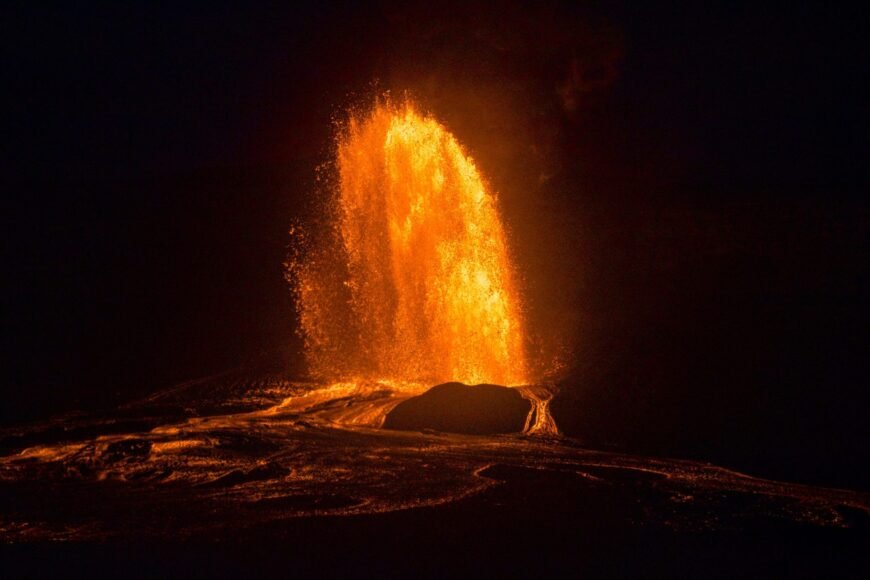
Illustrative photo: pexels-james-lee-932763-33295463








Leave a Reply