


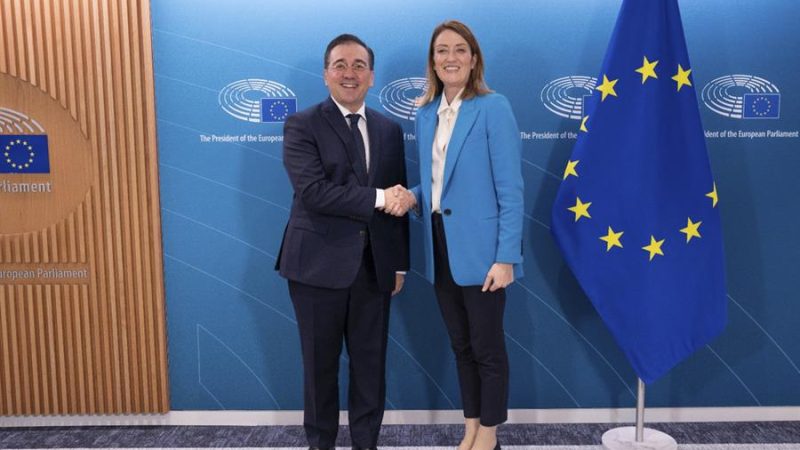
Brussels – On Wednesday, Foreign Affairs Minister José Manuel Albares informed the President of the European Parliament, Roberta Metsola, that the recognition of co-official languages is fundamentally tied to Spanish identity, as they await an internal report from the European Parliament to evaluate the implications of including these languages in parliamentary sessions.
After their meeting at the European Parliament headquarters, Albares emphasized that this issue transcends partisan politics, stating, “It is a matter of Spanish national identity.” The meeting had originally been intended for early November but was postponed due to adverse weather conditions. This discussion follows Metsola’s recent request for a comprehensive report regarding the potential use of Catalan, Basque, and Galician during the parliamentary plenaries, which is a necessary preliminary step for considering their incorporation into the European Parliament’s language policy.
The working group on language, citizens, and interpretation, part of the Bureau, will convene for the first time this legislative term on December 10th. This group is charged with drafting a report examining the practical, budgetary, and political ramifications of this proposal, although no deadline has been set for its completion.
While acknowledging that the report is ultimately the “sovereignty of the European Parliament,” Albares stated that the issue is firmly on the agenda and will proceed through the usual processes. The group includes two Spanish vice-presidents of the European Parliament: the socialist Javi López and the popular party member Esteban González Pons. Albares expressed his intent to keep this matter free from political contention, emphasizing the shared national identity represented by the co-official languages enshrined in the Constitution, which are widely used in various autonomous communities, including by members of the Popular Party.
“This is not about a victory of one group of Spaniards over another. Our co-official languages are part of our national identity, and I aim to unite all political factions around this issue,” he remarked.
During the meeting, Albares did not address the initial report requested by Metsola from the Eurochamber’s legal services back in 2022, which has not been made public and is believed to cover topics such as interpreter costs and the potential political implications for other European nations with linguistic minorities wishing to pursue similar recognition.
This development follows Albares’ third letter to Metsola in September, reiterating the importance of allowing the use of these three co-official languages as integral to Spanish national identity, which is embedded in its political and constitutional framework.
The European Parliament’s deliberation on this matter operates independently of the Spanish Government’s push for these languages to gain official status across the European Union. This issue is currently under discussion within the Council of the European Union, which comprises member governments. Although Madrid promoted this during its presidency of the Council, the proposal remains stalled.
Albares mentioned he has not yet had detailed discussions with the Polish Government, which will assume the semi-annual presidency of the Council in early 2025, about what will be included on the General Affairs Council agenda. However, he expressed optimism that Spain will have the topic featured on Poland’s presidency agenda without issue.
In addition to these discussions, the minister took the opportunity to congratulate Metsola on her re-election as President of the European Parliament and expressed gratitude for her advocacy for storm victims, supporting the swift regulatory processes that facilitate aid. (November 4)




Leave a Reply