


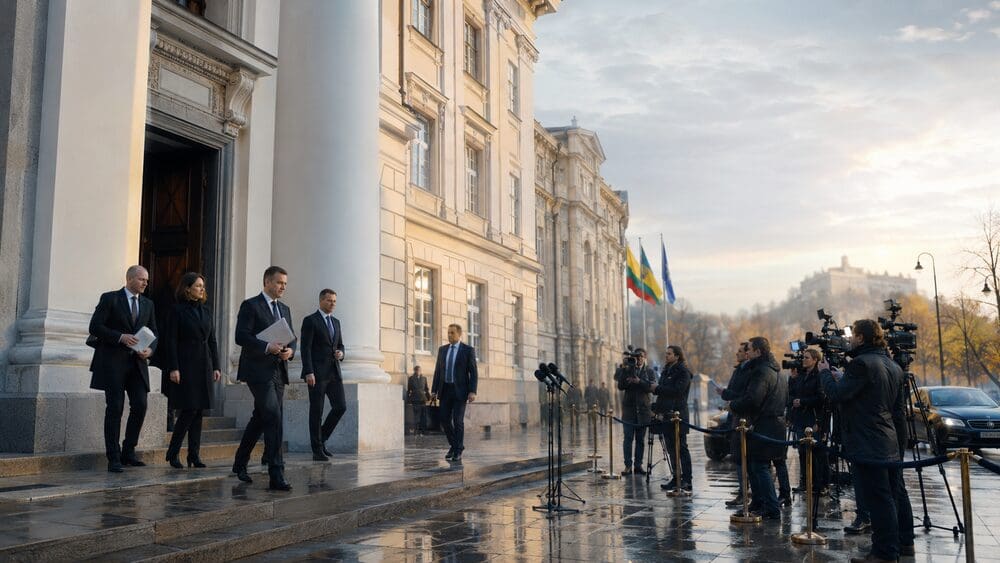
Lithuania is undergoing a political transition following the resignation of Prime Minister Inga Ruginienė and her cabinet, paving the way for a new centre-left government in the strategically important EU and NATO member state.
The outgoing administration approved its resignation on June 23, as Ruginienė suggested returning the government’s powers to President Gitanas Nausėda. The Lithuanian government announced the decree would be submitted to the president the same day, requesting ministers to stay in office until a new cabinet is formed.
This move does not immediately absolve the administration from daily duties. According to the country’s constitutional procedure, the president is likely to ask the departing government to continue in a caretaker role while a new prime minister is nominated, approved by parliament, and tasked with forming a cabinet and programme.
The resignation comes after a coalition reshuffle within Lithuania’s centre-left majority. Lithuanian public broadcaster LRT reported Social Democratic leader Mindaugas Sinkevičius is the proposed prime minister nominee. The president must present a candidate to the Seimas within 15 days, as per the parliamentary process.
If approved, the new prime minister would have up to another 15 days to present a cabinet and government programme for endorsement. The incoming majority is expected to unite the Social Democrats, the Union of Democrats “For Lithuania,” and the Lithuanian Farmers, Greens and Christian Families Union, securing 75 seats in the 141-member Seimas.
For Vilnius, the transition is politically sensitive despite a clear procedure. Lithuania shares borders with Belarus and Russia’s Kaliningrad exclave, supports Ukraine, and is navigating debates on China policy, social spending, and national resilience. Prolonged uncertainty would be closely monitored in Brussels and the Baltic region.
Ruginienė, a former trade union leader, steps down after less than a year in office. Her government faced coalition tensions and domestic controversies, but the resignation also reflects a planned reordering of the governing majority following the Social Democrats’ change of partners.
This event highlights a broader political restructuring across Europe, where governing parties are balancing social expectations, security pressures, and public distrust. The European Times recently reported on political changes in Britain, illustrating that significant parliamentary mandates do not guarantee lasting confidence.
In Lithuania, the immediate focus is on whether Sinkevičius can ensure continuity without treating the transition as a party arrangement. The new government must demonstrate that coalition dynamics can still produce credible public policy, particularly in social protection, corruption prevention, cyber security, and relations with vulnerable minorities.
Thus, the resignation is more than a routine cabinet reset. It is essential for Lithuania’s governing parties to reassure citizens that institutional stability can be maintained amid shifting political leadership.





Leave a Reply