



The first 100 days of the EU Special Envoy highlight a universal right under increasing global pressure and pose a question about the European Commission’s own dialogue with religious and belief communities.
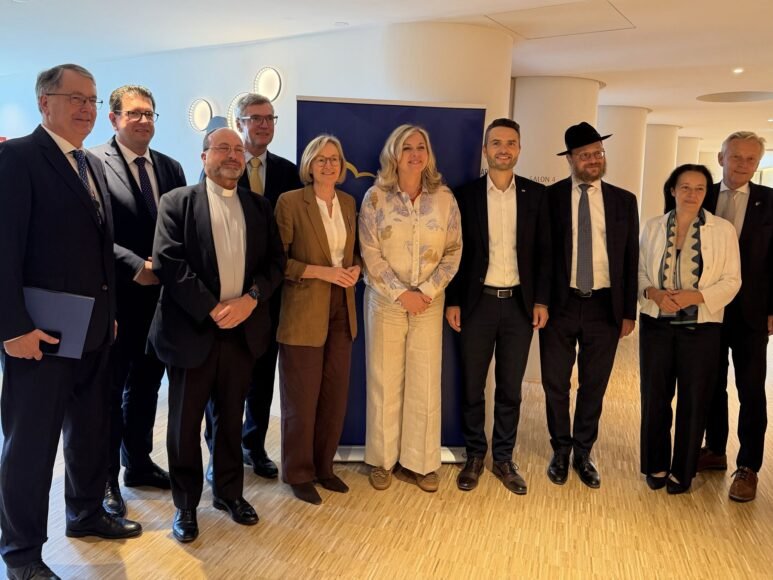
Mairead McGuinness, marking her initial 100 days as the EU’s Special Envoy for Freedom of Religion or Belief outside the EU, underscores this right as universal. Her focus on listening, pluralism, and equal protection is crucial in today’s international climate, offering Brussels a point for introspection. Within the European Commission, the Article 17 dialogue with religious and non-confessional groups has been coordinated by Vincent Depaigne since 2017. Almost a decade later, issues of access, transparency, and concentration of gatekeeping power warrant attention.
“The freedom to believe, not to believe, or to change”
“It has been 100 days since my appointment as EU Special Envoy for Freedom of Religion or Belief outside the EU,” Mairead McGuinness wrote on LinkedIn.
Her broad definition of the right was intentional.
FoRB is “the freedom to believe, not to believe, or to change beliefs,” allowing individuals to live without fear of losing employment, family, liberty, or life.
She emphasized that the right “equally protects the devout and atheists.” Restrictions on this freedom often coincide with impacts on freedom of expression, assembly, association, and non-discrimination.
This formulation is significant as it shifts the debate from protecting institutions to focusing on individual human rights, which shield a diverse array of religious communities, atheists, humanists, converts, dissenters, and those with unconventional beliefs.
McGuinness met with ministers, religious leaders, MEPs, ambassadors, international organizations, NGOs, and other FoRB advocates during her initial months.
“Every conversation reveals how swiftly this right can erode and the devastating consequences for victims,” she noted.
Her assessment is grim: growing extremism and polarization, increasing religious persecution, narrowing civic space, and the expanded reach of disinformation and hate via AI and social media.
An international issue of massive scale
The broader EU shares this concern.
On August 21, 2026, the EU marked the International Day Commemorating Victims of Acts of Violence Based on Religion or Belief by highlighting that nearly two-thirds of the global population live in countries where severe abuses and violations of freedom of religion or belief occur.
“Millions daily suffer from intolerance, discrimination, hatred, hostility, and violence due to their actual or perceived religion or belief, or lack thereof,” stated the EU.
McGuinness inherits a challenging portfolio.
The European Commission appointed her on March 26, 2026 as Special Envoy to promote freedom of religion or belief outside the EU. She is linked to Commissioner for Internal Affairs and Migration Magnus Brunner, who also holds political responsibility for the Commission’s Article 17 dialogue.
Her international mandate and the Commission’s internal religious dialogue differ but converge on a basic European principle: institutions should listen to a diverse mix of religious and belief communities, including those outside the traditional establishment.
This is where McGuinness’s experience becomes particularly relevant.
McGuinness knows Article 17 intimately
Before joining the European Commission, McGuinness spent years in the European Parliament. As Vice-President and later First Vice-President, she oversaw Parliament’s implementation of Article 17 of the Treaty on the Functioning of the European Union.
A 2018 European Parliament agenda identified her as the Vice-President responsible for Article 17 dialogue with religious and non-confessional organizations.
Article 17 is brief but important. It mandates the Union to respect churches, religious communities, philosophical organizations, and non-confessional bodies under national law.
Its third paragraph establishes:
“Recognizing their identity and specific contribution, the Union shall maintain an open, transparent, and regular dialogue with these churches





Leave a Reply