



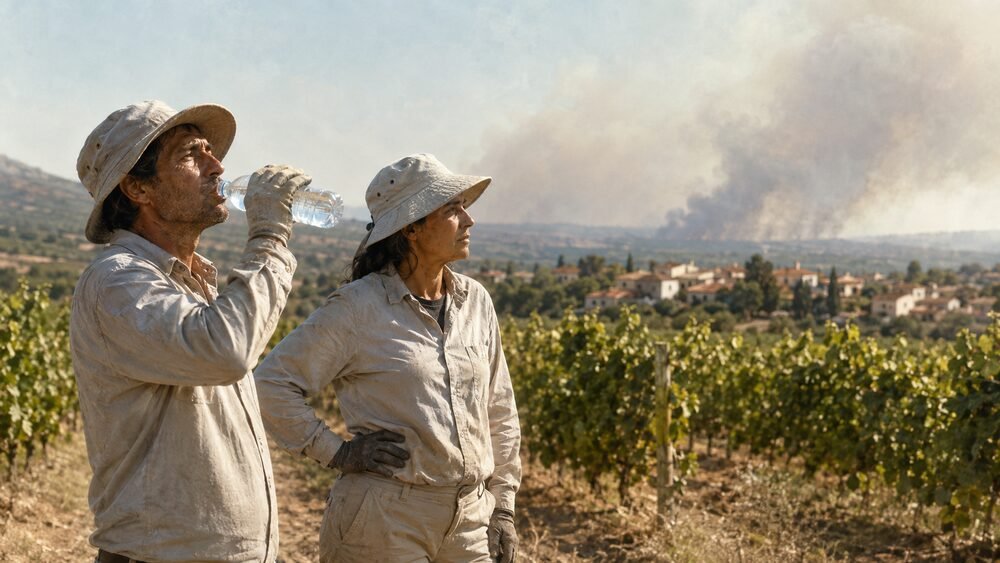
Wildfires and extreme heat in France and Spain highlight a broader workplace-safety issue in Europe. While fire crews face the most visible danger, agricultural workers, builders, delivery riders, and municipal employees also endure long hours in hazardous heat and smoke. Protecting these workers requires more than public warnings; practical plans are needed to enable work to slow or stop without financial consequences for workers.
The fires that led to evacuations in late July have put pressure on emergency services and local communities. The European Union has assisted with aircraft, firefighters, vehicles, and satellite mapping through its Civil Protection Mechanism.
Cross-border aid is vital, yet danger extends beyond evacuation zones. High temperatures, smoke, and physical labor can endanger people far from flames.
Outdoor workers vary in roles, from operating machinery to harvesting crops, road repairs, waste collection, public space maintenance, and city deliveries. Their exposure depends on temperature, humidity, air quality, protective gear, workload, and access to water and shade.
Risks are affected by employment conditions. Permanent municipal employees can report symptoms or request schedule changes more easily than seasonal farm workers paid by output. Subcontracted builders or platform couriers may fear loss of income if work is suspended. Migrant workers might receive late alerts, face language barriers, or be unsure of their rights.
Extreme heat is a labor-rights issue as well as a weather emergency. Advising people to avoid strenuous activity is ineffective when wages are tied to continuing work.
Smoke adds uncertainty. Air pollution affects communities beyond fire zones, with wind and fire behavior changing rapidly. Employers must follow air-quality and emergency information throughout the day, not just at shift start.
The EU’s workplace guidance on heat advises employers to assess exposure and organize work accordingly. Measures include reliable water access, shaded or cooled rest areas, frequent breaks, lighter workloads, schedule changes, and acclimatization time.
Effective measures should be agreed upon before crises. A written plan should specify who monitors conditions, when work is modified, which tasks are postponed, and how workers report symptoms. Supervisors must have the authority to act proactively.
Paid rest is crucial. A break that reduces precarious workers’ earnings may exist on paper but fail in practice, as with stop-work arrangements if employees fear punishment, replacement, or loss of future shifts.
Information should be available in languages and formats understood by all workers, including temporary staff and those employed through contractors. Rapid heat exhaustion symptoms necessitate clear instructions on seeking medical help.
Employers must manage workplace risks, but public authorities play a key role too. Heat and smoke alerts should link weather info with occupational guidance. Labor inspectorates need capacity to respond during emergencies, especially in sectors relying on seasonal or subcontracted labor.
Municipalities can adjust working hours, open cooling spaces, and provide advice to local businesses. Public bodies can require credible heat-protection plans through procurement contracts for construction, cleaning, transport, and maintenance providers.
Companies in the supply chain should assess whether delivery schedules, agricultural purchasing practices, or construction deadlines promote unsafe work. Suppliers should not be penalized for halting activity when warnings or conditions make work dangerous.
Climate adaptation must include worker protection. Europe’s experiences show that extreme heat cannot be treated as a temporary issue. Adaptation should extend to work organization, with shaded agricultural facilities, cooler building materials, improved urban tree cover, and better-designed working hours reducing exposure before emergencies.
Emergency crews and firefighting aircraft are indispensable when flames threaten lives and property. A credible European response must also ensure the safety of workers under the same sky. No worker should have to choose between income and avoiding preventable injury.






Leave a Reply