



Joachim Trier explores family dynamics through stories and silences
Joachim Trier’s Sentimental Value is a thoughtful family drama that delves into estrangement, artistic legacy, and the fine line between truly understanding someone and turning them into mere content. Reuniting with screenwriter Eskil Vogt and actor Renate Reinsve, Trier tackles reconciliation while acknowledging that recognition doesn’t erase damage.
The narrative centers on a fractured family. Nora, a successful stage actor played by Reinsve, and her sister Agnes, portrayed by Inga Ibsdotter Lilleaas, reconnect with their estranged father following their mother’s passing. Gustav Borg, played by Stellan Skarsgård, is a once-renowned filmmaker aiming to revive his career with an autobiographical piece.
Gustav offers Nora the lead role. Her refusal isn’t just professional; it’s a rejection of his belief that art can bypass years of emotional neglect. He then casts Rachel Kemp, a young American star, played by Elle Fanning, introducing an outsider to a story she can observe but not fully own.
The family home as a repository
Trier and Vogt pose a compelling question: who has the right to shape a family’s narrative? Gustav views experience as material for filmmaking. Nora sees that this process can strip private pain of its ownership. Agnes, caught between them, presents a different form of memory — less theatrical but equally significant.
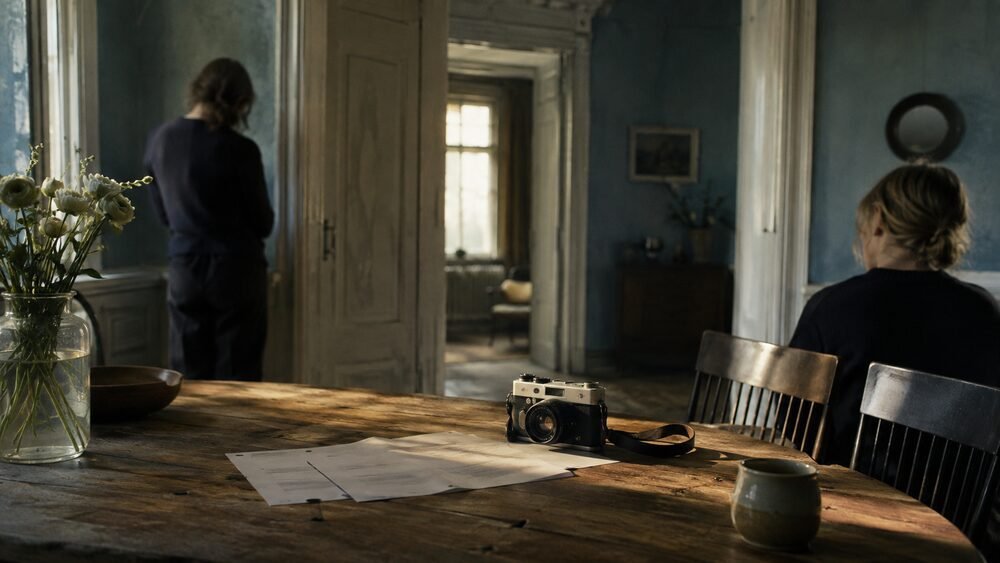
The inherited house embodies this conflict. It serves as more than a setting; it’s an archive of absences, routines, and events remembered differently by each family member. While the structure suggests continuity, those inside lack a shared understanding of its meaning. This metaphor provides the film’s emotional and visual core.
Trier’s direction often explores characters who articulate feelings better than they live with them. Here, filmmaking is part of the problem. Gustav’s intelligence doesn’t excuse his parental failures, nor does his desire for truth mean he’s ready for uncontrollable truths.
Performances rooted in distance
Reinsve excels as an actor whose stage command contrasts with private instability. Her collaboration with Trier continues from The Worst Person in the World, but Nora is a sharper, more guarded character. Her profession makes her father’s offer intrusive; he seeks not just forgiveness but the use of her talent for his introspection.
Skarsgård’s Gustav is equally complex, avoiding simplistic stereotypes of patriarch or genius. His charm and creativity coexist with cowardice, a testament to the screenplay’s refusal of easy moral categorization.
Lilleaas’s Agnes provides essential balance as the sibling with a more conventional life, yet carrying her own family history. Fanning’s Rachel, while clarifying what cannot be recreated by research, sometimes seems crafted mainly to highlight the Borg family rather than stand independently.
Art fails as a substitute for accountability
Sentimental Value, awarded the Grand Prix at the 2025 Cannes Film Festival, fits into European family cinema: literate, performance-driven, and aware of art’s moral ambiguities. Yet its most compelling insight is about the danger of using expression as reparation.
Creating a film about someone isn’t the same as listening to them. Understanding parental damage origins doesn’t negate its impact on children. Trier nonetheless finds space for connection, suggesting hope in small attentive acts rather than declarations or absolution.
The film is a well-structured drama, its control making emotional arrangements appear tidy. Yet its core conflict stays honest. Sentimental Value acknowledges that families inherit not just homes and memories but competing responsibilities. What matters is whether stories become possession or start a truthful conversation.
Editorial disclosure: This review is based on official production data, festival documentation and









Leave a Reply