


Belief in the divine creation of the world, as described in the Bible, involves various theological interpretations regarding the process of creation.
Concepts of the World’s Composition
Historically, Jewish and Christian traditions have had different interpretations regarding the composition of the world.
Creation from Nothing
The belief in God’s creation of the world from nothing (Latin: “ex nihilo”) is a foundational doctrine in traditional Christian theology, based on the Second Book of Maccabees, a deuterocanonical book of the Bible:
“I beseech you, my child, look at the heavens and the earth, and seeing all that is in them, know that God created all things out of nothing, and so the human race came into being” (2 Maccabees 7:28).
Although this is the most direct biblical statement on creation from nothing, Christian theologians have embraced it as a core tenet of faith [Catechism of the Catholic Church].
Saint Theophilus of Antioch critiqued non-Christian philosophical views, like those of Plato, arguing that the uniqueness of God’s power is in creating ex nihilo:
“Plato and his followers acknowledge God as having no beginning, the father and creator of all things, but then they assume that God and matter also have no beginning… However, God’s power is such that He creates whatever He wishes from nothing” [Saint Theophilus of Antioch. Epistle to Autolycus 2:4].
Saint Basil the Great also rejected Greek philosophical views on creation:
“They reason similarly about God’s creation: form was given to the world by the wisdom of the Creator of all things, but the Creator had substance from without… However, God created the matter corresponding to the form of the world” [Basil the Great. Sermons on the Hexameron. Sermons 2].
While the concept of creation from nothing is essential in Christian theology, it is not mandatory in other monotheistic religions like Judaism and Islam. In Judaism, the doctrine became prominent in the 11th century through Maimonides, although other concepts exist in the Talmud [Priest Oleg Davydenkov. Dogmatic Theology].
Jewish theologian Isiodorus Epstein notes:
“The question of whether the world arose ex nihilo or from pre-existing substance is philosophical and not directly tied to Judaism. Judaism emphasizes that the universe is God’s creation, not a blind coincidence” [Isiodorus Epstein. Chapter 14. The Judaism of the Talmud].
Creation from Matter
Jewish and Christian theology also consider creation from matter, based on Genesis’s opening verse:
“In the beginning God created the heavens and the earth…” (Gen. 1:1-2).
Some scholars suggest alternate translations such as “When God began to create,” implying creation from existing material [Michael David Coogan, et al. The new Oxford annotated Bible].
This understanding has been acknowledged in ancient Greek philosophy. Philo of Alexandria, influenced by Plato, and later Gersonides, who followed Aristotle, believed in creation from eternal, formless matter [Cosmogony in Jewish Philosophy].
Modern Jewish scholars see parallels with evolutionary theory. For example, Pinchas Polonsky discusses the Kabbalistic idea that God created and destroyed worlds, suggesting an evolutionary process [Pinchas Polonsky].
Many contemporary theologians integrate creation ex nihilo with scientific evolution, likening it to the Big Bang followed by development from existing matter [Catechism of Creation Part II: Creation and Science].
Believers in evolutionism view creation as matter evolving under divine guidance, marked by God’s intervention at pivotal moments [Fr. Alexander Men. Creation, Evolution, Man].
Some theologians, like Thomas Jay Urd, suggest Christians abandon ex nihilo creation, proposing instead a creation from chaotic elements [Catherine Keller. Face of the Deep].
Joseph Smith, founder of the Mormon Church, rejected ex nihilo creation, positing eternal matter [Doctrine and Covenants].
The Church of Jesus Christ of Latter-day Saints teaches the eternal nature of matter [Creation/Creatio ex nihilo // FAIR].
While traditional Christian theology seldom discusses eternal matter, theologian Thomas Aquinas considered an eternal universe compatible with creation, emphasizing creation as dependence on the Creator [J. M. Aubert].
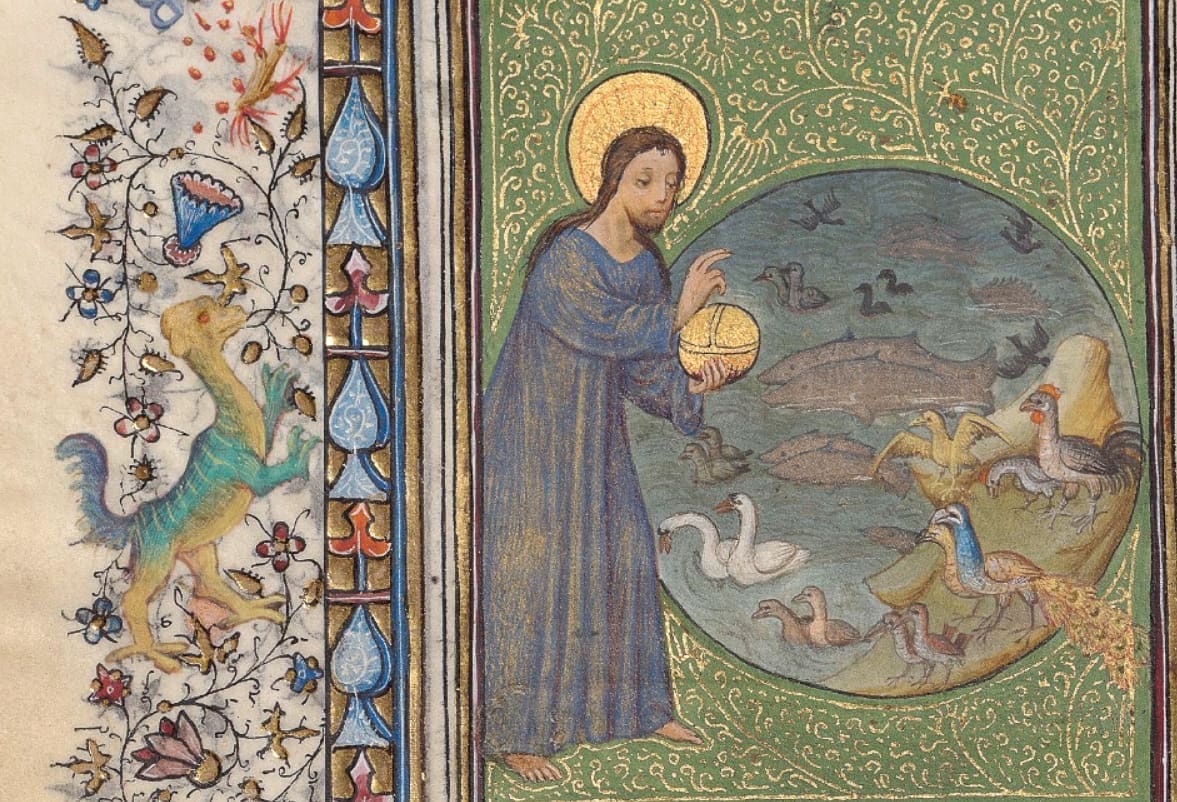
Illustration: God creating fish and birds. Miniature from “The Book of Hours of Joseph Bonaparte” ca. 1415.









Leave a Reply