


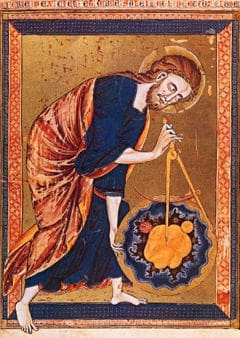
The concept of a singular God creating the world, as described in the Bible, is central to Judaism and Christianity. The primary creation account is found in Genesis, though interpretations vary among believers.
Genesis contains two creation narratives: the first spans the entire first chapter and the beginning of the second, describing the creation process in a week, with a Sabbath rest. God creates light on the first day, the firmament and waters on the second, dry land and plants on the third, celestial bodies on the fourth, birds and sea creatures on the fifth, and animals and humans on the sixth. The narrative concludes with God resting on the seventh day (Genesis 1:1–2:3).
The second narrative, starting in Genesis 2:4, details the creation of the Garden of Eden, the trees of life and knowledge, the commandment to avoid the tree of knowledge, and the creation of Eve from Adam’s rib (Genesis 2:4–25). References to God’s creation are present throughout the Bible, albeit with less detail than in Genesis.
Interpretation of biblical creation impacts theological debates and modern scientific views, particularly regarding evolution.
Historical Interpretations
Biblical creation texts were historically interpreted literally and non-literally. Basil the Great, a proponent of literal interpretation, argued against allegorical readings, asserting that God created the world in six 24-hour days.
The Reformation saw Protestant theologians like Martin Luther develop literal interpretations, rejecting notions that the biblical six days were metaphorical.
Other Ancient Interpretations
Non-literal interpretations trace back to pre-Christian Judaism and continued in early Christianity. Origen, in the third century, criticized literal readings of creation, suggesting the biblical narrative contains allegorical meaning. Augustine, in the 5th century, argued against literal interpretations when they conflict with scientific knowledge, asserting that the Holy Scriptures weren’t intended to convey scientific facts.
Modern Interpretations
Modern theologians, acknowledging scientific discoveries about the universe’s age, often interpret Genesis allegorically. Scientific creationism attempts to support a literal biblical reading, disputing established scientific theories on Earth’s history and evolution.
Scientific creationism, deemed pseudoscientific by academics, lacks empirical data and often contradicts scientific principles. It is primarily promoted by Protestant fundamentalists.
Separation of Science and Theology
Many Christians accepting evolution believe biblical texts present theological ideas rather than scientific facts. Catholic theologian Ludwig Ott notes the Church does not engage in scientific matters but refutes errors endangering faith. Pope John Paul II emphasized the Bible’s purpose of teaching the correct relationship between man, God, and the universe, not scientific knowledge.
Protestant theologian Gordon J. Glover argues for understanding Genesis in the context of ancient Near Eastern cosmology, separating it from modern scientific interpretation.
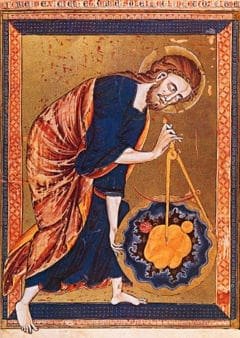
Illustration: God creating the universe with a compass. Miniature from a French Bible, 1220-1230, Austrian National Library, Vienna.










Leave a Reply