


The lecture hall resounds with the hit electronic dance track “I Like to Move It” by Reel 2 Real, as a group of 11-year-olds in fluorescent vests energetically perform their version of jumping jacks. They are led by prominent researchers from Europe at the front of the room. The aim is to assist an unfit superhero, Mr. Fit, in regaining his fitness through exercise, healthy eating, and sufficient rest. These themes are presented to the eager audience of children through engaging games.
Mr. Fit is enacted by a researcher from the University of Granada in Spain, who dons a superhero outfit for Science is Wonderful!, an annual event funded by the EU. “We examine children’s habits to see how they might affect health in later years,” explained Cristina Cadenas-Sanchez, a professor at the University of Granada who leads the academic team. “We collect data in schools and monitor these children as they grow.”
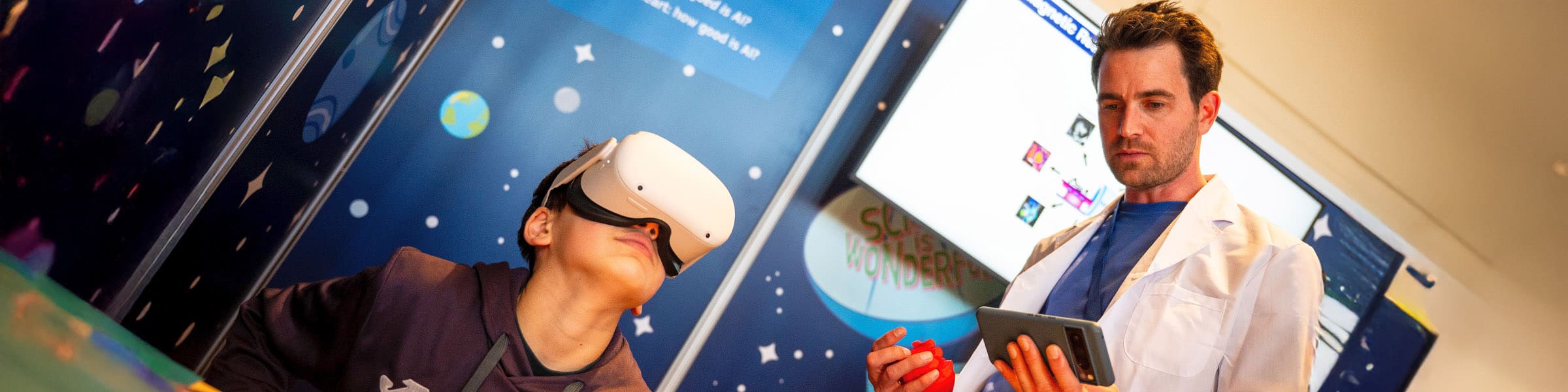
They showcased their PreCaFit research at the science fair in Brussels, where children aged 7 to 18 interacted with top scientists and learned about their work. More than 150 researchers hosted exhibits on topics like earthquake-resistant construction, primates, math, and malaria. The fair’s research was primarily presented by Marie Skłodowska‑Curie fellows, part of the EU’s research training program, with a few booths by European Research Council grantees.
The fair featured interactive stalls and enthusiastic scientists, with some dressed as superheroes. Many researchers participated out of a passion to share their love of science with the younger generation. “This event is a bridge to the next generation of scientists,” said Sybille Luhmann, project manager of the event’s 11th edition. “It dispels the notion that science is isolated; it’s an accessible field that can enhance our lives.”
In another room, younger children gathered around a table as a strange noise emerged from a device. This booth was run by Alberto Martín‑Pérez and Liga Jasulaneca from the Technical University of Delft in the Netherlands, working on PROPHOTOM, an EU-funded project creating ultra-sensitive sensors for bacteria.
Turning the invisible microbial world into something tangible was the challenge. “I start by asking what noises animals make,” said Martín-Pérez. “The children like to mimic those sounds. Then I ask about bacteria noises, which leaves them silent. Our research involves detecting these bacterial sounds.”
“Sound and movement are linked,” Martín-Pérez explained. “A vibrating guitar string creates sound. We can’t hear bacteria vibrations, but our technology detects them.” This was demonstrated by producing sounds from strings and using a frequency generator to create noise, before showcasing their bacterial vibration technology.
Explaining everything was intense, admitted Jasulaneca, who sometimes used interpreters, but it was rewarding when children understood.
Nearby, the bug booth highlighted mosquitoes and other insects, run by Raquel Martins Lana with her colleagues Andria Nicodemou and Tatiana Docile. They worked on REGIME, an EU-funded project on climate-sensitive diseases. Their research models the spread of diseases like malaria and dengue, which are moving beyond tropical areas due to climate change. Children learned prevention techniques through games.
“Children bring this knowledge home, teaching their families,” said Martins Lana.
Roberta Marziani, a Siena University mathematician, used soap bubbles to introduce complex math concepts. Her TopSing project studies minimal surfaces, a concept made clearer through soap bubbles that form the smallest possible surface when dipped into soapy water. The demonstration has applications in designing efficient electronics and architecture. “Children love the bubbles and are impressed by the math,” said Marziani, who hopes to spark interest among kids in the subject.
Amid the event’s activity, artist Valentine De Cort captured children’s imaginations. She asked kids why they liked science and what they would invent, transforming their ideas into illustrations. Her drawings, ranging from practical to whimsical, adorned the wall behind her. “I love their creativity,” said De Cort, inspired by their inventive ideas.
Over three days, more than 4,200 children attended the fair. For Luhmann, the event’s success was in connecting scientists and kids. “Scientists and children are the best audiences,” Luhmann noted. “Both have a keen desire to learn, making their interactions natural and rewarding.”
The interviewee views do not reflect those of the European Commission. If you enjoyed this article, consider sharing it on social media.
This edition of Science is Wonderful! coincides with the 30th anniversary of the Marie Skłodowska-Curie Actions (MSCA), the EU’s leading program for doctoral and postdoctoral training. Since 1996, MSCA has supported over 150,000 researchers through mobility, collaboration, and knowledge exchange across countries, disciplines, and sectors. The fair echoes this heritage by showcasing MSCA-led research to young audiences, inspiring future researchers and







Leave a Reply