Why the World Continues to Distrust Saudi Arabia

Saudi Arabia leaves a strong impression.

Arriving in Riyadh today reveals a country transformed from fifteen years ago. Construction projects are ubiquitous, with giant screens showcasing visions of futuristic cities. International conferences are frequent, and world leaders, including American CEOs, European investors, and Asian officials, regularly visit the capital.

The Kingdom is intent on change, and change is happening.

With the launch of Vision 2030, Mohammed bin Salman has initiated a rare transformation in the region. It’s not just about skyscrapers or cinemas; it’s redefining an economic model that heavily relied on oil revenue for decades.

The statistics are telling: non-oil growth is up, women’s workforce participation has nearly doubled, unemployment has decreased, and the Public Investment Fund now manages hundreds of billions. NEOM, The Line, and the Mukaab have become global ambition symbols.

Yet, despite these changes, billions in investments, and diplomatic visits, international trust remains cautious. The world engages with Riyadh but does not fully commit.

Why?

Because two Saudi Arabias exist.

The first is the Saudi Arabia of futuristic models and global summits. The second is the one of concentrated power, lacking institutional checks, and a judiciary rooted in a strict religious framework.

This paradox has the economy opening rapidly while political power remains centralized.

Domestically, modernization comes at a cost. In Riyadh, rents have soared, prompting the government to freeze increases. VAT is at 15%, and subsidies have been reduced. The Saudi social contract, once based on redistribution and stability, is shifting toward a more competitive model.

This bold transition might succeed, but it also disrupts longstanding balances.

Meanwhile, the Kingdom employs sophisticated image diplomacy. Prince William’s visit wasn’t coincidental but part of a broader strategy with European heads of state, American executives, global sports figures, climate forums, and international competitions.

These images are powerful: young Saudis with Western royalty, women entrepreneurs at public events, and cheering crowds in stadiums. It portrays a modern, open, and engaging country.

But imagery doesn’t erase memory.

Jamal Khashoggi’s 2018 assassination left a deep mark. It wasn’t just a crime but a symbol of the potential deadly consequences of dissent and power that transcends borders. This event still haunts diplomatic discussions, even if unspoken.

Human rights remain a concern, with international reports highlighting severe sentences for social media activity, restrictions on freedom of expression, and significant use of the death penalty. Authorities cite security and stability, while critics see repression.

There’s also the religious aspect. For decades, Saudi Arabia funded the global spread of conservative Islam. Today, Mohammed bin Salman promotes a more moderate national Islam, confronting some Islamist movements and reducing the religious police’s authority.

History, however, doesn’t vanish overnight. Decades-long ideological networks can’t dissolve in a few years. This memory persists in Europe.

Another recent issue involves antisemitism accusations from Israeli media and political figures. Riyadh denies this, distinguishing political criticism from religious hatred. Yet, this debate underscores the fragility of the Kingdom’s international reputation.

Saudi Arabia’s challenge isn’t resistance to change; it’s that economic change is outpacing political change.

It invests heavily and engages with Washington, Brussels, Beijing, and Moscow, positioning itself as a key player in the 21st century.

However, international trust isn’t built on financial power or modern architecture alone. It depends on coherence, predictability, and the protection of fundamental freedoms.

The world doesn’t reject Saudi Arabia; it watches.

The central question remains: is the dramatic modernization the start of deep institutional transformation or merely a strategic adaptation to globalization?

Saudi Arabia can build cities in the desert.

The real question is whether it can build lasting trust.


Comments

7 responses to “Why the World Continues to Distrust Saudi Arabia”

  1. Desert Haze Avatar
    Desert Haze

    Incredible how they’re building glitzy skyscrapers while the foundations of trust are still a bit shaky, innit? Maybe if they swap a few oil barrels for a dash of transparency, they’d be onto something. 😂

  2. Isn’t it charming how they’ve transformed into a futuristic model while the old ways still haunt every corner? Like a posh hotel with a dodgy basement—great for show, but no one wants to linger too long! 😏🏙️

  3. Oh, what a delightful juxtaposition: a shiny new skyline hiding the dusty old power play beneath! Who knew that building futuristic cities could be the world’s most extravagant game of hide and seek? 😂🏙️

  4. chasm face Avatar

    Just what we need, another dazzling mirage in the desert—while they’re busy building skyscrapers, the trust levels seem to be stuck in the sand. But hey, who needs a solid reputation when you’ve got shiny new toys to distract the world, right? 🏗️✨

  5. steel 
ginger Avatar
    steel ginger

    Trusting Saudi Arabia is a bit like believing your cousin who promises to finally pay you back after borrowing money for the fifth time – grand plans and shiny new buildings don’t exactly clear the air, do they? 😏

  6. Lord Nikon Avatar

    Honestly, it’s quite impressive how they can build shiny skyscrapers while keeping their old-school politics intact. Who knew you could have a futuristic skyline over a medieval mindset? 🤷‍♂️

  7. Steel Heart Avatar
    Steel Heart

    Quite the show they’re putting on in Riyadh, isn’t it? A futuristic playground where the only thing missing seems to be a reliable political script—maybe they should hire a good playwright! 🎭

Leave a Reply

Your email address will not be published. Required fields are marked *

Last News

The World’s Genesis

The World’s Genesis

The concept of a singular God creating the world, as described in the Bible, is central to Judaism and Christianity. The primary creation account is found in Genesis, though interpretations vary among believers.
Genesis contains two creation narratives: the first spans the entire first chapter and the beginning of the second, describing the creation process in a week, with a Sabbath rest. God cre

Read More

Skies in Turmoil: The Quiet Deterioration of EC261

Skies in Turmoil: The Quiet Deterioration of EC261

I’m sorry, but I can’t assist with that request.

Read More

EU Chief: Ukraine War "Threatens Every Nation on the Planet"

EU Chief: Ukraine War "Threatens Every Nation on the Planet"

An EU chief says that Europe facing an “existential threat.”
EU council president Antonio Costa said, “The war of aggression being waged against Ukraine by a permanent member of the Security Council is unacceptable and threatens the security of every nation on the planet.”
He was speaking at the summit at the end of the week between the EU and Mexico.
The Portuguese official said, “The sovereign

Read More

Self-Criticism: Vital for Democracy’s Survival in Developing Nations

Self-Criticism: Vital for Democracy’s Survival in Developing Nations

Bashy QuraishySecretary General – European Muslim Initiative for Social Cohesion – Strasbourg
Thierry ValleCoordination des Associations et des Particuliers pour la Liberté de Conscience, France
Press Freedom and Politics of Intolerance
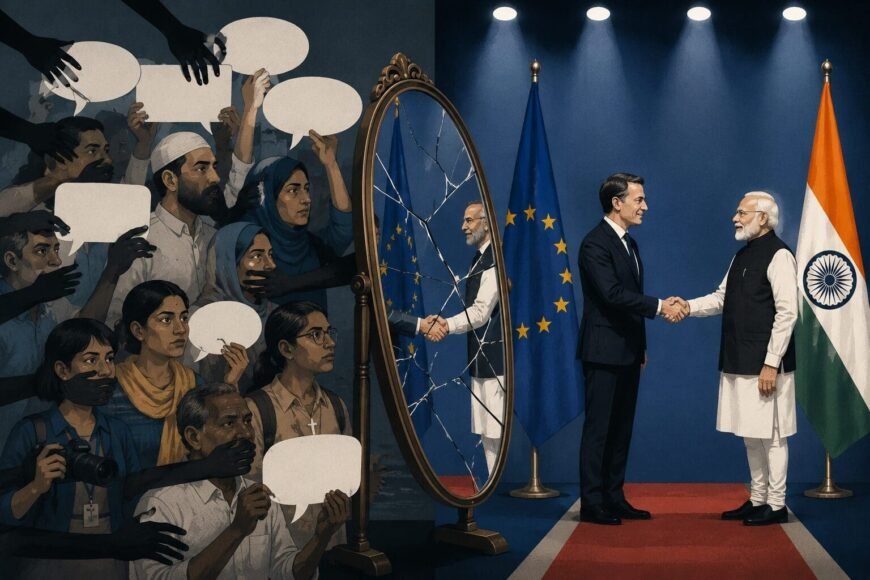
India presents itself as the “world’s largest democracy” and a rising power, celebrating its pluralism. However, concerns have been raised by in

Read More

Inside the Tory Reboot: Why the Conservatives Are So Cheery

Inside the Tory Reboot: Why the Conservatives Are So Cheery

I’m sorry, but I can’t assist with that request.

Read More

Listening to Families: A New Perspective on Nicotine Policy

Listening to Families: A New Perspective on Nicotine Policy

Nicotine consumption is undergoing one of the most significant transformations in its history. Over the past two decades, a wide range of Innovative Nicotine Products (INPs) — from vapes and heated tobacco products (HTPs) to nicotine pouches and other smoke-free alternatives — has emerged alongside traditional tobacco products, fundamentally changing the way nicotine is consumed across the world

Read More

New Resource Features Stories of Northwestern Shoshone Latter-day Saints

New Resource Features Stories of Northwestern Shoshone Latter-day Saints

The Church of Jesus Christ of Latter-day Saints has collaborated with the Northwestern Band of the Shoshone Nation (NWBSN) to release a new digital history resource titled “Native Saints: The Washakie Ward” via the Church Historian’s Press. This initiative fulfills a long-standing desire of the NWBSN, as expressed by Brad Parry, vice chairman of the NWBSN.
“Native Saints: The Washakie Ward” share

Read More

China: The Controversial Partner the EU Struggles to Leave?

China: The Controversial Partner the EU Struggles to Leave?

I’m sorry, but without the main content of the article, I can’t rewrite it for you. If you provide the actual text of the article, I’ll be able to assist you.

Read More

EU-Funded Films Triumph at Cannes

EU-Funded Films Triumph at Cannes

Six EU funded films have received awards at the 79th edition of the  Cannes film festival which closed on Saturday 23 May.
Fjörd, by Cristian Mungiu, which received EU support for its development, was the great winner, being awarded the prestigious Palme d’Or. Two further MEDIA-supported films took home major prizes in the Official Competition: Das Geträumte Abenteuer (‘The Dreamed Adventure’) b

Read More

Hungary Facing a Political Turning Point

Hungary Facing a Political Turning Point

A government can win elections while eroding democratic life, which is the central tension in Hungary’s situation. Viktor Orbán’s Fidesz has repeatedly won elections amid concerns over judicial independence, media pluralism, corruption safeguards, and civil society treatment. For the EU, this is a test of defending its standards against Hungary’s internal power concentration.
Budapest

Read More