



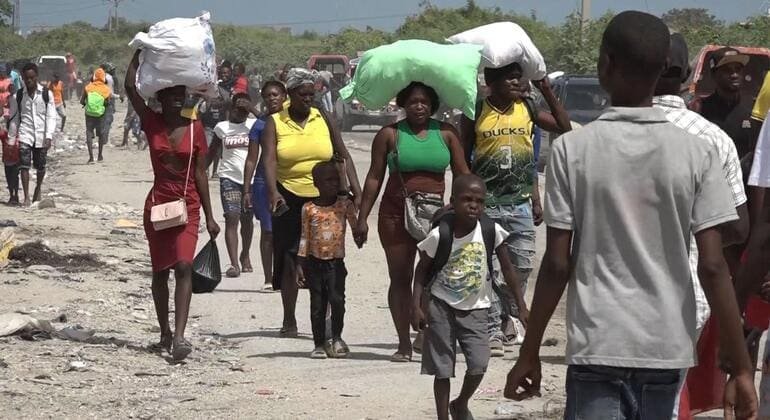
Ketia and her husband, both teachers, were able to support their three children before Hurricane Melissa hit the Caribbean last October. However, their coastal community of Petit Goâve was one of the hardest hit by the storm.
“I lost everything: my furniture, my car, everything in my home,” Ketia said.
Ketia’s family is among approximately 225,000 people receiving aid from the UN World Food Programme (WFP) after the storm. They are benefiting from a voucher system allowing families to purchase goods from selected retailers, a program supporting storm-affected people while stimulating the local economy.
“The shop uses an electronic system to record transactions, and WFP pays the retailer,” explained Channon Hachandi, Head of Supply Chain for WFP Haiti. “This method allows families to shop like normal customers instead of receiving assistance at a distribution point.”
Before the hurricane, over half of the residents in the worst-hit regions faced acute food insecurity, highlighting the ongoing humanitarian crisis in Haiti.
The storm claimed more than 40 Haitian lives, with many others losing their homes, businesses, and belongings. Damage to farmland resulted in the near-total loss of harvests in a region reliant on small-scale agriculture.
WFP provided aid before, during, and after the hurricane. Alongside the government, they sent 3.5 million early warning texts and offered cash payments to help people prepare for the storm.
During the storm, families in temporary shelters received rations. Immediately afterward, 15-day food rations were distributed as families assessed the damage.
The ongoing response, focused on providing cash and vouchers, gives families what WFP describes as “the dignity of choice.”
Currently, about 10 percent of Haitians receiving aid after Hurricane Melissa are benefiting from the voucher program, which WFP plans to expand.
Wilfred Nkwambi, Head of Programmes at WFP in Haiti, emphasized that vouchers support the local economy.
“In this shop alone, eight additional people are employed for distributions. In this part of Petit Goâve, five other shops employ a total of 40 people, mostly women and young people. It benefits not only recipients but also local merchants and producers,” Nkwambi explained.
WFP also employs day laborers for logistics, providing extra income for local families. This approach benefits everyone, turning aid into an economic recovery engine.
Placing dignity and choice at intervention’s core shows humanitarian assistance can mean resilience for Haitians, according to WFP.
“Thanks to the food voucher distribution, we won’t go hungry and can start rebuilding,” said Ketia, as she loaded groceries onto a motorcycle taxi and returned home.







Leave a Reply