


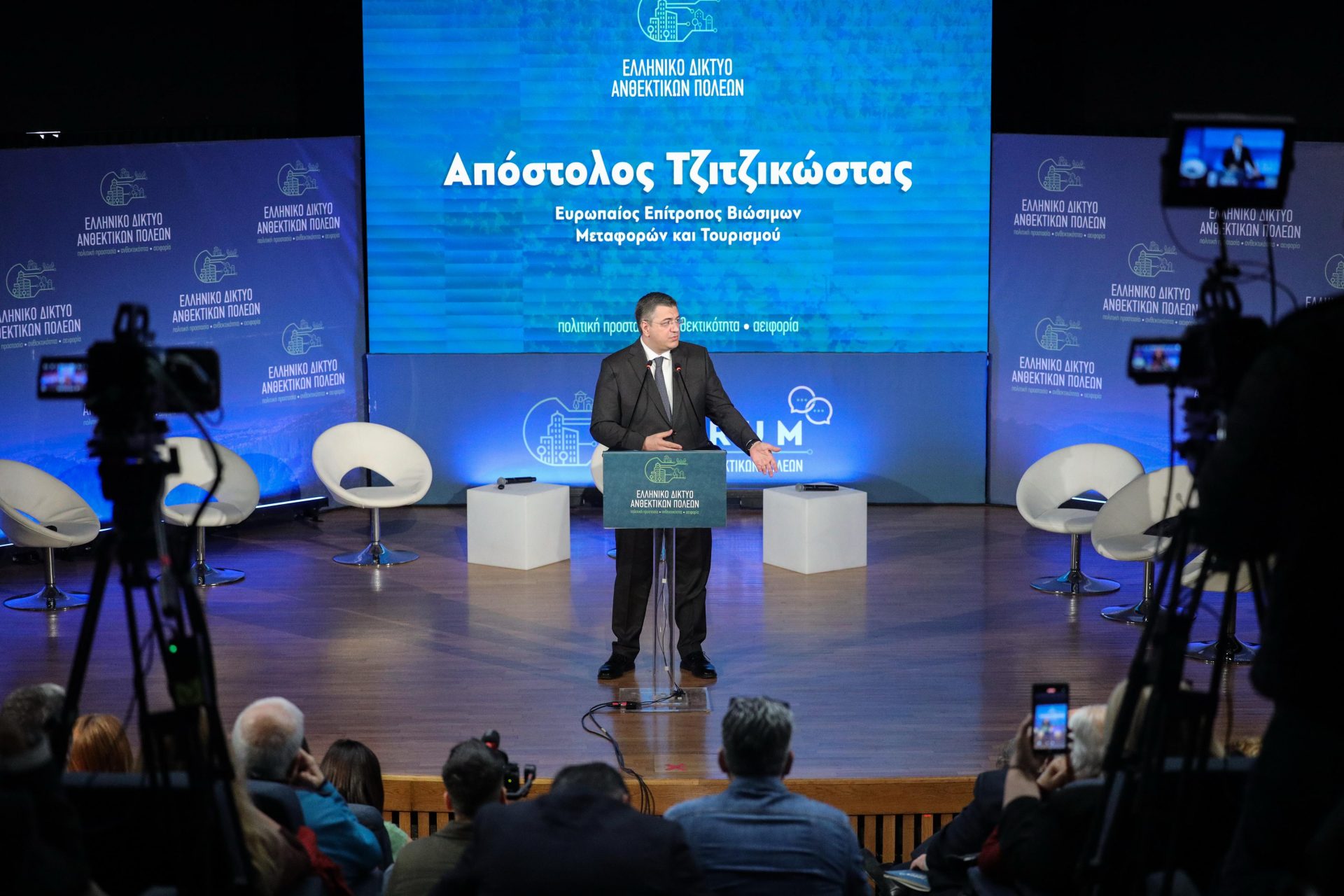
The Commissioner for Sustainable Transport and Tourism, Apostolos Tzitzikostas, emphasized the need for our cities to evolve into more resilient, humane, and environmentally sustainable spaces during the Forum of the Greek Network of Resilient Cities.
This two-day Forum, themed “Dialogue on Resilience: Active Support of Greek Cities for Mitigation and Adaptation to Climate Change,” brought together over 120 mayors, politicians, and scholars from across Greece.
In his opening remarks, Tzitzikostas highlighted the pressing challenges that require thoughtful planning and commitment, stating that cities are central to these discussions. He pointed out that by 2030, 60% of the global population is expected to reside in urban areas, a figure projected to rise to 80% by 2050. This rapid urbanization poses significant demographic, social, and environmental issues; cities occupy just 3% of the Earth’s land yet contribute to 72% of global greenhouse gas emissions. In the European Union, the statistics are similar, with cities covering 4% of the area while housing 75% of the population and accounting for 65% of energy consumption and 70% of carbon dioxide emissions.
Tzitzikostas identified climate change and urbanization as “two global mega-trends” that require careful examination of their interconnections, particularly in the Mediterranean, where the effects of climate change are most pronounced. These impacts jeopardize citizens’ health, infrastructure safety, and the economic stability of urban centers.
Despite these challenges, Tzitzikostas expressed optimism for three reasons. First, there is a deeper understanding of these challenges now than ever before, as evident in the dialogue fostered by the Forum and the Greek Network of Resilient Cities. Second, the EU has prioritized these issues, actively promoting sustainable policies and supporting cities through various programs and funding. Third, there exists an array of knowledge, technology, and tools to pursue significant goals, underscored by the EU’s commitment to fostering integrated partnerships and innovative solutions in the transition to resilient and sustainable cities.
He also highlighted key European programs such as “Horizon,” which finances innovative projects, the Recovery and Resilience Fund aimed at sustainable city development, and the NSRF, a vital resource for improving physical and digital infrastructure. Additionally, he mentioned the initiative for “100 Climate-Neutral and Smart Cities,” which seeks to position European cities as leaders in climate neutrality by 2030.
Cities like Athens, Thessaloniki, Trikala, Kozani, Ioannina, and Kalamata are working to cut air pollution by 200 million tons through various projects aimed at enhancing urban livability. Notably, 90% of climate action in Europe is currently being driven by regions and municipalities.
In discussing transportation, Tzitzikostas outlined a new strategy for the European automotive industry and a forthcoming sustainable transport strategy. He emphasized the importance of investing in clean urban mobility, electric vehicles, sustainable fuels, and digital transitions. He called for reduced reliance on fossil fuels, faster installation of electric charging stations, and the expansion of bike lanes to promote safer, greener transportation options for all citizens.
Addressing tourism, he noted the historic inclusion of tourism in a Commissioner’s portfolio and the efforts being made to establish a new European strategy. Tzitzikostas discussed the need for “balanced tourism,” where popular destinations are not overwhelmed while underappreciated locations are developed. He stressed the importance of extending the tourism season year-round and ensuring the preservation of natural and cultural heritage.
Amidst current geopolitical challenges, Tzitzikostas affirmed that while priorities may have expanded, the essential goals remain unchanged. He highlighted the potential decline of tourism by 10% by 2050 due to climate impacts, particularly affecting Mediterranean countries like Greece.
Summarizing, he concluded, “Our cities must and can become more resilient, more humane, and more environmentally sustainable. This is crucial for economic prosperity, attracting investment, addressing inequalities, and fostering social cohesion.”
For further reading, check out the article: A. Tzitzikostas: If necessary, the EU will act to defend the competitive position of European shipping.










Leave a Reply