


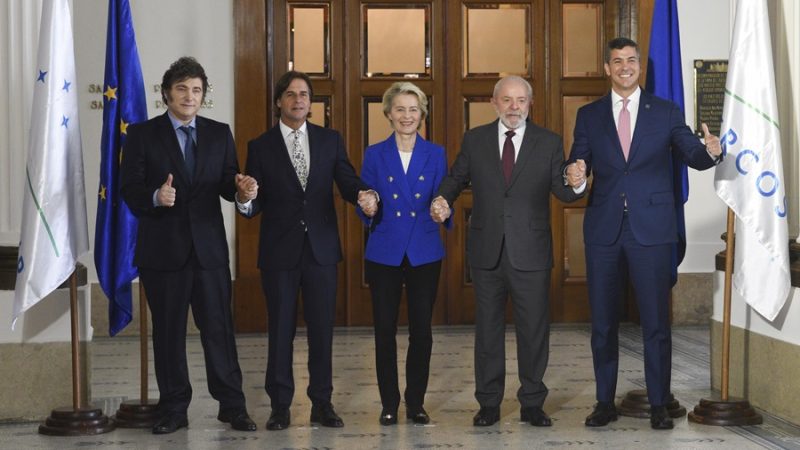
On Monday, European Commission spokesperson Paula Pinho announced that the Commission President Ursula von der Leyen intends to address the free trade agreement with Mercosur countries during next week’s European Council meeting in Brussels. This meeting will gather EU leaders on December 19th.
Pinho did not confirm if the trade agreement, which was negotiated on Friday in Uruguay between the EU and Mercosur nations—Brazil, Uruguay, Paraguay, Argentina, and Bolivia—will be officially included in the meeting’s agenda. However, she indicated that it will likely be a topic of discussion between von der Leyen and EU leaders during the event.
Sources in Brussels have indicated that von der Leyen particularly aims to engage with Donald Tusk and Giorgia Meloni, as both Poland and Italy have been vocal critics of the agreement.
Unexpectedly, von der Leyen was unable to hold a discussion with one of the agreement’s most prominent opponents, Emmanuel Macron. The French president had previously communicated his opposition to von der Leyen in a phone call, and there were hopes for a face-to-face meeting during the inauguration of the renovated Notre Dame Cathedral in Paris on Sunday. However, von der Leyen canceled her attendance due to scheduling conflicts. Pinho noted that while the President is in regular contact with Macron, the timing of their next conversation remains uncertain.
In terms of the agreement’s specifics, Olof Gill, the EC spokesperson for trade and agriculture, reassured that all food products and beverages entering the EU market will adhere to strict European safety and health standards, including regulations on pesticide use. He emphasized that Mercosur goods have been entering the EU market for years and must comply with existing EU rules. “No agreement will change that,” Gill asserted.
Pinho also mentioned that the EC plans to distribute the text of the agreement to legislators on Monday and intends to publish the document shortly thereafter.
After 25 years of negotiations, the agreement aims to facilitate access to South American markets for European technologies and secure raw materials essential for clean technology production, such as batteries. However, European farmers are concerned about the potential influx of inexpensive agricultural products from Brazil and Argentina into the EU market.
For the agreement to take effect, it must be ratified by the EU. (09.12.2024)




Leave a Reply