



The UN emergency relief chief, Tom Fletcher, warned of the rapid spread of violence causing mass displacement and economic shocks, stating, “We’re seeing the consequences spread faster than we can respond”.
In Geneva, the UN’s top humanitarian aid official called this a moment of grave peril and stated that without more support, “millions of people will die”.
$14 Billion Needed
The $23 billion appeal made last December by the UN aid coordinator to support 87 million of the world’s most vulnerable is still two-thirds short of being funded.
Fletcher noted that despite the global need for assistance far exceeding 87 million people, this figure represents those “in greatest need”.
“We still need over $14 billion now to deliver this plan, and this is at a time when conflict in the Middle East is costing $1 billion a day,” he said. “Even just $1 billion would allow us to save millions of lives.”
Fletcher emphasized the need to adapt humanitarian relief as global crises intensify, noting that Gaza and Sudan are top priorities for funding.
Strait of Hormuz Effects
Fletcher’s comments coincide with concerns about the closure of the Strait of Hormuz shipping corridor on 2 March and its impact on affected civilians.
With the corridor handling 20% of the world’s oil, Fletcher highlighted the broader impact on food, energy, and fertilizer costs.
“I’m worried that actually further escalation will damage other supply routes. All of this has a direct impact on our humanitarian supplies, including going to areas of key need in sub-Saharan Africa.”
‘We Refuse to Retreat’
Fletcher stressed that the global community’s priority should be the protection of civilians and infrastructure.
He urged member states to help protect humanitarian efforts in the region, following the deaths of aid workers in Sudan, Lebanon, and the Democratic Republic of the Congo.
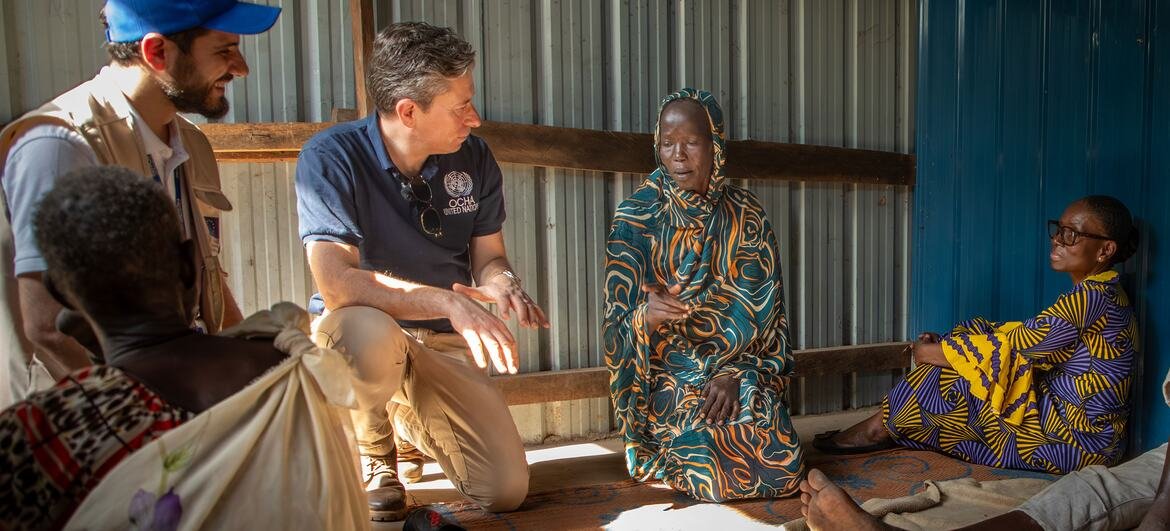
The UN’s Emergency Relief Coordinator, Tom Fletcher, talks to a displaced woman in a camp in Malakal, South Sudan.
“Aid workers are increasingly under attack,” Fletcher said, noting that “human ingenuity is being applied to find ever more sinister ways to kill at scale”.
Last year, 90% of those killed in drone attacks were civilians, many humanitarian workers.
“This is a tough moment for humanitarian action. We are overstretched, under sustained attack and under-resourced, but we refuse to retreat from our principles and we refuse to retreat from our mission.”
Source link






Leave a Reply