



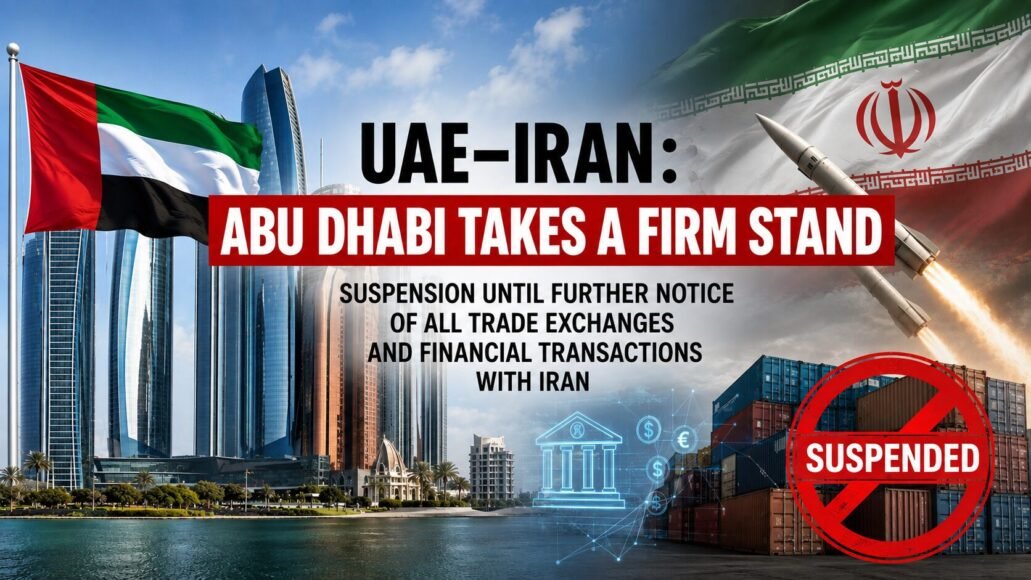
The United Arab Emirates has adopted a tougher stance towards Iran after detecting two ballistic missiles launched from Iranian territory. Abu Dhabi has announced a suspension of all trade exchanges and financial transactions with Iran until further notice. This decision highlights the UAE’s commitment to protect its sovereignty while leveraging its regional and international influence.
An exceptionally firm decision
The United Arab Emirates has significantly escalated its response to rising regional tensions by suspending all trade exchanges, commercial activities, and financial transactions with Iran indefinitely. This move, as reported by Gulf News and Sharjah24, reflects Abu Dhabi’s willingness to impose concrete consequences when national security and sovereignty are at risk. The UAE Ministry of Foreign Affairs emphasized its commitment to international law and the integrity of the international financial system. This announcement signals that Abu Dhabi is ready to use its economic and financial influence in addition to diplomatic statements, underscoring the role of trade and investment as vital instruments of power and stability in the region.
Two ballistic missiles at the heart of the escalation
The announcement is set against a serious military development following confirmation by the UAE Ministry of Defence of two ballistic missiles launched from Iran towards the UAE. According to Reuters, this incident is the first of its kind since the May 4 attack on the port of Fujairah. One missile fell outside UAE territorial waters, while the other landed within them. Emirati authorities have reinforced security measures, illustrating their preparedness to handle threats to their security, sovereignty, or stability.
UAE sovereignty as a red line
Abu Dhabi’s response underscores the principle that the sovereignty and national security of the UAE are non-negotiable, especially when faced with direct threats. The UAE is moving beyond verbal condemnation by employing diplomacy, territorial defense, and economic influence to signal that threats to its fundamental interests will have significant consequences. This reflects the UAE’s evolution into a strategic actor in the Middle East, capable of influencing diplomatic relationships, investment flows, and regional power balances.
Economic power becomes a strategic instrument
The suspension of UAE-Iran trade is significant given the UAE’s central role in regional and international economic networks. Historically, economic relations with Iran involved significant trade and financial flows. By suspending these transactions, Abu Dhabi is prioritizing national security over short-term commercial interests and signaling Tehran that economic ties cannot be separated from issues of sovereignty and security.
Abu Dhabi combines strength with strategic restraint
The UAE’s response combines firmness with strategic control, avoiding open military escalation by choosing an economic and financial measure. This approach provides multiple response options and preserves room for maneuver, demonstrating the UAE’s ability to exert pressure while maintaining control over its response’s pace and intensity, consistent with its objective of protecting stability and its position as a global economic center.
A message extending far beyond Tehran
While aimed at Iran, the UAE’s decision is observed globally, including by the U.S., European capitals, and international businesses reliant on regional stability. The proximity of the Strait of Hormuz amplifies the international significance of any escalation. Reuters noted increased oil prices amid concerns over Iran and the Strait’s security, highlighting the broader impact of Gulf tensions.
The UAE is asserting its regional influence
Abu Dhabi’s decision shows that threats to Emirati interests can lead to significant political and economic consequences. The UAE’s combination of defense capabilities, diplomatic influence, and financial power gives its actions against Iran strategic weight. The suspension of trade and financial transactions is a political signal of Abu Dhabi’s readiness to protect its national interests and sovereignty using its international influence.
A crisis that could reshape regional balances
The key question is how Tehran will respond to this measure and whether it will help contain tensions or initiate a new confrontation phase in the Gulf. It is clear that the UAE will not rely solely on diplomatic condemnation when its security is threatened and will use all available instruments to protect its interests. Abu Dhabi’s decision could set a precedent for how a major regional economic power uses its networks as strategic tools, reinforcing its role as a leading Middle Eastern actor during a crisis where missteps could have global repercussions.








Leave a Reply