The War That Was Inevitable, Yet Europe Barely Notices

Bashy Quraishy
Secretary General – European Muslim Initiative for Social Cohesion – Strasbourg
Thierry Valle
Coordination des Associations et des Particuliers pour la Liberté de Conscience, CAP Freedom of Conscience

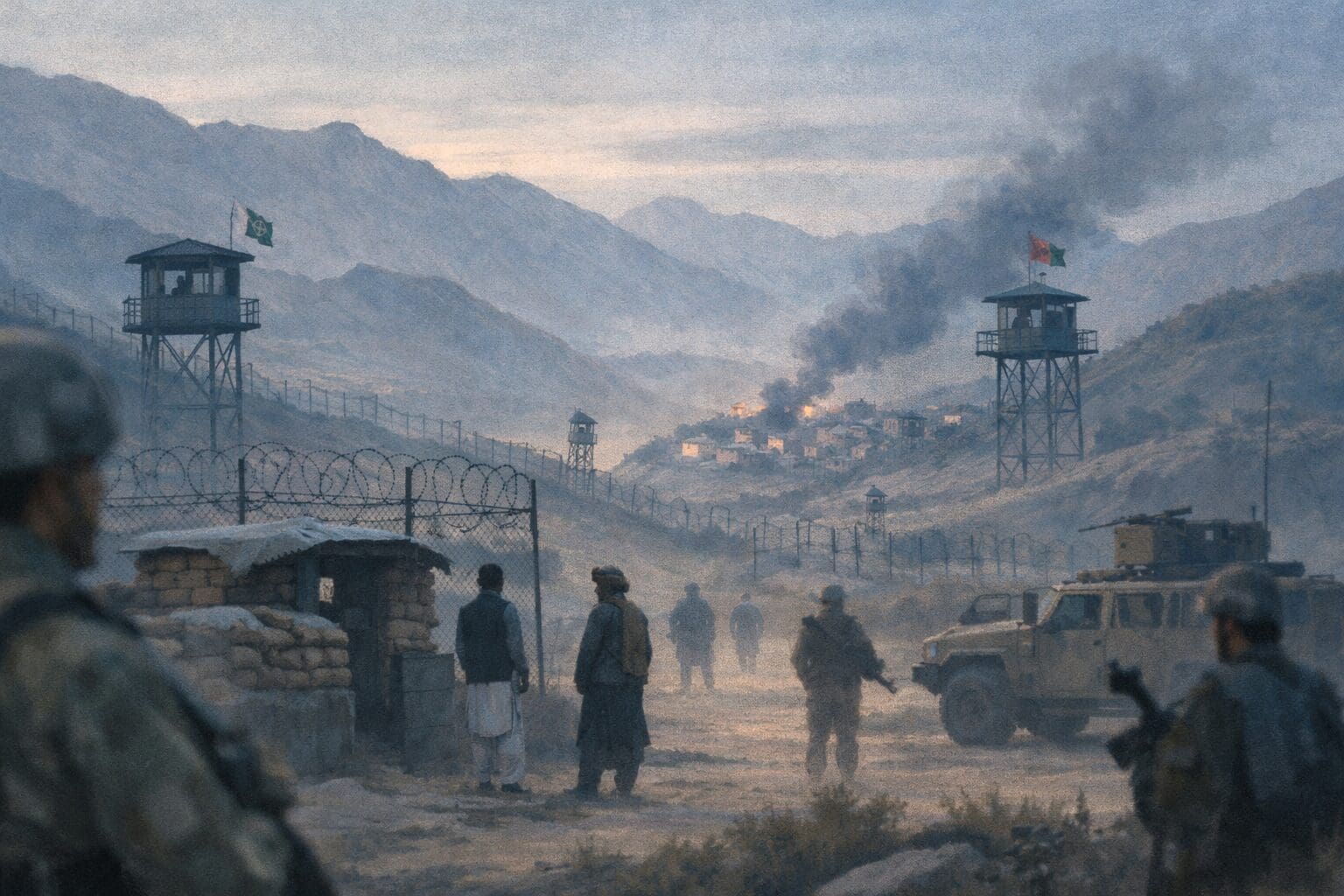
Over a century after the Durand Line was established by British imperial authorities, the contested border between Pakistan and Afghanistan has again erupted into conflict. The appearance of a sudden war is actually the result of decades of unresolved issues—colonial borders, militant movements, regional rivalries, and a fragile state system unable to manage them.

When hostilities broke out between Pakistan and Taliban-ruled Afghanistan on 27 February 2026, many saw it as a shocking escalation. In fact, it was anything but sudden. At the heart of it all is a colonial boundary on the map.

For decades, the frontier between the two countries has been one of the world’s most volatile borders. It is a line drawn by empire, challenged by nationalism, exploited by militant groups, and caught in the rivalries of regional powers. The present conflict is less a new war and more the violent return of a century-old dispute.

The British Border That Never Settled

The crisis dates back to 1893, when the British Empire sought to secure its north-western frontier in India. British diplomat Mortimer Durand negotiated a border agreement with Afghan ruler Abdur Rahman Khan.

The line they drew—now known as the Durand Line—cut through the traditional lands of the Pashtun tribes, dividing communities between Afghanistan and what was then British India. For the British, the line served as a strategic buffer against imperial rivals. For the tribes it separated, it held no significance. And for Afghanistan, it would later symbolize colonial injustice.

When Pakistan was created from the partition of British India in 1947, it inherited the Durand Line as its international border. However, Afghanistan never fully recognized it. Kabul claimed that the agreement was imposed by a colonial power and that the Pashtuns along the frontier should decide their own political future.

The dispute tainted relations from the start. Afghanistan was the only country to vote against Pakistan’s entry into the United Nations in 1947—a symbolic act foreshadowing decades of mistrust.

Cold War Alliances and the Refugee State

Despite the hostility, Pakistan soon became Afghanistan’s lifeline. When the Soviet Union invaded Afghanistan in 1979, millions of Afghans fled across the border. Pakistan suddenly became the center of one of modern history’s largest refugee crises. At its peak, around three million Afghans lived in Pakistan. Many stayed for decades. Entire generations were born and raised in refugee camps and cities like Peshawar and Quetta.

Pakistan also became the logistical heart of the anti-Soviet resistance. With support from the Central Intelligence Agency and funding from Saudi Arabia, Pakistan aided the Afghan mujahideen. However, the infrastructure created for that war—training camps, militant networks, ideological madrassas—did not vanish post-Soviet withdrawal. Instead, they evolved. From this environment emerged the movement that would later dominate Afghanistan.

The Rise of the Taliban

In the chaos of Afghanistan’s civil war during the 1990s, a new force emerged: the Taliban. The group was largely made up of Afghan students educated in religious schools in Pakistan’s border regions. Offering order after years of warlord violence, they seized Kabul in 1996 and established an Islamic emirate. Pakistan was among the few countries to recognize the Taliban government. The relationship was driven by strategic calculations: Islamabad hoped a friendly government in Kabul would provide strategic depth in its longstanding rivalry with India. However, regional geopolitics soon complicated this scenario.

India’s Quiet Battlefield

For decades, Afghanistan has also been a stage for the rivalry between India and Pakistan. During the Afghan republic set up after the 2001 overthrow of the Taliban, India heavily invested in Afghan infrastructure, diplomacy, and development projects. New highways, the Afghan parliament building, and numerous hospitals and schools were built with Indian aid. Pakistan viewed this growing presence with deep suspicion, fearing India could use Afghan territory to support separatist or militant groups within Pakistan.

Islamabad repeatedly accused Indian intelligence of backing insurgent networks in Pakistan’s western provinces—allegations India consistently denied. Whether exaggerated or not, the perception of encirclement shaped Pakistan’s security thinking. Afghanistan was never just a neighbor; it was part of the broader strategic contest between South Asia’s two nuclear-armed rivals.

When Allies Become Adversaries

When the Taliban reclaimed power in 2021 after NATO’s withdrawal from Afghanistan, many in Pakistan expected relations to improve. Instead, the opposite occurred. The central issue was the rise of Tehrik‑i‑Taliban Pakistan, known as TTP. Though ideologically aligned with the Afghan Taliban, TTP focuses on overthrowing the Pakistani

Comments

16 responses to “The War That Was Inevitable, Yet Europe Barely Notices”

  1. Moonflower Avatar
    Moonflower

    Isn’t it charming how a century-old border dispute can turn into a sudden war? Makes you wonder what the real estate agents were thinking when they drew that line, eh? 😏

  2. Seal Snake Avatar
    Seal Snake

    Right, because nothing screams “stability” like a century-old border dispute flaring up in 2026—who knew history could be so… predictable? 🤷‍♂️ It’s almost as if drawing lines on maps without considering the locals might lead to a bit of bother, innit?

  3. Lucky Aurora Avatar
    Lucky Aurora

    Oh, of course, yet another “unexpected” war sparked by a line on a map drawn by someone who probably couldn’t find it on a globe. You’d think by now, they might have figured out that history isn’t just a dusty old book, eh? 😏

  4. Racy Lady Avatar
    Racy Lady

    Isn’t it just delightful how centuries-old colonial messes keep giving us fresh headlines? One would think we’d learn to read a map by now, but apparently, that’s asking too much! 😂

  5. Highway Avatar

    Seems like the only thing getting resolved here is a century-old border dispute—who knew colonial hangovers could be so persistent? 🤷‍♂️ Maybe we should start handing out maps instead of weapons? 🌍💼

  6. Star Scratch Avatar
    Star Scratch

    Looks like the only thing more predictable than a rainy day in London is the never-ending squabble over the Durand Line. Who needs reality TV when you’ve got centuries-old border disputes to keep the popcorn popping? 🍿😉

  7. Mr. Wholesome Avatar
    Mr. Wholesome

    Just what we needed, another reminder that colonial mischief has a flair for the dramatic—who knew a hundred-year-old border dispute could become the latest blockbuster? 🎬 But hey, as long as we keep sipping our espresso, right? ☕️

  8. Skull Crusher Avatar
    Skull Crusher

    Seems like the world is busy binge-watching the latest season of “Border Disputes: The Never-Ending Saga.” Spoiler alert: nobody’s tuning in, and the plot twist is just more chaos! 😏

  9. natural mess Avatar
    natural mess

    Just what we needed—yet another “surprise” war sparked by a century-old colonial mess! It’s almost as if history is just waiting for us to take a break from our busy lives to remind us that some borders should have been left alone… 🙄🗺️

  10. new york winder Avatar
    new york winder

    A brilliant read, really—who knew a century-old border dispute could still cause such a ruckus? 😅 Maybe we should just hand out maps and let everyone play “finders keepers” instead!

  11. domino Avatar

    Isn’t it charming how Europe seems to be on a permanent coffee break while the world goes up in flames? ☕️🔥 Some things never change, eh?

  12. General Broomdog Avatar
    General Broomdog

    Just what we need, another reminder that historical borders are about as useful as a chocolate teapot. I suppose we can all just grab a pint and wait for the next inevitable round of “who’s really in charge” to kick off. 🍻😂

  13. So, the inevitable war that everyone somehow missed—must be one of those classic European “let’s ignore the elephant in the room” moments, right? 🤦‍♂️ Who needs foresight when you can just sip coffee and pretend history isn’t knocking at your door?

  14. Fuzzy Rainbow Avatar
    Fuzzy Rainbow

    Just what we needed—another beautifully complex mess created by the British, now blowing up in our faces like a poorly made soufflé. 🍰 Who knew colonial borders could stir up trouble? It’s almost charming how we pretend we’re surprised. 😏

  15. Station WMD Avatar
    Station WMD

    Isn’t it just charming how a century-old colonial blunder can still stir up the pot? Just another day in Europe, where history is more of a forgotten menu than a lesson, eh? 😏🍷

  16. Snow Hound Avatar
    Snow Hound

    Isn’t it just delightful how we’re still dancing around colonial borders like it’s a 19th-century ball? Meanwhile, the rest of us are just trying to figure out who forgot to bring the popcorn for this century-old soap opera. 🎭🍿

Leave a Reply

Your email address will not be published. Required fields are marked *

Last News

‘Orbán Breaks Silence: Political Era Ends Following Hungarian Election Defeat’

‘Orbán Breaks Silence: Political Era Ends Following Hungarian Election Defeat’

Orbán, Hungary’s 16-year leader, adopted a solemn demeanor throughout the interview, expressing personal feelings of pain and emptiness following the election results. He has been focusing on his work as “occupational therapy” to manage the shock, admitting, “Even I thought we were going to win.”
Magyar has signaled a departure from Orbán’s nationalist-populist

Read More

Sudan: RSF Shows Willingness While Burhan Struggles to Balance

Sudan: RSF Shows Willingness While Burhan Struggles to Balance

General Mohamed Hamdan Dagalo, the leader of Sudan’s Rapid Support Forces, has reiterated his commitment to ending the three-year civil war and engaging in peace negotiations. He is open to allowing UN-supervised humanitarian support in the areas under his control. In recent talks in Nairobi with Pekka Haavisto, the UN secretary-general’s envoy, Dagalo expressed readiness to stop the war an

Read More

Germany Ready to Deploy Minesweepers to Strait of Hormuz

Germany Ready to Deploy Minesweepers to Strait of Hormuz

The minesweeping plan was initially reported by Süddeutsche Zeitung.
Merz confirmed his government’s stance after meeting with Irish Prime Minister Micheál Martin in Berlin on Thursday. He emphasized that Germany is “fundamentally ready” to assist in securing shipping routes, but only under strict conditions.
These conditions include a stable ceasefire, a mandate within a collective security syste

Read More

Scientology Church Members Commemorated World Health Day in Europe and Beyond

Scientology Church Members Commemorated World Health Day in Europe and Beyond

Scientology Observes World Health Day with Drug Prevention, Blood Donation, and Community Health Efforts
KINGNEWSWIRE // PRESS RELEASE // BRUSSELS, Belgium — April 16, 2026 — Churches of Scientology worldwide commemorated World Health Day 2026 through various activities promoting physical well-being and social responsibility, highlighting the importance of health within Scientology’s social bett

Read More

Russia Overnight Attack on Ukraine Leaves at Least 16 Dead

Russia Overnight Attack on Ukraine Leaves at Least 16 Dead

Ukraine has successfully intercepted 90 percent of the killer drones and nearly 80 percent of the cruise missiles that Russia has targeted at the country over the past six months, according to Ukraine’s Defense Minister Mykhailo Fedorov, who spoke at the Ukraine Defense Contact Group meeting in Berlin on Wednesday. He reported that from last November to March this year, Russia launched 462 ballist

Read More

First Presidency Announces 2026–2027 Area Leadership Assignments

First Presidency Announces 2026–2027 Area Leadership Assignments

The First Presidency of The Church of Jesus Christ of Latter-day Saints has shared the 2026–2027 area leadership assignments and announced changes to enhance support in Area Presidencies for the needs of a growing Church. These changes take effect on August 1, 2026.
Each General Authority Seventy or Area Seventy serves in an Area Presidency. There are no specific counselor designations. The Area

Read More

Postal Conflict: The Election Brawl Begins

Postal Conflict: The Election Brawl Begins

With just three weeks to polling day, postal voting has commenced in local and devolved elections across the UK. Concerns are being raised about whether the process will remain clean and how deeply fake media could impact the campaign.
In Scotland, a major dispute has emerged between Labour and Reform regarding an alleged secret collaboration to oust the SNP, with both parties accusing each other

Read More

Extensive Grazing: Crucial for One-Third of Europe’s Protected Habitats | Press Releases

Extensive Grazing: Crucial for One-Third of Europe’s Protected Habitats | Press Releases

One-third of EU-protected habitats rely on low-intensity grazing, according to a European Environment Agency (EEA) briefing. To maintain these habitats protected under the EU Habitats Directive, 10-15% of EU cattle, sheep, and goats are necessary. Economic pressures and technological advancements have shifted farming to intensive methods, often leading to land abandonment in grazing-dependent are

Read More

Rumen Radev, Fighter Pilot, Aims to Resolve Bulgaria’s Political Deadlock

Rumen Radev, Fighter Pilot, Aims to Resolve Bulgaria’s Political Deadlock

Diverse Supporters
Amidst long-standing rumors of his plans to pursue the prime minister role, Rumen Radev announced his Progressive Bulgaria initiative in March. Though Radev does not formally lead Progressive Bulgaria, he is undeniably its central figure. The movement brings together a diverse group of politicians aligned with him, military personnel, newcomers, and former sports figures, with o

Read More

‘Sudan is an Atrocities Laboratory,’ UN Aid Chief Tells Berlin Conference

‘Sudan is an Atrocities Laboratory,’ UN Aid Chief Tells Berlin Conference

Countries have reportedly pledged over $1 billion at the third International Conference for Sudan, co-hosted by Germany, the African Union (AU), the European Union (EU), France, and the United Kingdom.
Senior UN officials delivered remarks, including humanitarian affairs chief Tom Fletcher, who described Sudan as an “atrocities laboratory,” citing sieges of cities like El Fasher in Darfur, deni

Read More