



The Serbian government has initiated legislative measures to create the Orthodox University “St. Sava,” which will be established by the Serbian Orthodox Church and may include the state as a co-founder. The project plans for budget funding and state-supported student education, though no official announcements about faculties, specialties, academic programs, or teaching staff have been made as of late August. The initiative was introduced in April this year with a memorandum signed between the government and the Serbian Church amid ongoing student protests.
On August 20, 2026, the government submitted a draft amendment to the Serbian parliament concerning the Law on Churches and Religious Communities. The draft is still under review but was approved in principle by the parliamentary Committee on Human Rights, Minorities, and Gender Equality on August 24.
The new Article 35a in the law allows the Serbian Orthodox Church to establish a “special university” of “special public importance,” emphasizing the Church’s historical role in Serbian education, science, culture, and national identity preservation. The SPC can have co-founders, including individuals, legal entities, or the Republic of Serbia.
The draft extends beyond granting the Church university establishment rights, allowing SPC institutions to receive republican budget funds for accredited programs. The government will determine the number of state-funded students. It also permits the creation of research organizations and training centers, potentially funded by the budget, including dual training and business cooperation.
Procedural requirements are eased: a university established by the Church won’t need to prove founding capital or bank guarantees for initial and subsequent accreditations; however, curricula must be accredited generally.
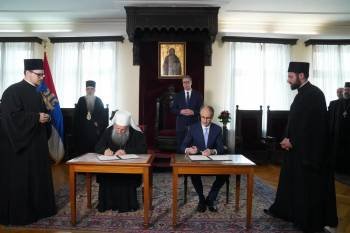
The university’s idea was formalized earlier this year when Serbian Patriarch Porfirije and Prime Minister Đuro Matsut signed a memorandum to establish the Serbian Orthodox University “St. Sava,” attended by President Aleksandar Vučić and Minister of Education Dejan Vuk Stanković. President Vučić envisioned theological education alongside medicine, law, natural and technical sciences, and arts.
No specialty list or faculty composition has been published, nor has the teaching staff been announced. The Orthodox Theological Faculty of the University of Belgrade is frequently mentioned as a possible contributor, with the newly established Faculty of Serbian Studies in Niš and the Despot Stefan Lazarević Faculty as potential participants, but no official structure for St. Sava has been announced. Minister Stanković supports increased Serbian Church involvement in the education system, linking it to enhanced study of Serbian tradition, culture, language, and history, suggesting an initial focus on theological and humanitarian studies.
Criticism focuses on the special status of the Serbian Orthodox Church. While all religious communities can establish higher education, a specific article regulates the Orthodox university’s unique status, allowing state co-founding and budget financing.
The bill claims that the Orthodox university’s “special public importance” doesn’t affect other religious communities’ equality. However, critics question if similar opportunities would be extended to other religious denominations like the Catholic Church or Islamic Community.
The law’s urgent adoption has also been criticized, with the government citing potential “harmful consequences” for religious institutions without explaining them, raising questions about pushing such significant education changes through the Church and Religious Communities Law instead of broader discussion.
The tension arises from Serbia’s political context, where universities and student movements are key government critics, and “St. Sava” is seen as an effort to create an academic center closer to state and church authorities.







Leave a Reply