



The Iron Pillar in Delhi
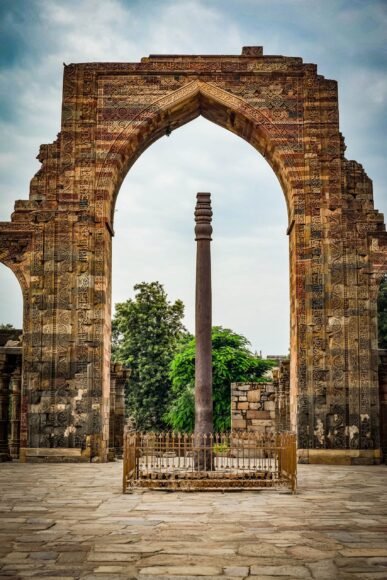
Metals typically have a limited lifespan, with iron quickly corroding when exposed to the environment. However, in the courtyard of the Quwwat-ul-Islam mosque in Delhi stands an anomaly: an iron pillar that defies this natural decay.
The pillar stands 7.21 meters tall from top to base, with 1.12 meters underground. The capital measures 306 mm and the structure weighs over six tonnes. Forged over 1,600 years ago, during the era of the Western Roman Empire, it has withstood the monsoons of northern India with minimal rust. This remarkable durability is attributed to the metal’s unique composition and lost ancient techniques.
The Banner of Vishnu
The pillar’s height, including its underground portion, approaches seven meters and weighs nearly six tons. Made of wrought iron, it features an ornament possibly once depicting Garuda, Vishnu’s mythical bird. The inscriptions on the pillar, about two meters from its base, are composed in classical Sanskrit verse, praising a ruler named Chandra. They describe victories and a dedication to Vishnu, with the pillar erected as a dhvaja – a banner – on Vishnupada, a hill associated with Vishnu. The inscription, crafted posthumously, suggests the king has “left this land.”
Chandra’s identity sparked debate until Bhau Daji’s 19th-century deciphering, supported later by John Faithfull Fleet linking it to the Gupta dynasty. Current belief attributes the pillar to Chandragupta II Vikramaditya, ruling from around 375 to 415 AD. The pillar’s script style and mention of Vishnu worship align with Chandragupta II’s reign. His coins bore the name “Chandra,” matching the pillar.
The Secret Beyond Science
The pillar is enveloped in mystery, prompting legends and speculative theories. One legend, recounted in “Prithviraj Raso” by Chand Bardai, involves the pillar being driven into the snake king Vasuki’s head, with the Tomara dynasty’s rule tied to the pillar’s stability. Anangpal, suspicious, unearthed it, found it bloodied, and reburied it loosely. The term “dhili,” meaning loose, is said to have eventually evolved into the city’s name: Dhilika, later Delhi.
In the early 20th century, metallurgist Robert Hadfield analyzed the iron, finding it surprisingly pure with no obvious impurities despite its age. Yet, its resistance to rust remained unexplained, adding to the intrigue.
One Percent Phosphorus
In 2000, R. Balasubramaniam’s study published in Corrosion Science unveiled the secret lay in the surface layer. The iron contained about one percent phosphorus, higher than modern steel, which typically minimizes phosphorus to avoid brittleness. Ancient methods lacked phosphorus-removal additives, causing the unconventional composition.
This “flaw” provided protection: a passive film forms, blocking oxygen and moisture, aided by Delhi’s alternating climate. Over centuries, it thickens, self-repairing when scratched. Delhi’s humidity, generally below seventy percent with rainy seasons, facilitates the protective layer’s growth.
Balasubramaniam’s analysis highlights the pillar’s rust resistance rather than stainlessness. This distinction underscores science’s reliance on subtle details.
Skill Surpassing Theory
The pillar’s story reveals more than chemistry. Gupta blacksmiths, unaware of phosphate films, excelled in craftsmanship, producing metals enduring millennia. Empirical skill surpassed theoretical understanding by fifteen centuries.
Yet, Balasubramaniam cautions that Delhi’s rising pollution might jeopardize the delicate balance preserving the pillar, potentially disrupting the unintended harmony achieved by ancient artisans.






Leave a Reply