


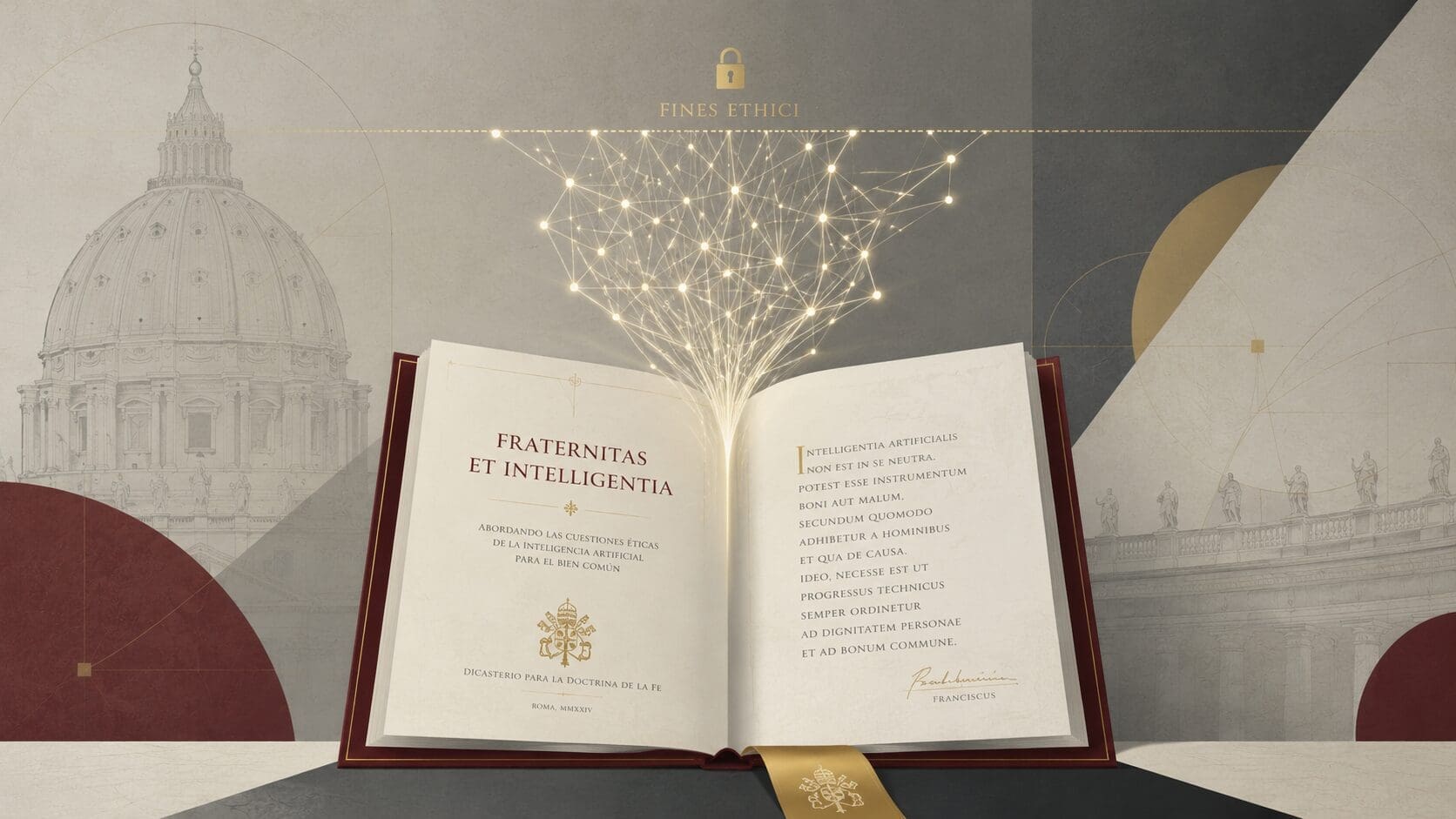
Pope Leo XIV has initiated an internal working group focused on artificial intelligence, as announced by the Holy See on May 16. This formation aligns with the upcoming release of the Pope’s first encyclical, titled Magnifica Humanitas (Magnificent Humanity), signed on May 15 and set for public unveiling on May 25.
The Encyclical: A Symbolic Date
The Pope chose to sign his encyclical on the 135th anniversary of Rerum Novarum, the foundational 1891 encyclical by Pope Leo XIII, from whom the current pontiff explicitly took his name. Rerum Novarum established modern Catholic social doctrine during the industrial revolution, addressing workers’ rights, capitalism’s limits, and state duties.
Pope Leo XIV has consistently drawn parallels between the 19th-century industrial revolution and the ongoing digital revolution. He believes artificial intelligence raises similar issues regarding human dignity, work, justice, and peace. The encyclical is expected to address AI within the framework of Catholic social thought.
The presentation of Magnifica Humanitas will occur on May 25 at 11:30 AM in the Synod Hall, with the Pope present. The event will include:
- Cardinal Víctor Manuel Fernández, Prefect of the Dicastery for the Doctrine of the Faith
- Cardinal Michael Czerny, Prefect of the Dicastery for Promoting Integral Human Development
- Christopher Olah, co-founder of Anthropic (United States), leading AI interpretability research
- Anna Rowlands, Professor of Political Theology and Catholic Social Doctrine at Durham University (UK)
- Dr. Léocadie Lushombo, Professor of Political Theology at the Jesuit School of Theology, Santa Clara University (California)
The inclusion of Christopher Olah is notable. Anthropic, the AI model Claude’s developer, prioritizes safety and risk reduction. The firm is currently in legal conflict with the Trump administration, which in February 2026 ordered all US agencies to cease using Anthropic’s technology and sanctioned the company for refusing to allow unrestricted military use of its AI.
The New Working Group
The inter-dicasterial commission, approved by the Pope on May 16, includes representatives from seven Vatican bodies, such as:
- The Dicastery for the Doctrine of the Faith
- The Pontifical Academy for Life
- The Pontifical Academy of Sciences
The commission will operate with a rotating presidency among participating institutions, under the Pope’s authority. Its objectives are to:
- Coordinate AI-related activities across Vatican institutions
- Share information and harmonize positions
- Define internal rules for AI use within the Holy See
- Analyze the effects of AI on human beings and humanity overall
The formation of the working group is driven by the rapid spread of artificial intelligence, its “potential effects on human beings and humanity overall,” and “the Church’s concern for the dignity of every human person,” as stated in the official Vatican communiqué.
Background: A Consistent Concern
This is not the Vatican’s first foray into AI ethics. The Holy See launched the Rome Call for AI Ethics in 2020, a principles document endorsed by Microsoft, IBM, and Cisco. Since then, the Vatican has issued several sets of ethical guidelines for AI in defense, education, and health, consistently asserting that technology should complement, not replace, human intelligence.
Pope Leo XIV, a former mathematics student and member of the Augustinian order, previously addressed AI in June 2025 at a conference, acknowledging the “indisputable contributions” of generative AI to medicine and scientific research, but also questioning “its possible repercussions on humanity’s openness to truth and beauty.” The concept of truth, central to Augustinian spirituality, seems vital to his reflection, especially concerning the widespread dissemination of deepfake content.
The Pope has also advised priests against using AI to compose their homilies and condemned the uncontrolled military application of AI, critiquing what he termed an “inhuman evolution” of the relationship between war and new technologies during a speech at Rome’s La Sapienza University.
What Can We Expect?
Several questions emerge as the Vatican positions itself in the global AI ethics landscape:
- Will the encyclical propose concrete regulatory principles, or will it remain at the level of doctrinal orientation?
- How will the working group interact with existing international frameworks, such as the EU AI Act or various national AI safety institutes?
- Will the Vatican’s voice influence the ongoing rivalry between Washington, Beijing, and Brussels, where ethical considerations often take a back seat to technological competition?
- What practical guidelines will emerge for the 1.3 billion Catholics worldwide regarding AI use in daily life, education, and work?
The presentation on May 25 may provide initial answers. It is already evident that Pope Leo XIV aims to establish the Vatican as a central moral authority in the global conversation on artificial intelligence — not by opposing the technology, but by emphasizing that its development remain grounded in





Leave a Reply