


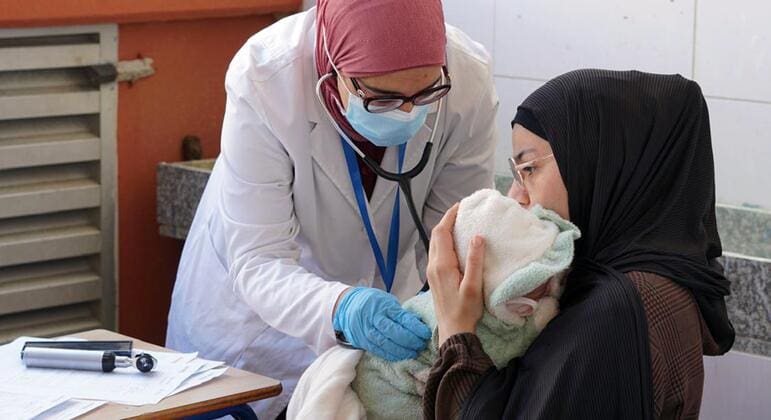
“There are 11,600 pregnant women affected, with 4,000 expected to give birth in the next three months,” stated Anandita Philipose, Lebanon Representative for the UN Population Fund, UNFPA. “Many of these women have been displaced, with limited access to essential health services, and some have given birth under dangerous conditions, sometimes even by the roadside.”
The situation in Lebanon has worsened, especially in the south, Beirut, Mount Lebanon, and the Bekaa Valley, since the escalation of conflict across the Middle East, initiated by Israeli-U.S. strikes in Iran on February 28, Iranian retaliations in several Gulf States, Hezbollah rocket attacks into Israel, and Israeli airstrikes in response.
Health care severely affected
UNFPA reported that 55 hospitals and clinics have shut down, either due to their locations within zones affected by Israeli mass evacuation orders or because of direct damage to them, noted Ms. Philipose.
The UN peacekeeping mission in Lebanon, UNIFIL, has documented daily rocket, missile, and drone attacks on Israel and the Golan Heights from Lebanon, along with artillery fire and aerial assaults by Israeli forces, who have made ground incursions up to seven kilometers (4.3 miles) into Lebanon, according to Kandice Ardiel, UNIFIL spokesperson.
Reporting from the force’s Naqoura headquarters near the Blue Line dividing Lebanon and Israel, Ms. Ardiel noted a major escalation on Wednesday night, involving over 100 projectiles fired from Lebanon and Israel, along with seven airstrikes in the operational area.
“However, yesterday was quieter. We haven’t observed much activity, and I don’t have today’s numbers yet, but in Naqoura, it was relatively calm… nonetheless, the situation remains volatile and could shift at any moment.”
Migrant vulnerability
As violence persists, the UN migration agency, IOM, has indicated that over 822,000 people have been displaced within Lebanon alone, with migrants found to be “particularly vulnerable” and having “nowhere to go,” stated Mathieu Luciano, IOM Chief of Mission in Lebanon.
“Lebanon hosts 200,000 migrants who come here for work and are particularly vulnerable,” he said from Beirut. “Hailing from Ethiopia, Sri Lanka, Kenya, Sudan, Bangladesh, and other nations, most work in agriculture, construction, and as domestic workers. The crisis has severely impacted them, leaving many with nowhere to go and reliant on community organizations, churches, embassies, and NGOs for shelter.”
According to the UN refugee agency, UNHCR, over 4.1 million people have been internally displaced in Afghanistan, Iran, Lebanon, and Pakistan since the escalation began.
Help to leave Iran
Within Iran, IOM has started assisting migrants to return to their home countries. “We’ve received requests for assisting others. The current challenge is securing resources to facilitate this,” said David John, Director of Movement, Resettlement, and Labour Pathways at the agency.
“So far, about 11,400 Iranians have entered Türkiye, while over 24,600 Afghans have returned from Iran to Afghanistan. Both figures remain within the average daily crossings,” UNHCR spokesperson Babar Baloch reported to journalists in Geneva.
UNHCR has devised solutions to counter supply chain disruptions due to the conflict. “Despite airspace closures and frequent disruptions, UNHCR responded promptly,” Mr. Baloch noted. “Essential relief items are pre-positioned across the region, including in Termiz, Uzbekistan, strategically near Iran and several country-level warehouses.”





Leave a Reply