


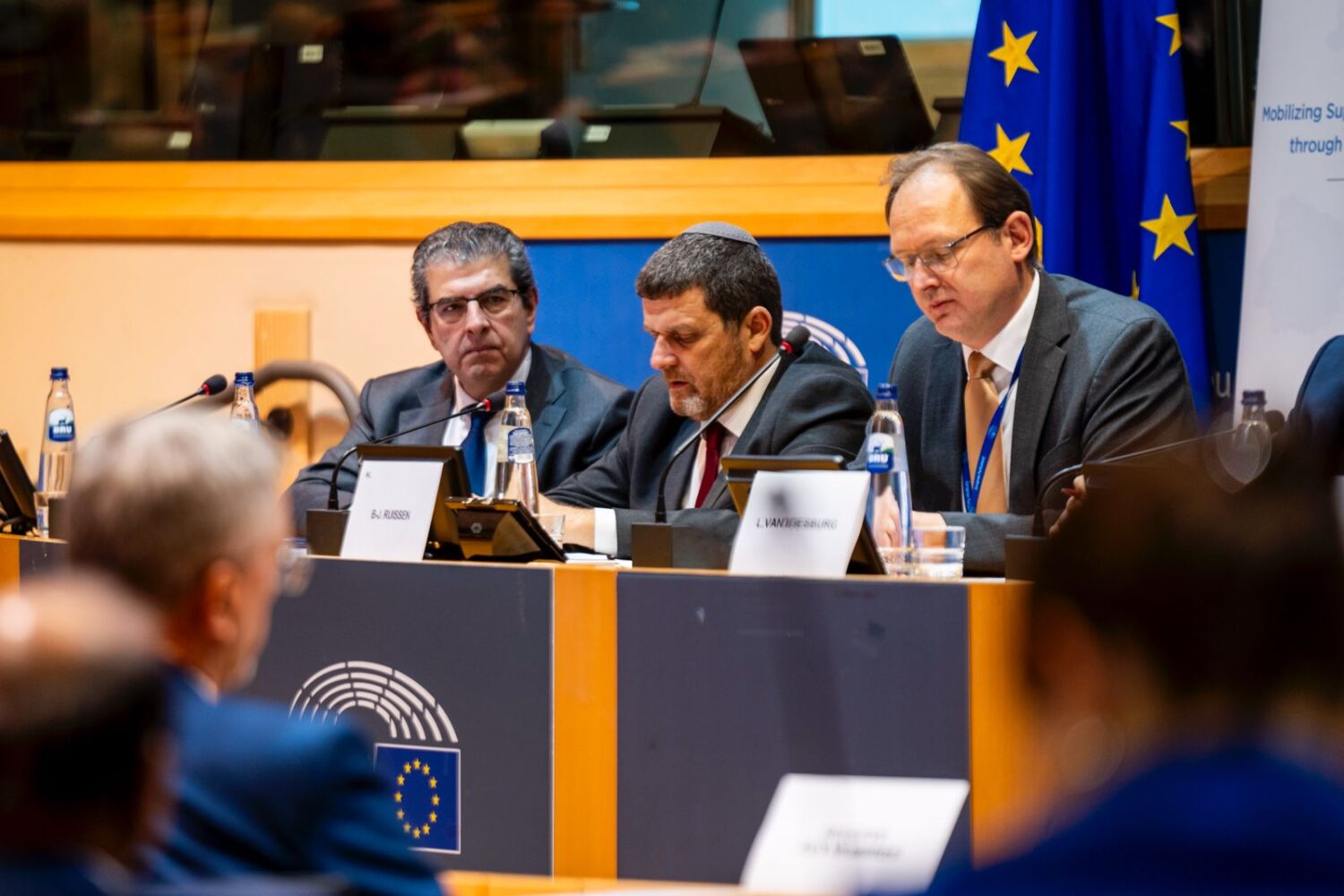
A conference held at the European Parliament on December 4, hosted by MEP Bert-Jan Ruissen, delivered a clear message: “The Islamic Revolutionary Guards Corps (IRGC) should be recognized by the EU as a terrorist organization.” The event, titled “The Iranian regime, a risk for the security of Europe and Israel,” drew approximately 200 participants, including several Members of Parliament.
The IRGC and Its Activities
The IRGC, designated as a terrorist organization by the U.S. on April 15, 2019, and by Canada under its Criminal Code on June 19, 2014, has an estimated 125,000 soldiers. Its primary mission is to uphold Iran’s theocratic Islamic system. The IRGC’s Quds Force, its overseas wing, is accused of orchestrating networks of Iranian proxies such as Hamas in Gaza and Hezbollah in Lebanon.
In October 2023, The New York Times disclosed secret documents indicating that Iran was aware of Hamas’s plan to launch its October 7 attack on Israel, which resulted in over 1,200 deaths, and that Tehran supported the assault. The IRGC has also been implicated in a violent crackdown on Iranian protesters, supplying arms to Russia, launching ballistic missile strikes against Israel, and supporting militias throughout the Middle East.
Canada’s designation of the IRGC has led to stringent consequences, including the freezing of any IRGC-owned property within Canada and criminal penalties for individuals dealing with its assets, whether domestically or abroad.
—
Lithuania Leads the Way in Europe
On October 3, 2024, Lithuania became the first EU country to officially recognize the IRGC as a terrorist organization. The Lithuanian Parliament, or Seimas, passed a resolution condemning the IRGC’s actions, describing them as a threat to international security and stability. Emanuelis Zingeris, Chair of the Committee on Foreign Affairs, highlighted the growing danger posed by Iran’s military support for Russia in the war against Ukraine and its direct attacks on Israel.
The resolution also criticized the IRGC’s collaboration with groups such as Hamas, Hezbollah, Palestinian Islamic Jihad, and Ansar Allah (the Houthis), as well as its broader support for terrorist activities globally. Lithuania called on the EU and other democratic nations to join in officially designating the IRGC as a terrorist organization. The resolution passed unanimously with 60 votes in favor.
—
Mounting Pressure on the EU
Despite repeated calls from the European Parliament, efforts to add the IRGC to the EU’s terrorist list have so far been unsuccessful. On January 19, 2023, the European Parliament adopted a resolution urging the EU to sanction individuals and entities linked to human rights violations in Iran, including the IRGC and its affiliates.
The resolution demanded the inclusion of not only the IRGC but also its subsidiary forces, such as the paramilitary Basij militia and the Quds Force, on the EU’s terrorist list. It called for a ban on any financial or economic activities involving businesses associated with the IRGC, while highlighting the need to avoid harming the Iranian population or humanitarian aid efforts. The document also condemned the IRGC’s indiscriminate attacks, such as those in Iraqi Kurdistan, which threaten civilian lives and regional stability.
For this designation to take effect under EU rules, a judicial decision by a member state is required, followed by unanimous agreement among all 27 EU members—a process that allows a single dissenting country to block the move. Germany, France, and the Netherlands have previously expressed support for recognizing the IRGC as a terrorist group, with backing from European Commission President Ursula von der Leyen and the European Parliament.
—
A Call to Action for the EU
In his closing remarks at the European Parliament conference, MEP Bert-Jan Ruissen urged the EU to blacklist the IRGC as a terrorist organization. He emphasized the growing threat posed by Iran to Israel and the broader region, citing the recent string of attacks on Israel and Iran’s extensive network of terrorist proxies.
Ruissen also drew attention to the IRGC’s activities in Europe, including attacks on Jewish individuals and members of the Iranian diaspora, often carried out using criminal networks. Though these actions may be less visible to the general public, he noted that they pose a significant security risk across the continent.
He concluded with a stark warning:
“I hope this conference has served as an eye-opener to the big risks we are facing, both in Israel and Europe. We need increased cooperation to counter the Iranian threat. Western allies need to stand ready to support Israel in defending itself against the malicious Iranian regime. The EU should list the IRGC as a terrorist organization, and the security and intelligence services of Member States should actively cooperate to track down and eliminate the Iranian threats on their soil.”
Ruissen’s statement underscored the urgency for unified international action to address the destabilizing influence of the IRGC and the Iranian regime.








Leave a Reply