


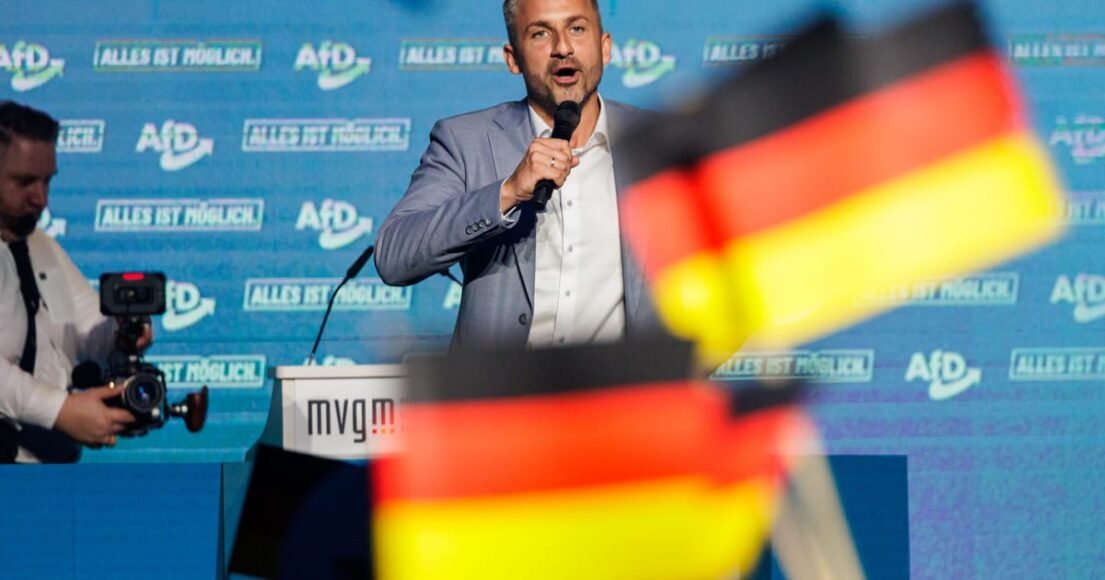
“The AfD has emerged as the leading party in Saxony-Anhalt’s state parliament, a development requiring the CDU to navigate this outcome,” he remarked.
The fact that 40% of voters backed the AfD, despite its regional branch being identified as a right-wing extremist group by the state intelligence agency and reports linking lead candidate Siegmund’s associates to an organization inspired by the Hitler Youth, indicates substantial public disillusionment with mainstream parties, the media, and institutions across eastern Germany — an area that experienced communist rule during the Cold War.
Since its inception in 2013, the party saw its best performance by focusing on deporting migrants with a “remigration offensive,” fostering closer ties with Moscow — including reviving school exchange programs with Russia — removing rainbow flags from schools, introducing a “baby welcome grant” of €2,000 for the first two children and €4,000 for each additional child. Additionally, they vowed to modify school curricula regarding Germany’s Nazi history to end what some members label a “guilt cult.”
Nevertheless, the party’s gains seemingly stem more from the public’s repudiation of mainstream parties, specifically Merz and his conservative alliance. Just 9% of Saxony-Anhalt voters approved of Merz’s leadership, as per an ARD exit poll.
Saxony-Anhalt has the lowest average net income in Germany, with economic concerns over industrial decline and soaring energy costs greatly influencing voters. An ARD survey revealed 70% were “greatly worried” about the ability to pay bills due to rising prices, while 58% feared maintaining their standard of living was at risk.
Polls suggest the AfD is also leading in Mecklenburg–Western Pomerania, with elections set for Sept. 20. Meanwhile, in Berlin, traditionally left-leaning, the AfD is polling at approximately 18% as voters prepare to cast ballots on the same day.
Saxony-Anhalt’s outcome exceeds the AfD’s prior significant achievement in Thuringia, where they garnered 32.8% of the vote in 2024. Post-election, the CDU was compelled to form a minority coalition with left-wing parties.
This story is being updated.






Leave a Reply