



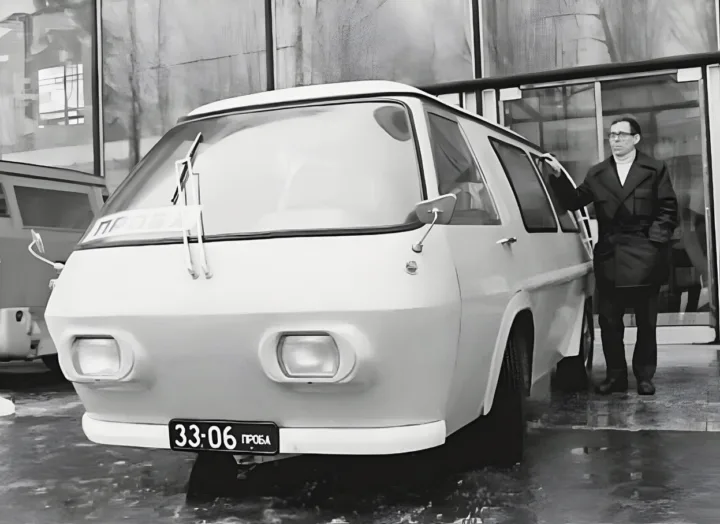
During the Soviet era, the Estonian SSR housed an automobile factory called TARZ (Tartu Auto Repair Plant), which manufactured trucks and buses under the TA brand. In addition to conventional production and Estonia track racing cars, numerous vehicle prototypes were created, leaving an enduring impression. Among them was the experimental ET-800 Electra minibus, recognized for its futuristic design and its status as the first hybrid car in the former Soviet Union.
The project traced back to the mid-1960s in Tallinn, where automobile designer Roman Bertelov developed a small lightweight truck named the ET-600, featuring a ZAZ-966 engine and a fiberglass body. A pilot batch of around 40 units was made between 1967-1970; however, serial production was not undertaken. Subsequently, Bertelov conceived a hybrid vehicle project titled the ET-800 “Electra.” This eight-seater van, boasting a sleek plastic body, was powered by a ZAZ-966 gasoline engine paired with a standard tram electric motor. Bertelov designed the body and chassis, resembling the ET-600, while Vadim Pitersky crafted the sophisticated electrical system. The vehicle’s generator included a 24-volt DC rectifier, with the rear wheels driven by a 28 kW electric motor. A 400 kg nickel-cadmium battery was placed between the front seats. The van was operated using a standard steering wheel and two pedals—brake and gas—with a transmission offering three positions: forward, reverse, and neutral. Its instrument panel featured a speedometer, tachometer, voltmeter, and ammeter. The ET-800 could travel 80 kilometers per charge at speeds up to 60 km/h. Beyond this, the gasoline engine activated, charging the battery while operating. Initially, it was noted that the hybrid minibus accelerated too sharply, necessitating a complete redesign of the control system for better on-road handling.
The ET-800’s public debut was scheduled for April 22, 1970, coinciding with Lenin’s centenary. During its Moscow presentation, the van toured central streets with Bertelov, Estonian Prime Minister Walter Clauson, USSR Electrical Industry Minister Alexei Antonov, and several officials aboard. Following this test, the prototype received approval, hinting at potential mass production.
However, Clauson opposed the idea, citing Estonia’s lack of facilities for developing electric vehicles and disinterest in recruiting workers and specialists from other Soviet republics. Tests continued for about a month, revealing defects in the electrical system, primarily concerning the battery’s low efficiency and tendency to overheat.
Related coverage: Serbia Submits Bill to Establish Church University “St. Sava” | Concept and Image of Divine Wisdom in the Old Testament (1) | Poison kills last wild bearded vulture in Bulgaria



Leave a Reply