


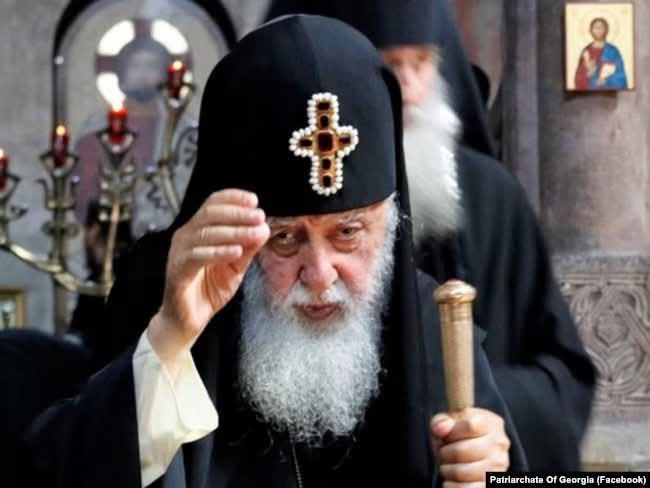
The patriarch’s name is tied to the acknowledgment of the Georgian Orthodox Church’s restored autocephaly and ancient patriarchal dignity by the Ecumenical Patriarchate of Constantinople in 1990. Under Ilia II’s blessing, the Bible and theological works were published in modern Georgian, and newspapers were established. In 1988, he led the relocation of Mtskheta Theological Seminary to Tbilisi and the founding of the Tbilisi Theological Academy; theological schools were opened across Georgia: in Batumi, Akhaltsikhe, and Kutaisi.
Theological schools and a gymnasium were founded in Khulo. After several centuries, the Gelati Theological Academy and Gelati Academy of Sciences were reinstated under Church auspices. Over two decades, the Georgian Church expanded from 15 to 33 dioceses, 53 monasteries, 1,000 clergy, canonized new saints, and constructed the Holy Trinity Cathedral.
Georgia declared a mourning period, with government-ordered half-mast flags on administrative buildings nationwide. Patriarch Ilia II passed away on March 17, 2026, aged 93. The Caucasus Medical Center, represented by the patriarchal throne’s vicar, Metropolitan Shio, announced his death as a significant loss for the global Orthodox Church. Ilia II’s body was taken from the patriarchal residence to the Holy Trinity Cathedral, where it will lie in repose until his March 22 burial at Sioni Church, as he wished. People from all over Georgia gathered at the Holy Trinity Patriarchal Church.
The Holy Synod confirmed Metropolitan of Senaki and Chkhorotsk Shio (Mujiri) as locum tenens to oversee the patriarchal elections.
Ilia II (born Irakli Georgievich Gudushauri-Shiolashvili) was born on January 4, 1933. He was tonsured as a monk in 1957 and given the name Ilia. On April 18, 1957, he was ordained hierodeacon by Patriarch Melchizedek III in the “Sioni” cathedral. On May 10, 1959, he became a hieromonk, ordained by Russian Patriarch Alexy I, and became an abbot on December 19, 1960. In 1961, he received the archimandrite title and, in 1963, was elevated to bishop by Catholicos-Patriarch Ephrem II. From 1963 to 1972, he was the inaugural rector of Mtskheta Theological Seminary; he was then assigned to the Sukhumi-Abkhazian Diocese in 1967. On May 17, 1969, he advanced to Metropolitan, and on December 23, 1977, was elected Catholicos-Patriarch of All Georgia. From 1964 until becoming Patriarch, he led the Georgian Orthodox Church’s Synodal Department for External Church Relations.
During Vakhtang Gorgasali’s reign, a warrior named Sno distinguished himself. The king named his son Gudushauri and built a fortress in his honor. The Gudushauri family, known as warriors, lived in Khevi; Shiola Gudushauri was noted for boldness. It’s believed the Catholicos-Patriarch Ilia II descended from his line. Shiola Gudushauri ruled the Gudushauri valley in the 7th century, which included several villages. His descendants adopted Shiolashvili as their surname to preserve his name.
The patriarch’s father, Giorgi Gudushauri, was from Sno, and his mother, Natalia Kobaidze, hailed from Sioni. In 1927, they moved temporarily to Vladikavkaz, maintaining ties with Georgian clergymen like Catholicos-Patriarch Kallistrat Tsintsadze. These connections kept Ilia II linked with Georgians in Vladikavkaz.
The Dzaugu Church (Vladikavkaz) was under the Georgian Church’s jurisdiction. Ilia II was baptized here, receiving the name Heraclius, after Tsar Heraclius. His baptism was led by Archimandrite Tarasius (Kandelaki), the Catholicos-Patriarch Kirion’s former secretary, and the godmother was nun Zoile (Dvalishvili), who later became an abbess. The godmother often visited Samtavro with Heraclius, where he met Catholicos-Patriarch Kallistrat Tsintsadze and received his blessing.
Giorgi Shiolashvili’s children were raised attending church. The family frequented the St. Prophet Elijah church; Giorgi also created a prayer corner at home in honor of the Mother of God.
Patriarch Ilia II remembers his childhood prayers with family before


Leave a Reply