Gaza: ‘People Losing Hope’ as Aid Access to North Remains Blocked, Warns UNRWA

UN Official Warns of Deteriorating Humanitarian Crisis in Gaza Amid Looming Famine

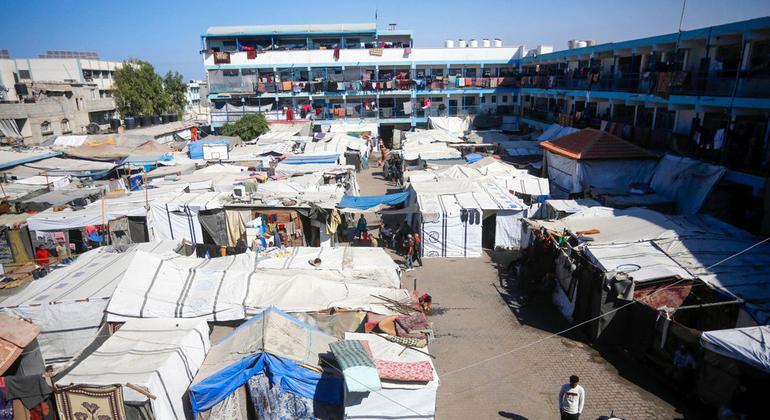
Reporting from central Gaza, Louise Wateridge, a senior emergency officer with the United Nations Relief and Works Agency for Palestine Refugees (UNRWA), sounded the alarm about the dire conditions in the Gaza Strip. As winter approaches, hundreds of thousands of people forcibly displaced by the ongoing conflict are living in makeshift shelters, sleeping on the floor amidst unsanitary conditions, including raw sewage.

“We are deeply concerned about what will happen to 500,000 people living in flood-prone areas as the rains begin,” Wateridge said during a press briefing in Geneva.

The humanitarian situation in Gaza is further exacerbated by critically low levels of aid entering the war-torn enclave. According to Ms. Wateridge, the volume of supplies has reached its lowest point in months, with just 37 trucks of aid entering Gaza daily in October—a fraction of what was permitted before the conflict. This amounts to merely six percent of the previous commercial and humanitarian supply levels for the 2.2 million residents.

US Aid Deadline Passes Without Progress

When asked about the U.S.-imposed deadline for Israel to improve Gaza’s aid conditions by November 12, Wateridge confirmed that the situation has only worsened. Aid deliveries have decreased despite international calls for increased access.

In northern Gaza, where the UN has been denied entry, the desperation is palpable. “People are begging for scraps of bread and water,” Wateridge revealed, adding that 80 percent of Gaza’s population—about 1.7 million people—did not receive food rations in October. The situation is so critical that last Friday, the UN-partnered Integrated Phase Classification (IPC) Famine Review Committee issued an urgent alert warning of imminent famine in northern Gaza.

As the suffering intensifies, Wateridge warned, “People are losing hope.” Despite planned humanitarian missions to northern Gaza this week, Wateridge and her colleagues were blocked from delivering supplies such as chlorine tablets or assessing shelter conditions. For over a month, no UNRWA staff has been able to access these besieged areas.

Hospitals on the Brink: “Every Hour Counts”

Wateridge described harrowing accounts from UN colleagues and medical workers in the north, painting a stark picture of the deteriorating situation. Hospitals have run out of blood supplies and essential medicines, while ambulances are no longer operational. Bodies lie in the streets as people resort to using donkey carts to reach medical facilities.

“Colleagues are trapped in residential buildings, unable to leave. The eight water wells in Jabalia managed by UNRWA have also stopped functioning, leaving residents without clean drinking water,” she said.

The situation is becoming increasingly urgent, with Wateridge stressing the necessity of gaining access to the besieged northern areas. “Every hour matters now,” she pleaded, reiterating UNRWA’s call to Israeli authorities for immediate entry to provide critical aid.

Ceasefire: The Only Path to Relief

The conflict’s broader consequences are also escalating. Late last month, the Israeli Parliament voted to ban UNRWA operations within the country, including prohibiting any contact with its officials. The legislation will take effect in 90 days, further complicating efforts to alleviate suffering in Gaza.

Addressing both sides of the conflict, Wateridge called for an immediate ceasefire. “Our message to Hamas and the Israeli forces is clear: there needs to be a ceasefire,” she said. While condemning the “horrific attacks” by Hamas on Israeli civilians on October 7, she emphasized that ongoing civilian suffering on both sides must stop.

“We’ve witnessed unimaginable suffering—Israeli civilians subjected to terror on October 7, followed by the devastating impact on civilians in Gaza. A ceasefire, the release and safe return of all hostages, and respite for all affected civilians in Gaza and the wider region are urgently needed,” she concluded.



Comments

4 responses to “Gaza: ‘People Losing Hope’ as Aid Access to North Remains Blocked, Warns UNRWA”

  1. Oh, fantastic, just what we need—another “urgent” UN report from a cozy Geneva office while folks in Gaza are dodging bullets and seeking shelter from the rain. Remind me again, are we waiting for a miracle or just more paperwork? 🙄📄

  2. Mr. Thanksgiving Avatar
    Mr. Thanksgiving

    Oh, brilliant! Just when you thought the humanitarian crisis couldn’t get any more “exciting,” we find that the aid trucks are playing a game of hide and seek in Gaza. Who knew “hope” was the latest lost cause? 😂

  3. Little General Avatar
    Little General

    Oh joy, another announcement about the humanitarian crisis in Gaza—because obviously, the UN has all the time in the world to sound alarms while aid trickles in slower than a snail on holiday. 🐌💼 Who knew saving lives could be such a bureaucratic tango?

  4. fuzzy logic hottie Avatar
    fuzzy logic hottie

    Oh, splendid! Just as winter’s chill sets in, we’ve got a humanitarian crisis in Gaza that makes a snowstorm look like a picnic. Who knew that blocking aid could turn into a global sport? Bravo, world leaders! 👏

Leave a Reply

Your email address will not be published. Required fields are marked *

Last News

Sudan: SAF Drones Strike Civilians Despite Protection Claims

Sudan: SAF Drones Strike Civilians Despite Protection Claims

In a span of one week, Sudan’s Kordofan region has faced a series of devastating drone strikes and indiscriminate attacks on civilians, attributed by multiple sources to the Sudanese Armed Forces (SAF).
At least fifty-seven people were killed in just two days, according to United Nations human rights officials, with many of the victims being children. The types of targets—a market, a displa

Read More

What to Anticipate in Reeves’ Spring Statement

What to Anticipate in Reeves’ Spring Statement

As the spring statement nears and a senior official leaves No 11 Treasury, can the chancellor secure more funds to satisfy the public and her party?
Sam and Anne examine the sectors demanding additional funding—particularly student loans and defense—even though Rachel Reeves claims this isn’t the time for increased expenditure.
Meanwhile, in the Lords, is the assisted dying bill nearing its

Read More

Four Years Later: LWF Sustains Hope in Ukraine

Four Years Later: LWF Sustains Hope in Ukraine

Reflecting on the four-year mark of the conflict in Ukraine, Bishop Pavlo Shvarts, head of the German Evangelical Lutheran Church of Ukraine, remarked, “It is a tragic day for our people and our history.” He expressed gratitude, saying, “We sincerely thank all of you who continue to pray for us and to keep our church in your heart.” Bishop Shvarts urged continued support for the church’s efforts

Read More

Inside the EU Ambassadors’ Crisis Bunker

Inside the EU Ambassadors’ Crisis Bunker

Brussels is adapting to a changing geopolitical scene.
Coreper meetings — regular assemblies of EU ambassadors — are increasing in frequency, showcasing how the bloc is evolving. Previously seen mainly as preparatory, these meetings now play a crucial role in shaping discussions before leaders meet.
The energy narrative progresses. The European Commission addresses Hungary’s alerts about disrupti

Read More

EU Eases Supply-Chain Due Diligence Rules

EU Eases Supply-Chain Due Diligence Rules

Member states have approved a pared-down version of the EU’s corporate sustainability rules, focusing mainly on the largest companies and extending key deadlines. Proponents claim the revisions reduce bureaucracy and maintain competitiveness; opponents believe they diminish a mechanism designed to tackle human rights violations and environmental damage in global supply chains.
On Tuesday, 2

Read More

Merz Advocates for Adjusting Germany’s ‘Unhealthy’ Trade Relations with China

Merz Advocates for Adjusting Germany’s ‘Unhealthy’ Trade Relations with China

Prior to Merz’s visit, several German business executives urged the chancellor to adopt a tougher stance on China’s industrial strategies, which give its firms price benefits through means such as subsidies, strategic dumping, and an undervalued currency.
Responding to these concerns, Merz called for fair competition, emphasizing the need for transparency, reliability, and adherence to established

Read More

Updates on Temples in Brazil, the Philippines, Texas, and South Dakota

Updates on Temples in Brazil, the Philippines, Texas, and South Dakota

Teresina Brazil Temple
The First Presidency of The Church of Jesus Christ of Latter-day Saints has announced that the groundbreaking services for the Teresina Brazil Temple will occur on Saturday, April 18, 2026. Elder Ciro Schmeil, First Counselor in the Brazil Area Presidency, will preside at the event.
As previously announced, the Teresina Brazil Temple will be built on a 3.60-acre site locate

Read More

Canada’s AI Minister Blames OpenAI for ‘Failure’ After Mass Shooting

Canada’s AI Minister Blames OpenAI for ‘Failure’ After Mass Shooting

“We were seriously concerned about the reports suggesting that there might have been a chance to involve law enforcement more, and we want to ensure that if any company has such an opportunity, they would take it further,” he added.
OpenAI’s head of policy, Chan Park, alongside six other company representatives, met with members of Prime Minister Mark Carney’s Cabinet on Tuesday in Ottawa — a meet

Read More

Somalia: Hungry Population Almost Doubles in One Year

Somalia: Hungry Population Almost Doubles in One Year

More than 1.8 million children under five are at risk of acute malnutrition between now and June, according to the latest analysis published by the IPC food security monitoring platform. This concerning situation follows the failure of rains during the October to December Deyr season and a consequent drop in crop production. The hardest hit are poor farmers, pastoralists, and internally displaced

Read More

La menace Trump plane sur l’accord de libre-échange UE-Mexique

La menace Trump plane sur l’accord de libre-échange UE-Mexique

Le traité révisé facilite une intégration accrue de l’économie mexicaine, principalement manufacturière, avec l’industrie européenne, notamment dans l’automobile. Il permet aussi une augmentation des investissements européens au Mexique.
Pour le Mexique, c’est une façon de réduire sa forte dépendance envers l’économie américaine. Cependant, cette dépendance même rend

Read More