


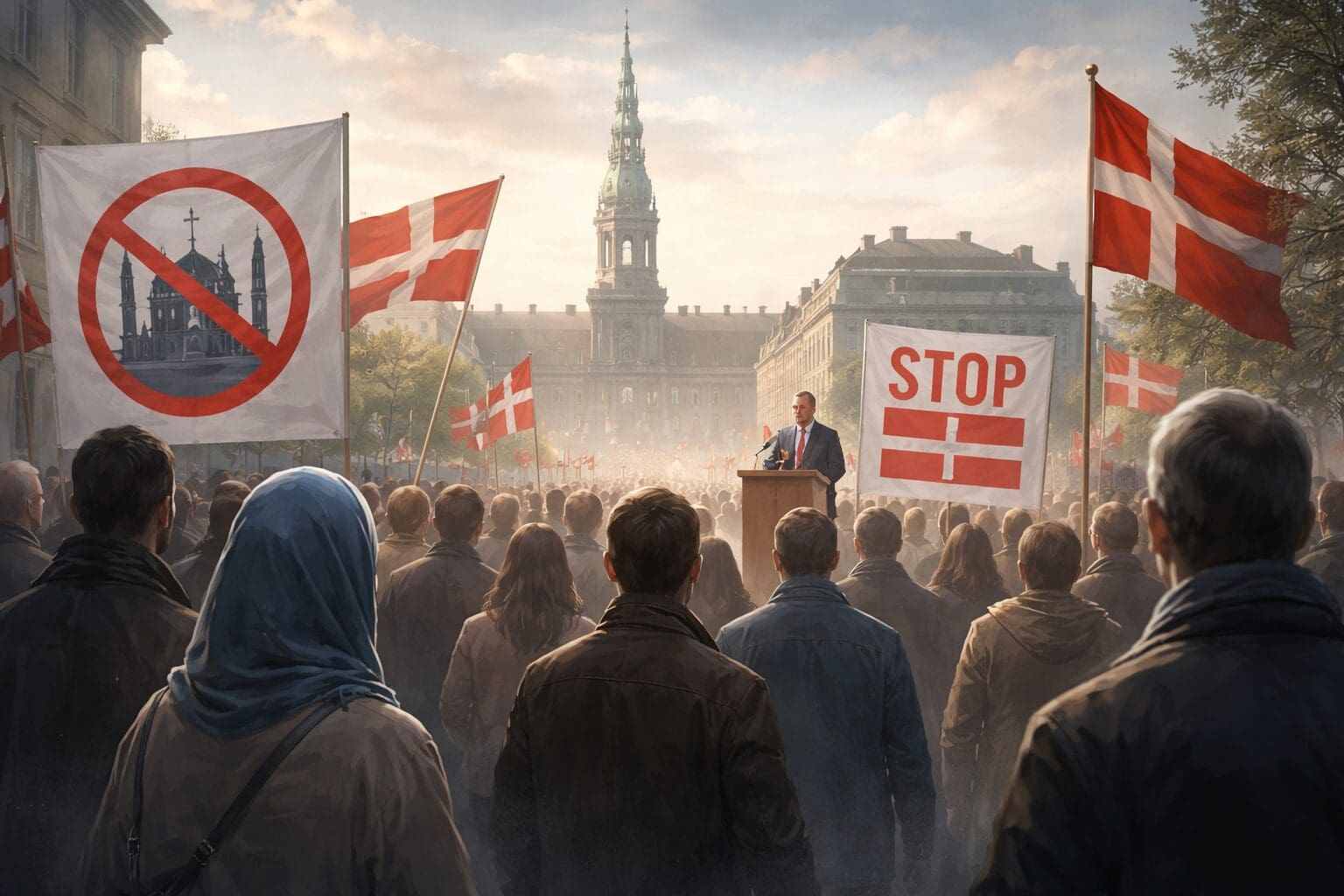
How Anti-Islam Politics Moved from the Fringe to the Center of Political Campaign
Bashy Quraishy
Secretary General – European Muslim Initiative for Social Cohesion – Strasbourg
Thierry Valle
Coordination des Associations et des Particuliers pour la Liberté de Conscience
The recent parliamentary elections in Denmark on March 24, 2026, signaled a significant shift in the political landscape. Held by Prime Minister Mette Frederiksen amid geopolitical tensions, especially regarding Greenland and the US, the election was expected to solidify her leadership. Instead, it revealed setbacks for the governing coalition and disturbing political undercurrents.
The Social Democrats and their coalition suffered major losses. More notably, parties with anti-Islam and anti-immigration agendas performed strongly. The Danish People’s Party and right-wing groups portrayed Islam as a threat to national identity, rather than a cultural difference.
This election marked the culmination of a political shift. It normalized the idea of Islam as incompatible with Danish society. Campaign rhetoric framed Islam as a civilizational challenge, linking Muslim communities to crime and social issues. Immigration and integration were top concerns for voters, highlighting the resonance of these narratives.
Central to this shift was identity politics targeting minorities. Danish People’s Party leader, Morten Messerschmidt, called for “net emigration of Muslim residents,” placing religion at the core of political identity. Such proposals entered mainstream debate as negotiable positions.
Framing of Islam as a Societal Threat
In the lead-up to the election, anti-Islam discourse dominated. Integration, security, and cultural values were framed to disproportionately target Muslim communities. Mainstream actors cautiously navigated these debates, rarely challenging the divisive framing, creating a vacuum filled by parties pushing political boundaries.
This development built on years of framing Islam as a societal problem. PM Frederiksen described Islam as “a barrier to integration,” while extreme politicians like Rasmus Paludan called for Muslims to leave Denmark. Although condemned, such statements expanded acceptable discourse, making moderate exclusionary positions appear reasonable. Normalization operates through electoral success, repetition, and insufficient resistance.
The normalization of exclusionary rhetoric shifted the political center. Once-fringe positions gained legitimacy, embedding narratives that undermine equality and mutual respect.
Silence as Strategy by Mainstream Parties
A notable feature was not just anti-Islam rhetoric, but the lack of opposition to it. Mainstream parties avoided direct confrontation, adopting softer variations like “integration challenges” and “cultural cohesion.”
This convergence is strategic: challenging narratives risks alienating voters. By not contesting the premise, mainstream actors legitimize it, shifting the debate to how exclusionary ideas should be implemented.
Exclusionary rhetoric no longer needs to win arguments, just be repeated.
A Representation Gap is Widening
Denmark’s population includes many citizens with immigrant roots, yet political representation is marginal. Of 179 parliament members, only four have ethnic minority backgrounds, despite significant immigrant roots.
This disparity is influenced by party structures. Minority candidates are underrepresented and often placed in unwinnable positions. Political recruitment relies on networks that minorities struggle to access, with “electability” concerns persisting.
A political system focused on minority communities yet resistant to participation results in a parliament debating integration and identity with minimal representation from affected communities.
Rhetoric and representation reinforce each other. Absence of minorities in parliament makes debates abstract and detached, sustaining simplified narratives and discouraging political participation, deepening underrepresentation. This benefits those relying on polarization.
Breaking the Pattern and Changing the Picture, from Margins to Representation
Reversing this trajectory requires structural change. Political parties must confront their role in shaping discourse and challenge assumptions framing Islam as a threat.
Candidate selection must change, actively recruiting minority candidates and ensuring measurable inclusion.
Recognizing risks of inaction is key. An unbalanced parliament is vulnerable. Democratic legitimacy depends on meaningful representation.
Minority participation should be seen as political agency, not assimilation. Engagement is essential for reshaping the system. Responsibility lies with those controlling access.
Representation must be viewed as democratic legitimacy. A parliament not reflecting its population risks losing trust, failing to address societal complexities. Civic participation in minority communities is crucial. Higher voter turnout and engagement can influence strategies, especially in urban areas where minority voters are significant.
Minorities Should Utilize Their Rights and Responsibilities in the Political Spectrum
Low ethnic voter turnout highlights the need for renewed engagement from Denmark’s ethnic and religious minorities. Political participation is essential for representation and influence. Voting, civic engagement, and involvement in political parties ensure minority voices in decision-making.
Younger generations’ awareness of political representation’s importance is encouraging. Supporting their public life entry, locally or nationally, helps rebalance discourse and bring lived experiences into policymaking.
Denmark’s democracy depends on defining itself amid rising polarization. Will it reaffirm inclusivity and democratic integrity, or allow exclusionary narratives to deepen?
The answer depends




Leave a Reply