


Shëngjin: A Refuge for Afghan Refugees Caught in Limbo
The coastal town of Shëngjin played a pivotal role as a temporary safe haven for Afghan refugees in the wake of the Taliban’s return to power in August 2021. For many of these refugees, however, this “temporary” stay stretched on for nearly two years as they awaited clearance to relocate to the United States. The bureaucratic bottleneck left them in a frustrating state of limbo.
Sandër Marashi, the head of Shëngjin’s bustling port, noted a recent lull in the arrival of migrants. While no new arrivals have been reported for weeks, he highlighted that “the entire Italian staff is still at the port and at the center, managing all operations here.”
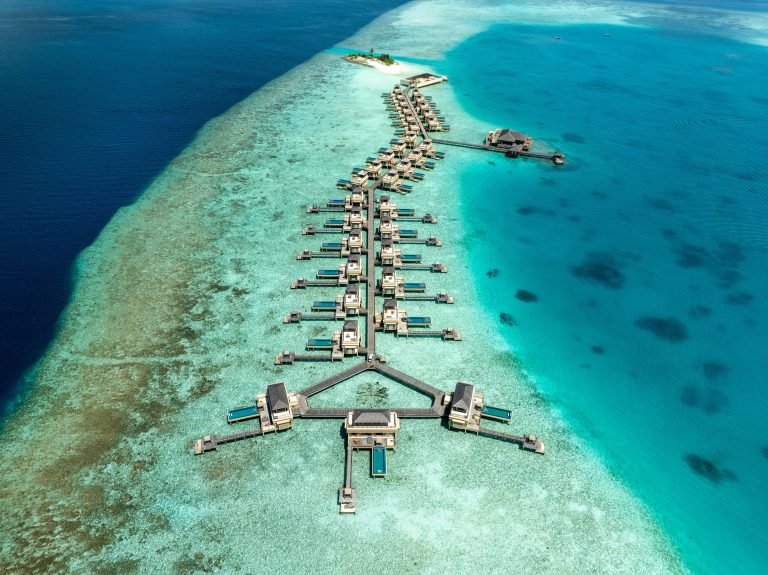
Meanwhile, Shëngjin’s role as a resort town seems to have blended oddly with its responsibilities as a migrant hub. Locals report seeing law enforcement officers from Italy’s Carabinieri indulging in the relaxed atmosphere of the five-star Rafaelo Resort. While their official vehicles remain parked conspicuously out front, these officers are said to spend their time soaking up the sun and enjoying seafood feasts.
Pictured above: A poster critical of Edi Rama, Albania’s Prime Minister, and Giorgia Meloni, Italy’s Prime Minister, illuminates the underlying tensions surrounding the migrant centers. | Adnan Beci/AFP via Getty Images.
Tensions Among Staff
While Shëngjin exudes a sense of leisure, the situation for Italian staff at Gjadër, a remote mountainside village that hosts another of the migrant centers, is far less rosy. Albanian media reports describe the personnel stationed there as isolated and increasingly resentful of their Shëngjin counterparts, who seem to have drawn the more comfortable assignment. Gjadër’s remote location offers little in the way of entertainment or social interaction, leaving its staff marooned amidst a small local population.
In a lighthearted twist to their predicament, members of the Italian penitentiary police stationed in Gjadër have reportedly found a surprising new pastime. Lacking refugees to supervise, they’ve started rescuing and caring for the village’s stray dogs, according to an article in the Italian penitentiary police’s internal magazine.
‘A Very Expensive Waiting Room’
The costs associated with maintaining the migrant centers have raised eyebrows in both Albania and Italy. In April, the Italian government approved a €65 million allocation to fund the construction of the two centers, in addition to earmarking €2.5 million for the operational expenses of Italian staff in 2024. Over the next five years, Italy expects to spend roughly €680 million on managing and maintaining these facilities.
The financial burden and the protracted wait for Afghan refugees to be resettled have transformed the centers into what some describe as “a very expensive waiting room.” As Shëngjin balances its dual identity as a resort destination and a holding hub, lingering questions about the efficiency and purpose of such centers remain unanswered.





Leave a Reply