


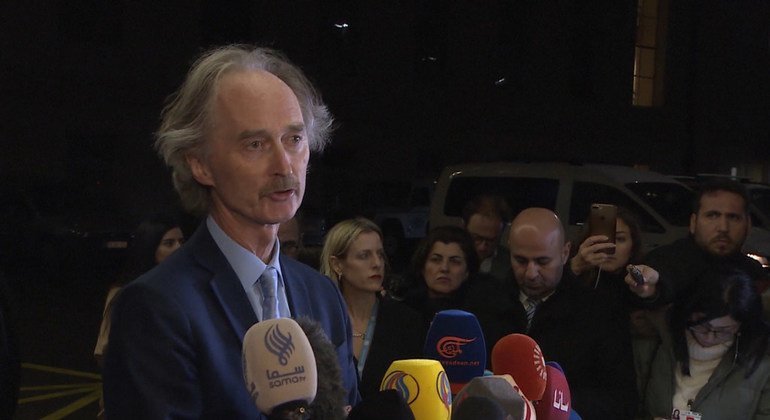
Syria at a Crossroads: UN Special Envoy Highlights Opportunities and Risks
“Syria is now at a crossroads with great opportunities ahead, but also serious risks,” said Geir Pedersen, the UN Special Envoy for Syria. Speaking about the current situation after the fall of the Assad regime, he emphasized the need to address both possibilities and challenges. “While HTS (Hay’at Tahrir al-Sham) has become the dominant group in Damascus, it’s crucial to remember that they are not the only armed faction operating in the capital,” he noted.
Celebratory scenes filled the streets of Damascus after the regime’s collapse; however, Mr. Pedersen cautioned that the transfer of power has not been entirely smooth. Reports of looting and the unlawful occupation of public and private properties initially surfaced but have since subsided. “This is a positive development,” he told journalists in Geneva.
—
Uncertainty Beyond Damascus
While the capital has seen significant transformations, the broader situation in Syria remains uncertain, a lingering consequence of the nation’s 13-year-long war. This conflict has entangled regional and international players, hindering efforts for a UN-led resolution.
“The conflict in the northeast is far from over,” Mr. Pedersen explained, referring to ongoing clashes between the Syrian National Army, opposition groups, and the Syrian Democratic Forces (SDF). He called for calm in the area, stressing the necessity of avoiding further violence.
Addressing concerns about recent Israeli operations, including troop movements into the occupied Golan Heights and airstrikes on Syrian targets, Mr. Pedersen was firm: “This must stop.” While the UN Envoy himself is not directly in contact with Israeli officials, he noted that UN peacekeepers stationed in the Golan Heights maintain daily communication. “The United Nations in New York has conveyed the same message—that these actions constitute a violation of the 1974 disengagement agreement,” he emphasized.
—
Diplomatic Maneuvering Amid Transition
Providing a glimpse into the high-stakes diplomacy surrounding Syria’s transition, Mr. Pedersen shared insights from his closed-door briefing to the UN Security Council in New York. “During my briefing, I received a message from Syria’s ambassador to the UN, speaking on behalf of the authorities in Damascus. This indicates that communication channels are still functioning,” he said.
The Special Envoy also touched on the complex role of HTS, whose leader, Abu Mohammad al-Jolani, hinted in a CNN interview at potentially dismantling the organization. “We remain in a highly fluid period, with much still unsettled,” Mr. Pedersen said. “This is a real opportunity for change, but it must be driven by the Syrian people themselves and supported by the UN and the international community.”
—
Challenges of Engaging with HTS
One of the most significant hurdles to advancing peace talks is the international designation of HTS as a terrorist organization, a classification rooted in UN Security Council Resolution 2254 from 2015. This resolution explicitly calls for the suppression of terrorist acts carried out by HTS’s predecessor, the Al-Nusra Front.
However, Mr. Pedersen hinted that this classification could soon be reevaluated. “We need to examine the facts and acknowledge what has transpired over the past nine years. HTS and other armed groups have been sending positive messages to the Syrian people—messages of unity and inclusiveness,” he said. “In cities like Aleppo and Hama, we’ve seen reassuring developments on the ground that give hope for a more stable future.”
—
A Hopeful But Fragile Transition
As Syrians in exile prepare to return to their homeland, the UN Envoy highlighted the collective desire among regional powers—Turkey, Russia, Iran, and several Arab states—for Damascus’s new leadership to honor its initial commitments to a peaceful transition of power. Mr. Pedersen stressed the importance of international support in ensuring this process succeeds.
He shared a poignant moment that encapsulates the sentiment of many Syrians. “When I was leaving Doha, a Syrian family approached me. They had been living in Sweden after fleeing Hama 10 years ago. They told me, ‘Mr. Pedersen, we are so hopeful. We know there are challenges, but we want to go back home.’ This is the hope shared by countless Syrians today,” he said.
—
Conclusion
Syria’s path forward remains uncertain yet filled with possibilities. As the country navigates this delicate period of transition, the UN and the global community must seize this moment to support Syrians in their quest for a peaceful, united, and inclusive future.





Leave a Reply