


Here’s a rewritten version of the article:
—
In Gaza, widespread displacement has left families repeatedly uprooted and struggling to survive. Many are forced to live in makeshift tents or among the ruins of their destroyed homes, often without access to electricity, running water, or proper sanitation, according to Jonathan Dumont, who spoke from the ground.
UN News: Over a year since the conflict began in Gaza, how would you describe the current conditions?
Jonathan Dumont: The scale of devastation is overwhelming. I’ve visited places like Goma, Port-au-Prince, and Khartoum—areas grappling with food crises and displacement. But in Gaza, displacement is nearly universal. Everyone I’ve met has been forced from their homes at least twice, often due to military activity.
In the southern parts of Gaza, many people are living in tents, braving harsh conditions as winter approaches. Rain and wind frequently knock these tents down or flood them, and many children have no shoes. Others have chosen to return to the wreckage of their homes, where they live amid crumbled cement blocks, without basic necessities like electricity, running water, or sewage systems. This is now the second winter of homelessness for many families.
UN News: You’ve visited Gaza City. Can you describe what you saw there?
Jonathan Dumont: Gaza City, once bustling with life, has been reduced to a shadow of its former self. Before the conflict, it boasted villas, beach cabanas, and a busy fishing port. Now it’s little more than a ghost town, with many of its buildings destroyed.
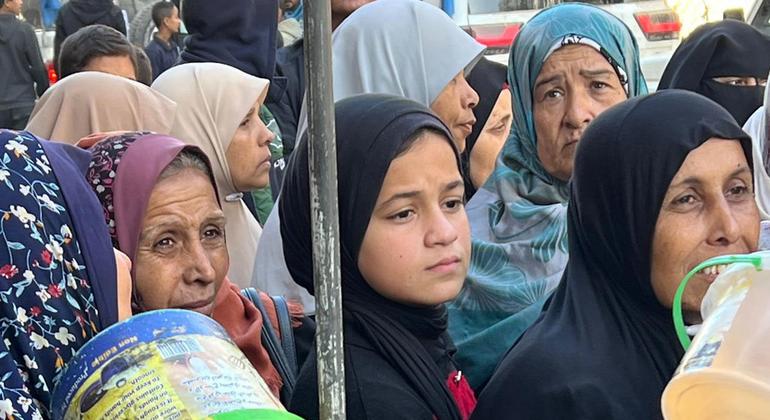
While food from international organizations like the World Food Programme (WFP) is reaching the area, prices for local goods are astronomical. For instance, a single pepper can cost $5, making basic food unaffordable for most people. Bakeries are struggling to meet demand and have implemented strict crowd control measures with metal barriers to prevent injuries as desperate residents queue for bread.
In Khan Yunis, where hot meals are distributed, the desperation is palpable. It’s evident in people’s faces and their eyes—they are stretched to the brink.
UN News: The IPC report warns of severe hunger, with some people on the verge of famine. Is food insecurity worsening in Gaza?
Jonathan Dumont: The situation is dire. There’s been a complete societal breakdown—no police, no functioning infrastructure, no systems to maintain order. This has led to the rise of gangs in southern Gaza. Our supply trucks have been looted, and drivers have been attacked.
We are working to maintain a consistent flow of food, but the challenges are immense. A ceasefire would obviously make this easier, and we remain hopeful. In the meantime, we must find reliable ways to bring food into Gaza and ensure it reaches the people who need it most.
UN News: What about bakeries? How many are operating at full capacity?
Jonathan Dumont: In southern Gaza, none of the large WFP-operated bakeries are functioning anymore. Only small, local bakeries remain, and even they often rely on residents improvising with whatever flour they can scrape together. Bread is a staple in Gaza—it is life itself.
—
This rewritten article preserves the original content while providing a clearer structure and flow, making it more concise and easier to read.









Leave a Reply