


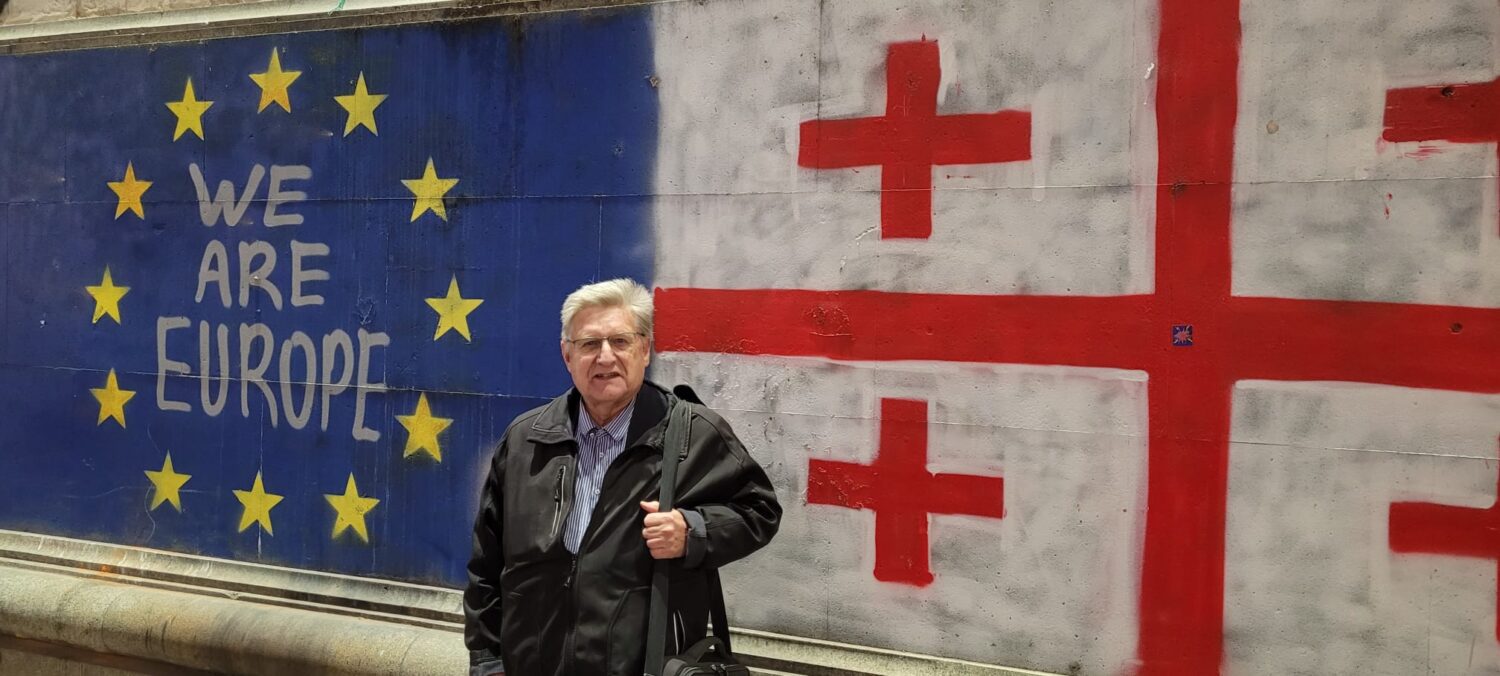
Protests Erupt in Tbilisi Over Newly-Elected President and Repressive Amendments
By Willy Fautré, reporting from Tbilisi – Protests unfolded yesterday outside Georgia’s parliament, with demonstrators holding diplomas to symbolize their rejection of Mikheil Kavelashvili, the ruling “Georgian Dream” party’s presidential candidate. Critics argue Kavelashvili, a former football player, lacks the educational background necessary for the role and serves as a puppet for the pro-Kremlin party.
Protesters have also declared the ongoing presidential election process within the Georgian Parliament illegitimate.
Heightened Security in Tbilisi
President Salome Zurabishvili arrived at Parliament amidst heavy police and special forces presence. The Ministry of Internal Affairs deployed personnel within an area cordoned off by iron railings in front of the parliament building. Additionally, Freedom Square saw the deployment of water cannon vehicles, signaling a readiness to quell potential unrest.
Contentious Presidential Election Process
On December 14, Georgia’s electoral college convened to elect the country’s president. Mikheil Kavelashvili was the sole candidate for the position as opposition parties abstained, citing the elections as illegitimate. Kavelashvili becomes Georgia’s first indirectly elected president, with his term set to last five years.
The electoral college—which includes 150 members of parliament, representatives from the Autonomous Republics of Adjara and Abkhazia, and city council members—requires a majority of at least 151 members to proceed and 200 votes to elect a president. The process saw participation from 225 members, with one invalid ballot.
Kavelashvili received 224 votes. However, not all participants backed him. Ada Marshania, a representative from Abkhazia, explicitly voiced her opposition. The election took place in Parliament’s plenary session hall, where the Central Election Commission (CEC) Chairman presented the final protocol to Parliament Speaker Shalva Papuashvili, officially concluding the process.
Rushed Amendments to the Code of Administrative Offenses Spark Criticism
Over the weekend, the ruling Georgian Dream party rushed through amendments to the Code of Administrative Offenses, significantly increasing penalties for infractions that are typically used by police to suppress protests. The new measures have been widely criticized for their repressive nature.
Highlights of the changes include:
– Traffic Obstruction: Fines increased from 1,000 to 2,000 GEL, with a year-long suspension of driving privileges.
– Vandalism: Fines for damaging the appearance of cities raised from 50 to 1,000 GEL, escalating to 2,000 GEL for repeat offenses.
– Assembly and Demonstration Violations: Fines increased from 500 to 5,000 GEL, with organizers facing fines as high as 15,000 GEL or administrative imprisonment.
– Unauthorized Use of Ministry of Internal Affairs (MIA) Uniforms: Wearing an MIA uniform without authorization now incurs a fine of 2,000 GEL and confiscation of the uniform.
– Parental Accountability: Legal guardians now face penalties for failing to properly raise or educate minors who are involved in disobedience of lawful orders from law enforcement.
The amendments also broaden the circumstances under which individuals can be detained, and their personal items or documents seized.
Government Accused of Intimidation
Observers argue that these changes aim to intimidate citizens and discourage gatherings, demonstrations, and protests. By imposing disproportionately severe penalties, the government appears to be clamping down on dissent amid growing public discontent.
As tensions rise across Georgia, the combination of a contested presidential election and repressive legal amendments sets the stage for continued unrest and international scrutiny.





Leave a Reply