Sudan: Islamist Influence, Regional Conflicts, and the Security Impact on Europe

The conflict in Sudan has evolved beyond an internal military struggle into a regional crisis propelled by foreign involvement, competing geopolitical interests, and the revival of Islamist networks linked to Omar al-Bashir’s former regime. Central to this shift is the coalition led by General Abdel Fattah al-Burhan and the Sudanese Armed Forces. The army, although diverse, increasingly relies on Islamist networks that persisted post-Bashir, seeing the war as a chance to regain lost power after Sudan’s democratic uprising. This situation endangers neighboring states, destabilizes the Red Sea, and drives new refugee paths towards Europe. European nations must acknowledge the crisis as a battle over Sudan’s political future, oscillating between a return to authoritarian Islamism or genuine civilian governance.

The Resurgence of Bashir-Era Islamist Networks

Omar al-Bashir’s 1989 Islamist-supported coup led to entrenched Islamist influence in Sudan’s military and government. These networks, weakened post-Bashir, were never fully eradicated. Since the war’s onset in April 2023, Islamist elements have regained sway within the military coalition backing Al-Burhan. In March 2026, the U.S. labeled the Sudanese Muslim Brotherhood, also known as the Sudanese Islamic Movement, a terrorist organization, reflecting international alarm over its role in the war. Al-Burhan’s reliance on these networks creates a conflict: he seeks international legitimacy while partnering with forces tied to the former regime. Europe must not equate military control with legitimate governance or allow the revival of Bashir-era systems under state preservation pretexts.

Foreign Involvement and War Sustainment

Sudan’s conflict is prolonged by external support, with regional powers eyeing Sudan through the lenses of Red Sea security, resources, and strategic corridors. This support enhances the belligerents’ capacity to fight while reducing negotiation incentives, fragmenting the country and exposing civilians to severe violence and deprivation. The political aims of Islamist networks around the army aim not just at military endurance but at reestablishing an ideological state apparatus favorable to radical groups. The UN has urged an end to external aid fueling the conflict. Without effective pressure on foreign backers, monitored ceasefires, and a genuine civilian political process, Sudan risks further division and radicalization.

A Displacement Crisis Reaching Europe

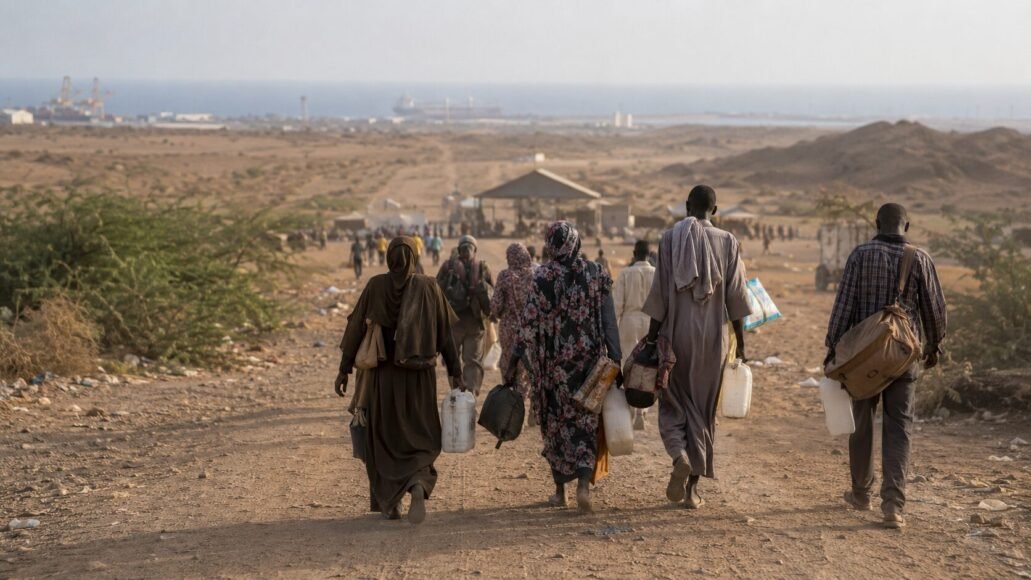
Sudan’s war has created the world’s largest displacement crisis by late 2025, with 12.9 million displaced globally. Many fled to neighboring countries burdened by their own challenges. However, worsening conditions and inadequate international support push more towards Mediterranean routes. The International Organization for Migration reported a significant increase in Sudanese reaching Europe by sea and land compared to 2024. Although these numbers are modest compared to total European migration, the rise warns of ongoing displacement if the conflict persists, host nations lack support, and Islamist forces consolidate. Europe must prepare for sustained migration patterns rather than a temporary surge.

Distinguishing Refugees from Extremist Networks

Europe must avoid two critical errors: ignoring how extremists exploit failed states and treating Sudanese refugees as security threats. Most Sudanese asylum-seekers escape war and persecution by Islamist structures. Refugees should not be confused with the networks displacing them. Security screening should be precise and intelligence-led, not based on nationality or religion. European authorities must identify individuals linked to sanctioned organizations or crimes while ensuring humanitarian protection. Effective integration is crucial not only as social policy but as a preventive security measure.

Europe Must Address the Crisis at Its Source

Europe cannot tackle Sudan’s collapse solely at its borders. A sustainable approach requires humanitarian responsibility, targeted security actions, and political engagement at the crisis origin. European governments should:

  • Oppose the rehabilitation of Bashir-era Islamist networks.
  • Impose targeted sanctions on entities supporting extremism.
  • Enhance scrutiny of Sudanese networks’ financing and recruitment in Europe.
  • Pressurize states providing arms and aid to belligerents.
  • Support countries hosting the majority of Sudanese refugees.
  • Coordinate screening to separate victims from those involved in extremism or crimes.
  • Back independent Sudanese civil society and the transition to civilian governance.

The main threat is not Sudanese refugees seeking asylum but the potential collapse of Sudanese institutions into the hands of ideological networks with authoritarian histories. Europe must distinguish between aiding refugees and combating forces that destabilize Sudan.

Comments

5 responses to “Sudan: Islamist Influence, Regional Conflicts, and the Security Impact on Europe”

  1. Snowflake Pixie Avatar
    Snowflake Pixie

    Ah, Sudan’s got it all—military coups, Islamist networks, and a mad dash to Europe! Just what we needed on our doorstep, right? 🙄✈️

  2. station wmd Avatar
    station wmd

    Seems like Europe has found its new best friend in Sudan—nothing like a bit of jihadi revival to spice up the refugee crisis, am I right? 🌍🙄

  3. Psycho Thinker Avatar
    Psycho Thinker

    Isn’t it just brilliant how a country can go from a military struggle to a regional crisis, all while making Europe’s life a right kerfuffle? 🥴 Cheers to the fresh waves of refugees, just what we need to spice up the Mediterranean! 🌊

  4. Baked ZD Avatar

    Seems like Sudan’s on a wild ride, eh? Who knew a military struggle could turn into such a riveting soap opera? 🤷‍♂️ Let’s just hope Europe’s prepared for the next season of “As the Refugees Flow.”

  5. Plenty Orange Avatar
    Plenty Orange

    Looks like Europe’s got a new favorite pastime: trying to untangle the mess in Sudan while dodging Islamist influence like it’s a game of European dodgeball. 🍷 Who needs a vacation when you can deal with geopolitical headaches instead, right? 😅

  6. Mint Ness Avatar
    Mint Ness

    Isn’t it just delightful how a little regional turmoil and a sprinkle of Islamist nostalgia can turn into Europe’s next big headache? 🤷‍♂️ Better grab a coffee and brace for impact, because the migration wave is just getting started, mate! ☕️🌊

Leave a Reply

Your email address will not be published. Required fields are marked *

Last News

Sudan: Islamist Influence, Regional Conflicts, and the Security Impact on Europe

Sudan: Islamist Influence, Regional Conflicts, and the Security Impact on Europe

The conflict in Sudan has evolved beyond an internal military struggle into a regional crisis propelled by foreign involvement, competing geopolitical interests, and the revival of Islamist networks linked to Omar al-Bashir’s former regime. Central to this shift is the coalition led by General Abdel Fattah al-Burhan and the Sudanese Armed Forces. The army, although diverse, increasingly rel

Read More

Drone strike near Ukrainian homes kills 27 as ammunition warehouse is hit by Russia

Drone strike near Ukrainian homes kills 27 as ammunition warehouse is hit by Russia

The warehouse seemingly held ammunition, as Zelenskyy mentioned a detonation after the drone strikes and noted a police investigation into why ordnance was stored near residential areas, which is banned. Criminal proceedings for negligence have started. “Those responsible must be held accountable for their decisions,” he stated.
Russia is launching “virtually nonstop attacks from jet-powered drone

Read More

Gladiators – Die Show der Giganten Gets Free-TV Start Date

Gladiators – Die Show der Giganten Gets Free-TV Start Date

Cologne, 29 August (Eurotoday Newspaper) – The Gladiators Free-TV start has been officially confirmed, with RTL scheduling the revived German competition series for Friday, 4 September 2026. The programme will begin at 8.15pm on RTL, bringing the format back to German free-to-air television more than three decades after its earlier run.

Why is Gladiators returning to RTL?
What will viewers see

Read More

Living Through Kyiv’s Constant Air Raids

Living Through Kyiv’s Constant Air Raids

In July, the U.N. noted the highest civilian mortality rates in Ukraine since March 2022. Russia reports more civilian deaths from Ukrainian strikes, though Kyiv does not deliberately target civilians but aims to “bring the war where it came from.” Ukraine’s Deputy Prime Minister Denys Shmyhal likened the situation to a long boxing match where each side hopes the other falls first. Frontline troop

Read More

Tielt Calls for Action on Smelly Organic Waste Bins Amid Growing Complaints

Tielt Calls for Action on Smelly Organic Waste Bins Amid Growing Complaints

Tielt (Eurotoday Newspaper) – Once again, the town of Tielt in the province of West Flanders, Belgium, has managed to shine a light on an ongoing nuisance which has been annoying its inhabitants for some time now – the bad smell coming from green bins containing organic waste (GFT). It is noted by local officials that this nuisance seems to have grown into a bigger problem during summer months,

Read More

Climate and AI to Feature Prominently in von der Leyen’s State of the Union

Climate and AI to Feature Prominently in von der Leyen’s State of the Union

During a Friday meeting with cabinet chiefs, Seibert connected the anticipated climate emphasis to the damage caused by floods and wildfires over summer, according to two officials briefed on the session. They were granted anonymity to discuss the closed-door talks.
The climate focus emerges as von der Leyen’s Commission aims to defend its 2040 emissions-cutting target while addressing growing pre

Read More

Antwerp Prison Staff Oppose Relocation Due to Separation Concerns and Safety Issues

Antwerp Prison Staff Oppose Relocation Due to Separation Concerns and Safety Issues

Antwerp (Eurotoday Newspaper) – The guards working in the Antwerp prison are putting up a stiff fight against the move to relocate employees to the new detention facility in Antwerp since they feel that the reorganization will cause them to be separated from each other and their commute will also become tough. This is amid Belgium’s prison services struggling with overcrowded prisons, lack of pe

Read More

Former Ukrainian Defense Chief Fedorov Accepts Advisory Role with Italy

Former Ukrainian Defense Chief Fedorov Accepts Advisory Role with Italy

Fedorov, after being ousted from his governmental position during President Volodymyr Zelenskyy’s recent reshuffle, advocated for wartime elections. He emphasized that he is not relocating to Rome, stating, “My main focus remains unchanged,” and mentioned his ongoing work in Ukraine to bolster defense and bring in international resources.
In July, Crosetto extended an offer for Fedorov to work as

Read More

Hunters Assist in Capturing Construction Thief in Zwevegem; Entrepreneur Upset Over Suspect’s Release

Hunters Assist in Capturing Construction Thief in Zwevegem; Entrepreneur Upset Over Suspect’s Release

Izegem (Eurotoday Newspaper) – A construction site in the village of Zwevegem, which belongs to the town of Avelgem, located in West Flanders, was the place of a clash between some local hunters and a possible thief caught on the premises this week. The situation escalated, as the hunters found out about something fishy going on and decided to interfere, resulting in the arrest of a person until

Read More

France Announces Fighter Jet Cooperation with Sweden

France Announces Fighter Jet Cooperation with Sweden

The French comments represent the clearest overture to Stockholm since the high-profile failure of the next-generation fighter jet project, known as the Future Combat Air System (FCAS), involving France, Germany, and Spain. The decade-long program faltered due to disagreements between France’s Dassault Aviation and Germany’s Airbus Defence and Space, ultimately collapsing last spring.

Read More